


Shopping Cart
Remove All Your shopping cart is currently empty

Synonyms:
| Pack Size | Price | USA Stock | Global Stock | Quantity |
|---|---|---|---|---|
| 10 mg | Inquiry | 10-14 weeks | 10-14 weeks | |
| 50 mg | Inquiry | 10-14 weeks | 10-14 weeks |
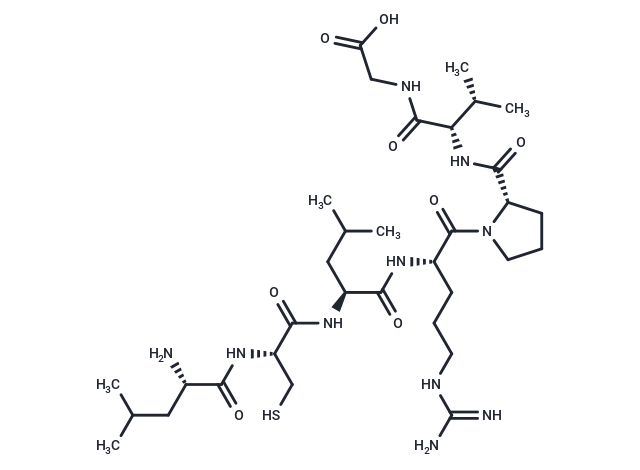
| Description | Xentry is a cell-penetrating peptide (CCP) composed only of seven amino acids from the hepatitis B virus: LCLRPVG. By linking with anti-B-raf antibodies and siRNA, Xentry can target and eliminate B-raf-dependent melanoma cells. It can be administered alone or combined with β-galactosidase to deliver substances to most tissues in mice, except circulating blood cells. Xentry is useful for delivering macromolecules such as antibodies, siRNA, and enzymes. |
| In vitro | Xentry (10 μM) penetrates adherent cells in an energy-dependent manner, including the cell lines HepG2 (liver), C32 (melanoma), DU145 (prostate), H441 (lung cancer), BT474 (breast), Cos (kidney), and Rin-m5F (pancreatic beta cells), but does not penetrate non-adherent resting blood cells. When conjugated with β-galactosidase (10-20 μM, 4 h), Xentry is internalized by viable HepG2 cells and enters through the multi-ligand glycan pathway. Additionally, Xentry (1 h) effectively delivers antibodies and siRNA to melanoma cells, inducing apoptosis in B-raf dependent melanoma cells. |
| In vivo | Within 15 minutes of a single intravenous dose, Cy7-labeled Xentry (2-20 μg/mL) disperses extensively across various tissues, with notable accumulation in epithelial tissues such as the intestines, stomach, and bronchi; 24 hours later, it predominantly remains in the liver and kidneys in Balb/c mice. TAMRA-labeled Xentry (2-100 μg/mL), also administered in a single intravenous dose, effectively delivers macromolecular complexes to multiple tissues in Balb/c mice, particularly concentrating in intestinal epithelial cells and splenic marginal sinuses. |
| Molecular Weight | 756.96 |
| Formula | C33H60N10O8S |
| Cas No. | 1352335-71-7 |
| Smiles | C([C@@H](NC([C@@H](NC([C@@H](NC([C@H](CC(C)C)N)=O)CS)=O)CC(C)C)=O)CCCNC(=N)N)(=O)N1[C@H](C(N[C@H](C(NCC(O)=O)=O)[C@H](C)C)=O)CCC1 |
| Sequence | Leu-Cys-Leu-Arg-Pro-Val-Gly |
| Sequence Short | LCLRPVG |
| Storage | Keep away from moisture Powder: -20°C for 3 years | In solvent: -80°C for 1 year Shipping with blue ice/Shipping at ambient temperature. |
 For example, if the intended dosage is 10 mg/kg for animals weighing 20 g , with a dosing volume of 100 μL per animal, and a total of 10 animals are to be administered, using a formulation of
  10% DMSO+ 40% PEG300+ 5% Tween 80+ 45% Saline/PBS/ddH2O , the resulting working solution concentration would be 2 mg/mL.
Dissolve 2 mg of the compound in 100 μL DMSO to obtain a stock solution at a concentration of 20 mg/mL . If the required concentration exceeds the compound's known solubility, please contact us for technical support before proceeding.
1) Add 100 μL of the DMSO stock solution to 400 µL PEG300 and mix thoroughly until the solution becomes clear.
2) Add 50 µL Tween 80 and mix well until fully clarified.
3) Add 450 µL Saline,PBS or ddH2O and mix thoroughly until a homogeneous solution is obtained.
| Size | Quantity | Unit Price | Amount | Operation |
|---|
 Feedback
 Hello! How can I help you today?
Copyright © 2015-2026 TargetMol Chemicals Inc. All Rights Reserved.
