


Shopping Cart
Remove All Your shopping cart is currently empty

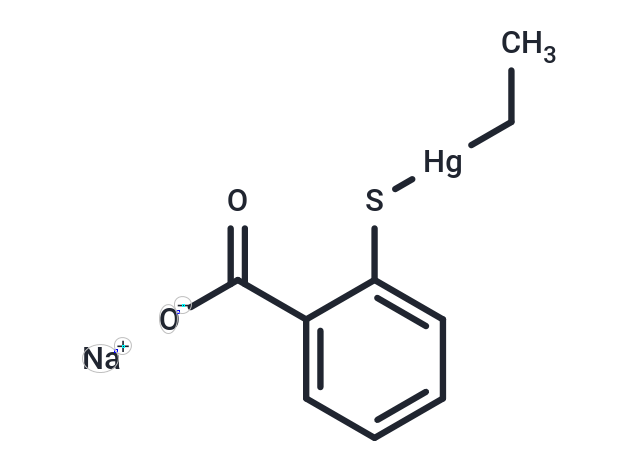
Synonyms: Sodium ethylmercurithiosalicylate
| Pack Size | Price | USA Stock | Global Stock | Quantity |
|---|---|---|---|---|
| 100 mg | $30 | - | In Stock | |
| 200 mg | $36 | - | In Stock | |
| 500 mg | $56 | - | In Stock | |
| 1 g | $80 | - | In Stock |
| Description | Thimerosal is a mercury-containing vaccine preservative, which is currently considered one of the suspected causative agents of neurodevelopmental disorders. |
| In vivo | Thimerosal increases the density of μ‑opioid receptors (MOR) in the periaqueductal gray (PAG) in a dose-dependent manner. High-dose thimerosal significantly elevates MOR density in the dorsomedial periaqueductal gray (DMPAG) and lateral periaqueductal gray (LPAG). At a dose of 3000 μg Hg/kg, thimerosal also increases MOR density in the caudate putamen (CPU). In contrast, two higher doses of thimerosal reduce MOR density in the dentate gyrus (DG) [1]. Four intramuscular injections (240 μg Hg/kg) on postnatal days 7, 9, 11, and 15 induce persistent changes in amino acid efflux: elevated glutamate and aspartate levels, accompanied by decreased glycine and alanine levels. These changes remain detectable 10–14 weeks after injection. Four injections of thimerosal at 12.5 μg Hg/kg do not significantly alter glutamate and aspartate concentrations measured by microdialysis. Application of thimerosal to the prefrontal cortex (PFC) via perfusion fluid rapidly increases glutamate efflux. Coadministration of the neurosteroid dehydroepiandrosterone sulfate (DHEAS; 80 mg/kg; intraperitoneal injection) blocks the effects of thimerosal on glutamate and aspartate, whereas administration of the steroid alone has no significant effect on these amino acids. Coadministration of DHEAS and thimerosal in the perfusion fluid also blocks the acute effect of thimerosal on glutamate [2]. |
| Synonyms | Sodium ethylmercurithiosalicylate |
| Molecular Weight | 404.81 |
| Formula | C9H9HgNaO2S |
| Cas No. | 54-64-8 |
| Smiles | [Na+].CC[Hg]Sc1ccccc1C([O-])=O |
| Storage | Keep away from moisture Powder: -20°C for 3 years | In solvent: -80°C for 1 year Shipping with blue ice/Shipping at ambient temperature. | |||||||||||||||||||||||||||||||||||
| Solubility Information | H2O: 80 mg/mL (197.62 mM), Sonication is recommended. | |||||||||||||||||||||||||||||||||||
Solution Preparation Table | ||||||||||||||||||||||||||||||||||||
H2O
Note : The dilution table applies only to solid products. For liquid products, please calculate the stock solution based on the stated concentration and/or density. | ||||||||||||||||||||||||||||||||||||
 For example, if the intended dosage is 10 mg/kg for animals weighing 20 g , with a dosing volume of 100 μL per animal, and a total of 10 animals are to be administered, using a formulation of
  10% DMSO+ 40% PEG300+ 5% Tween 80+ 45% Saline/PBS/ddH2O , the resulting working solution concentration would be 2 mg/mL.
Dissolve 2 mg of the compound in 100 μL DMSO to obtain a stock solution at a concentration of 20 mg/mL . If the required concentration exceeds the compound's known solubility, please contact us for technical support before proceeding.
1) Add 100 μL of the DMSO stock solution to 400 µL PEG300 and mix thoroughly until the solution becomes clear.
2) Add 50 µL Tween 80 and mix well until fully clarified.
3) Add 450 µL Saline,PBS or ddH2O and mix thoroughly until a homogeneous solution is obtained.
| Size | Quantity | Unit Price | Amount | Operation |
|---|
 Feedback
 Hello! How can I help you today?
Copyright © 2015-2026 TargetMol Chemicals Inc. All Rights Reserved.
