


Shopping Cart
Remove All Your shopping cart is currently empty

Synonyms:
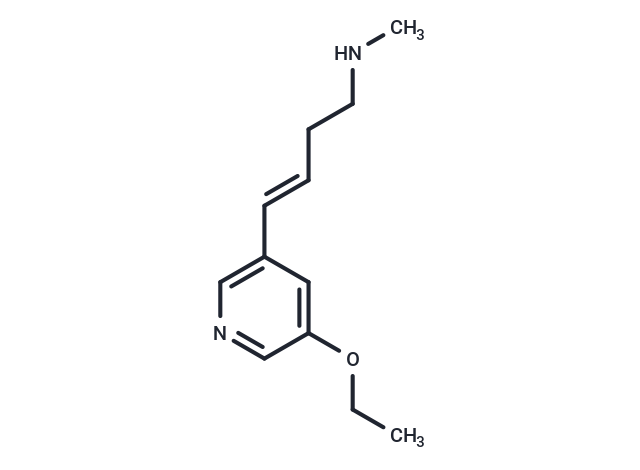
| Pack Size | Price | USA Stock | Global Stock | Quantity |
|---|---|---|---|---|
| 10 mg | Inquiry | 10-14 weeks | 10-14 weeks | |
| 50 mg | Inquiry | 10-14 weeks | 10-14 weeks |
| Description | TC-2559 free base is an α4β2 nicotinic acetylcholine receptor (nAChR) agonist with an EC50 of 0.18 μM. It shows weaker agonistic effects on β4 subunit nAChR genotypes (α2β4, α4β4, and α3β4 receptors), with EC50 values ranging from 10-30 μM. In vitro, TC-2559 free base enhances dopamine cell firing in the rat ventral tegmental area (VTA), increasing the excitability and bursting activity of VTA dopaminergic neurons. It also inhibits STAT3 to exert anti-inflammatory effects, alleviates mechanical allodynia in mice, and improves cognitive deficits in rats. TC-2559 free base is utilized in neuropathic pain research. |
| In vitro | TC-2559 free base effectively binds to [3H]-moketope with a binding affinity (K i) of 5 nM. At concentrations of 0-100 nM, TC-2559 free base enhances dopamine release in rat striatal synaptosomes (EC 50 = 203 nM, E = 97%) and Rb protein release in brain thalamic synaptosomes (EC 50 = 367 nM, E = 107%), while showing no activity in TE671/RD and PC12 cells at 1 mM. At 10 μM for 2 hours, it significantly reduces neuronal death in fetal rat brain cells. In mouse macrophages, TC-2559 free base (200-500 μM for 3-6 hours) inhibits the upregulation of cytokine ligand 3 (CCL3) and interleukin 1b (IL-1b), and at 500 μM for 1-6 hours, it suppresses phosphorylation of signal transducer and activator of transcription 3 (pSTAT3). Additionally, at 0.5 mM for 24 hours, it inhibits the overexpression of interleukin-1β (IL-1β) in mouse peritoneal macrophages treated with PSL. TC-2559 free base demonstrates weaker agonistic efficacy on nAChR subtypes with β4 subunit (α2β4, α4β4, and α3β4 receptors), with EC 50 values of 14, 12.5, and >30 μM, respectively. |
| In vivo | TC-2559 free base (0.124-2.063 mg/kg, s.c., single dose) reverses memory impairment in rats caused by cholinergic blockade in a dose-dependent manner. HC-2559 (0.124-1.238 mg/kg, s.c., single dose or over 5 days) significantly reduces working memory errors and enhances working memory consistently. A single dose of HC-2559 (0.206-2.063 mg/kg, s.c., single or over 14 days) causes motor suppression, but no behavioral tolerance occurs with repeated administration. TC-2559 free base (0.021-1.32 mg/kg, i.v., cumulative or single dose) activates nucleus accumbens dopamine neurons via α4β2-like nicotinic receptors. Additionally, TC-2559 free base (0.47-4.70 mg/kg, s.c., or 20 nmol, perineural injection, 3 days) alleviates mechanical allodynia in a murine behavioral model, and at 20 nmol (perineural injection, 3 days), it inhibits microglial activation in the SDH following peripheral nerve injury in mice. |
| Molecular Weight | 206.28 |
| Formula | C12H18N2O |
| Cas No. | 189274-78-0 |
| Smiles | C(=C/CCNC)\C=1C=C(OCC)C=NC1 |
| Storage | Powder: -20°C for 3 years | In solvent: -80°C for 1 year Shipping with blue ice/Shipping at ambient temperature. |
 For example, if the intended dosage is 10 mg/kg for animals weighing 20 g , with a dosing volume of 100 μL per animal, and a total of 10 animals are to be administered, using a formulation of
  10% DMSO+ 40% PEG300+ 5% Tween 80+ 45% Saline/PBS/ddH2O , the resulting working solution concentration would be 2 mg/mL.
Dissolve 2 mg of the compound in 100 μL DMSO to obtain a stock solution at a concentration of 20 mg/mL . If the required concentration exceeds the compound's known solubility, please contact us for technical support before proceeding.
1) Add 100 μL of the DMSO stock solution to 400 µL PEG300 and mix thoroughly until the solution becomes clear.
2) Add 50 µL Tween 80 and mix well until fully clarified.
3) Add 450 µL Saline,PBS or ddH2O and mix thoroughly until a homogeneous solution is obtained.
| Size | Quantity | Unit Price | Amount | Operation |
|---|
 Feedback
 Hello! How can I help you today?
Copyright © 2015-2026 TargetMol Chemicals Inc. All Rights Reserved.
