


Shopping Cart
Remove All Your shopping cart is currently empty

Synonyms: Quinupristin (mesylate)
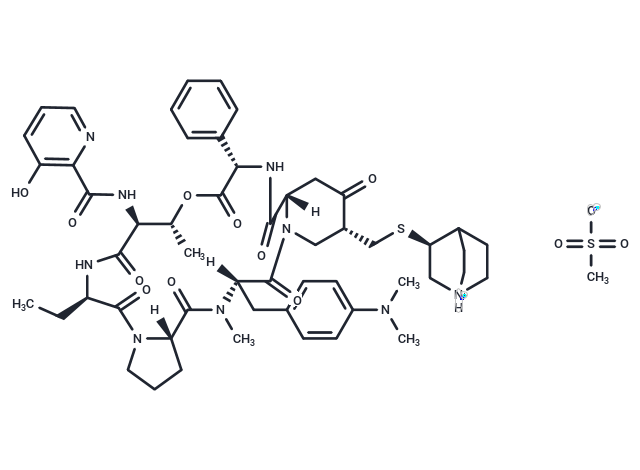
| Pack Size | Price | USA Stock | Global Stock | Quantity |
|---|---|---|---|---|
| 5 mg | $1,116 | Inquiry | Inquiry |
| Description | Quinupristin is a streptogramin antibiotic. Streptogramins, a class of antibiotics, is effective in the treatment of vancomycin-resistant Staphylococcus aureus and vancomycin-resistant Enterococcus, which are two of the most rapidly growing strains of multidrug-resistant bacteria. Streptogramins fall into two groups: streptogramin A and streptogramin B. |
| In vitro | In vitro: Quinupristin can bind to sequential sites located on the 50s subunit of the bacterial ribosome. Dalfopristin binding causes a conformational change in the ribosome that subsequently increases the binding of quinupristin. The combined actions of the two agents create a stable drug-ribosome complex causing inhibition of protein synthesis by prevention of peptide-chain formation, blockade of extrusion of newly formed peptide chains, and bacterial cell death [1]. |
| In vivo | In vivo: The combination of quinupristin-dalfopristin (Q-D) and gentamicin was tested against two strains of gentamicin- and dalfopristin-susceptible methicillin-resistant Staphylococcus aureus (MRSA). A rabbit endocarditis model simulated the pharmacokinetics achieved in humans receiving intravenous injections of Q-D and gentamicin. For the MLSB-susceptible strain, a 4-day regimen reduced mean bacterial titers (MBT) in vegetations from 8.5 ± 0.8 logs CFU/g (control group) to 3.0 ± 0.9 (Q-D) and 2.6 ± 0.5 logs CFU/g (Q-D plus gentamicin). For the strain constitutively resistant to MLSB, a 4-day regimen reduced MBT in vegetations from 8.7 ± 0.9 logs CFU/g (control group) 5.2 ± 2.2 (Q-D) and 5.1 ± 2.4 log CFU/g (Q-D plus gentamicin). The differences between control and treatment groups were significant for both strains, although there was no significant difference between treatment groups [2]. |
| Synonyms | Quinupristin (mesylate) |
| Molecular Weight | 1118.3 |
| Formula | C53H68N9O10S·CH3SO3 |
| Smiles | O=C1C[C@](C(N[C@@H](C2=CC=CC=C2)C(O[C@H](C)[C@H](NC(C3=C(O)C=CC=N3)=O)C4=O)=O)=O)([H])N(C([C@@](CC5=CC=C(N(C)C)C=C5)([H])N(C)C([C@]6([H])CCCN6C([C@H](N4)CC)=O)=O)=O)C[C@H]1CS[C@@H]7C[NH+]8CCC7CC8.CS([O-])(=O)=O |
| Relative Density. | no data available |
| Sequence | Thr-Abu-Pro-Phe-Pip-Phg (Lactone:Thr1-Phg6) |
| Sequence Short | TXPFTX |
| Storage | Keep away from moisture Powder: -20°C for 3 years | In solvent: -80°C for 1 year Shipping with blue ice/Shipping at ambient temperature. |
| Solubility Information | DMSO: Soluble Ethanol: Soluble |
 For example, if the intended dosage is 10 mg/kg for animals weighing 20 g , with a dosing volume of 100 μL per animal, and a total of 10 animals are to be administered, using a formulation of
  10% DMSO+ 40% PEG300+ 5% Tween 80+ 45% Saline/PBS/ddH2O , the resulting working solution concentration would be 2 mg/mL.
Dissolve 2 mg of the compound in 100 μL DMSO to obtain a stock solution at a concentration of 20 mg/mL . If the required concentration exceeds the compound's known solubility, please contact us for technical support before proceeding.
1) Add 100 μL of the DMSO stock solution to 400 µL PEG300 and mix thoroughly until the solution becomes clear.
2) Add 50 µL Tween 80 and mix well until fully clarified.
3) Add 450 µL Saline,PBS or ddH2O and mix thoroughly until a homogeneous solution is obtained.
| Size | Quantity | Unit Price | Amount | Operation |
|---|
 Feedback
 Hello! How can I help you today?
Copyright © 2015-2026 TargetMol Chemicals Inc. All Rights Reserved.
