


Shopping Cart
Remove All Your shopping cart is currently empty

Synonyms:
| Pack Size | Price | USA Stock | Global Stock | Quantity |
|---|---|---|---|---|
| 10 mg | Inquiry | 10-14 weeks | 10-14 weeks | |
| 50 mg | Inquiry | 10-14 weeks | 10-14 weeks |
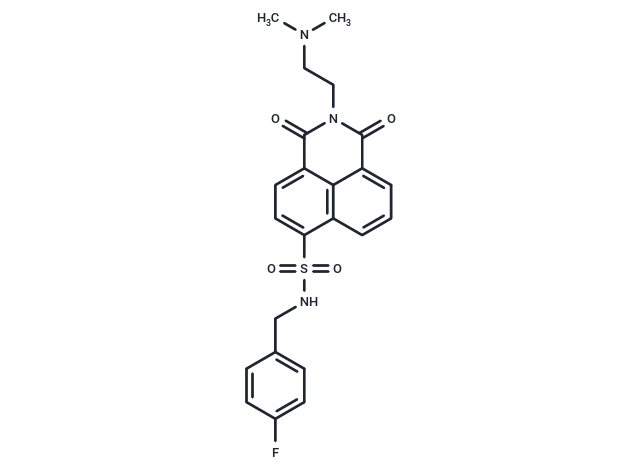
| Description | PLK1-IN-10 (Compound 4Bb), an orally active inhibitor of the PLK1 PBD (polo-box domain), inhibits the interaction between PLK1 and the cell division regulator protein 1 (PRC1) and reduces the protein expression of the CDK1-Cyclin B1 complex. Additionally, PLK1-IN-10 interacts with glutathione (GSH), enhancing cellular oxidative stress and promoting cell death [1]. |
| In vitro | PLK1-IN-10 significantly induces cell cycle arrest at the G2/M phase in A549 and A549/DDP cells, inhibiting their proliferation when used at concentrations ranging from 0 to 6 μM over 48 hours [1]. At 20 μM, PLK1-IN-10 stabilizes the PLK1 protein in A549/DDP cells across various temperatures [1]. Additionally, a 5 μM concentration of PLK1-IN-10 over 24 hours reacts with GSH, yielding a dose- and time-dependent fluorescence response, which is more pronounced in A549/DDP cells [1]. Exposure to 0 to 9 μM of PLK1-IN-10 for 48 hours elevates intracellular ROS levels in A549/DDP cells [1]. The interaction between PLK1 and PRC1 is inhibited by a 10 μM dose of PLK1-IN-10 over 48 hours, resulting in multinucleation [1]. PLK1-IN-10 exhibits anticancer activity against NCI-H1975 cells, with an IC50 value of 7.83 μM [1]. In Western blot analysis, PLK1-IN-10 treatment of A549 and A549/DDP cells at concentrations of 0, 1.5, 3, and 6 μM for 48 hours resulted in the downregulation of PLK1, CDK1, Cyclin B1, the CDK1-Cyclin B1 complex, and Cdc25 protein expression [1]. Cell cycle analysis of A549 and A549/DDP cells exposed to the same concentrations for 48 hours indicated a significant increase in cells in the G2/M phase, leading to mitotic catastrophe [1]. |
| In vivo | PLK1-IN-10 administered at doses of 30 and 50 mg/kg intraperitoneally every other day for 32 days significantly inhibited tumor growth in a A549/DDP resistant xenograft mouse model, with the higher dose inducing tumor regression [1]. Additionally, an oral administration of PLK1-IN-10 at 30 mg/kg on the same schedule effectively suppressed tumor growth in the NCI-H1975 resistant xenograft model over a period of 20 days [1]. Efficacy studies in these animal models revealed that the 30 mg/kg dose group achieved a total tumor inhibition (TGI) rate of 42%, while the 50 mg/kg group attained a TGI of 62%, significantly extending median survival times from 38 days in the control group to 53 and 62 days in the 30 and 50 mg/kg groups, respectively. Furthermore, the compound did not cause significant changes in mouse body weight or major organ function, except for a slight difference observed in the heart index at 30 mg/kg. A significant reduction in Ki-67 positive cells and no noteworthy changes in H&E staining of major organs further confirmed the compound’s biosafety. |
| Molecular Weight | 455.50 |
| Formula | C23H22FN3O4S |
| Cas No. | 2991469-21-5 |
| Smiles | S(NCC1=CC=C(F)C=C1)(=O)(=O)C=2C3=C4C(C(=O)N(CCN(C)C)C(=O)C4=CC=C3)=CC2 |
| Storage | Powder: -20°C for 3 years | In solvent: -80°C for 1 year Shipping with blue ice/Shipping at ambient temperature. |
 For example, if the intended dosage is 10 mg/kg for animals weighing 20 g , with a dosing volume of 100 μL per animal, and a total of 10 animals are to be administered, using a formulation of
  10% DMSO+ 40% PEG300+ 5% Tween 80+ 45% Saline/PBS/ddH2O , the resulting working solution concentration would be 2 mg/mL.
Dissolve 2 mg of the compound in 100 μL DMSO to obtain a stock solution at a concentration of 20 mg/mL . If the required concentration exceeds the compound's known solubility, please contact us for technical support before proceeding.
1) Add 100 μL of the DMSO stock solution to 400 µL PEG300 and mix thoroughly until the solution becomes clear.
2) Add 50 µL Tween 80 and mix well until fully clarified.
3) Add 450 µL Saline,PBS or ddH2O and mix thoroughly until a homogeneous solution is obtained.
| Size | Quantity | Unit Price | Amount | Operation |
|---|
 Feedback
 Hello! How can I help you today?
Copyright © 2015-2026 TargetMol Chemicals Inc. All Rights Reserved.
