


Shopping Cart
Remove All Your shopping cart is currently empty

Synonyms:
| Pack Size | Price | USA Stock | Global Stock | Quantity |
|---|---|---|---|---|
| 10 mg | Inquiry | 10-14 weeks | 10-14 weeks | |
| 50 mg | Inquiry | 10-14 weeks | 10-14 weeks |
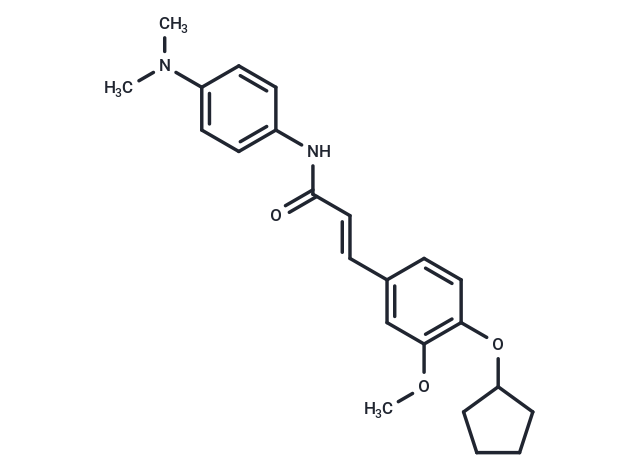
| Description | Neuroprotective agent 12 is an orally active compound capable of crossing the blood-brain barrier, offering significant neuroprotective properties. It exhibits robust antioxidant and anti-inflammatory effects, markedly inhibiting cell death induced by glutamate and acrolein. This agent reduces the expression of PDE4B while elevating levels of HO-1, p-CREB, and BDNF. In a traumatic brain injury (TBI) mouse model, Neuroprotective agent 12 demonstrates potent neuroprotection and holds potential for research into TBI and other central nervous system disorders. |
| In vitro | Neuroprotective agent 12 (Compound 5) can reverse cell death in HT22 cells induced by glutamate or acrolein within 24 hours. This compound, at concentrations of 3-300 μM over 0.5-24 hours, is non-toxic to HT22 cells below 100 μM and markedly reduces cytotoxicity caused by glutamate or acrolein. It interacts with the PDE4D active site without affecting PDE4B2 and PDE4D7 activity. At 1-10 μM over 24 hours, Neuroprotective agent 12 significantly elevates protein levels of p-CREB, BDNF, and HO-1 in HT22 cells, regulating the PDE/CREB pathway by directly reducing PDE4B protein levels. Also, at 1-10 μM with 1 μg/mL LPS over 24 hours, it inhibits LPS-induced neuroinflammation by modulating the NF-κB pathway and decreases NO release in LPS-stimulated BV2 cells in a dose-dependent manner. The compound exhibits good intestinal absorption and blood-brain barrier penetration, inhibits CYP2C19, CYP2C9, and CYP2D6, but does not inhibit CYP1A2 or Pgp substrates, and has low toxicity (LD50: 300-5000 mg/kg). |
| In vivo | In a mouse model of traumatic brain injury, Neuroprotective agent 12 (Compound 5) administered via gavage at 5-10 mg/kg, twice over 48 hours, demonstrates significant anti-ischemic activity and blood-brain barrier neuroprotection. |
| Molecular Weight | 380.48 |
| Formula | C23H28N2O3 |
| Cas No. | 2522599-69-3 |
| Smiles | O(C1=C(OC)C=C(/C=C/C(NC2=CC=C(N(C)C)C=C2)=O)C=C1)C3CCCC3 |
| Storage | Powder: -20°C for 3 years | In solvent: -80°C for 1 year Shipping with blue ice/Shipping at ambient temperature. |
 For example, if the intended dosage is 10 mg/kg for animals weighing 20 g , with a dosing volume of 100 μL per animal, and a total of 10 animals are to be administered, using a formulation of
  10% DMSO+ 40% PEG300+ 5% Tween 80+ 45% Saline/PBS/ddH2O , the resulting working solution concentration would be 2 mg/mL.
Dissolve 2 mg of the compound in 100 μL DMSO to obtain a stock solution at a concentration of 20 mg/mL . If the required concentration exceeds the compound's known solubility, please contact us for technical support before proceeding.
1) Add 100 μL of the DMSO stock solution to 400 µL PEG300 and mix thoroughly until the solution becomes clear.
2) Add 50 µL Tween 80 and mix well until fully clarified.
3) Add 450 µL Saline,PBS or ddH2O and mix thoroughly until a homogeneous solution is obtained.
| Size | Quantity | Unit Price | Amount | Operation |
|---|
 Feedback
 Hello! How can I help you today?
Copyright © 2015-2026 TargetMol Chemicals Inc. All Rights Reserved.
