


Shopping Cart
Remove All Your shopping cart is currently empty

Synonyms:
| Pack Size | Price | USA Stock | Global Stock | Quantity |
|---|---|---|---|---|
| 1 mg | $54 | In Stock | In Stock | |
| 5 mg | $102 | In Stock | In Stock | |
| 10 mg | $146 | In Stock | In Stock | |
| 25 mg | $262 | In Stock | In Stock | |
| 50 mg | $363 | In Stock | In Stock | |
| 100 mg | $518 | In Stock | In Stock | |
| 200 mg | $713 | - | In Stock |
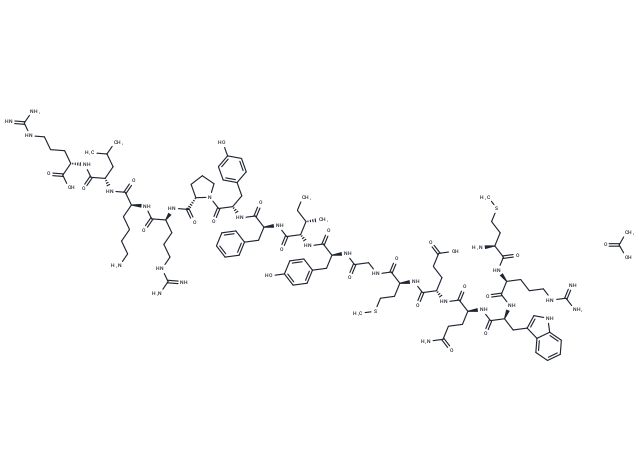
| Description | MOTS-c(Human) Acetate is a mitochondrial-derived peptide. MOTS-c(human) acetate induces the accumulation of AMP analog AICAR, increases activation of AMPK and expression of its downstream GLUT4. MOTS-c(human) acetate induces glucose uptake and improves insulin sensitivity. MOTS-c(human) acetate has implications in the regulation of obesity, diabetes, exercise, and longevity. |
| In vitro | MOTS-c inhibits the folate cycle at the level of 5Me-THF, resulting in an accumulation of AICAR [5-aminoimidazole-4-carboxamide ribonucleotide). MOTS-c also increases cellular NAD+ levels, which are also nucleotide precursors[1]. |
| In vivo | MOTS-c injections in mice show activation of skeletal muscle AMPK and increased the level of its downstream glucose transporter GLUT4. MOTS-c may also act as a potential mitochondrial signal that mediates an exercise-induced mitohormesis response, thereby stimulating physiological adaptation and increased tolerance to exercise[1]. |
| Molecular Weight | 2234.64 |
| Formula | C103H156N28O24S2 |
| Smiles | CC[C@H](C)[C@@H](C(=O)N[C@@H](CC1=CC=CC=C1)C(=O)N[C@@H](CC2=CC=C(C=C2)O)C(=O)N3CCC[C@H]3C(=O)N[C@@H](CCCNC(=N)N)C(=O)N[C@@H](CCCCN)C(=O)N[C@@H](CC(C)C)C(=O)N[C@@H](CCCNC(=N)N)C(=O)O)NC(=O)[C@H](CC4=CC=C(C=C4)O)NC(=O)CNC(=O)[C@H](CCSC)NC(=O)[C@H](CCC(=O)O)NC(=O)[C@H](CCC(=O)N)NC(=O)[C@H](CC5=CNC6=CC=CC=C65)NC(=O)[C@H](CCCNC(=N)N)NC(=O)[C@H](CCSC)N.CC(O)=O |
| Relative Density. | 1.31g/cm3 |
| Sequence | H-Met-Arg-Trp-Gln-Glu-Met-Gly-Tyr-Ile-Phe-Tyr-Pro-Arg-Lys-Leu-Arg-OH |
| Sequence Short | MRWQEMGYIFYPRKLR |
| Storage | Keep away from moisture Powder: -20°C for 3 years | In solvent: -80°C for 1 year Shipping with blue ice/Shipping at ambient temperature. | |||||||||||||||||||||||||
| Solubility Information | DMSO: 10 mM, Sonication is recommended. H2O: 20 mg/mL (8.95 mM), Sonication is recommended.  | |||||||||||||||||||||||||
Solution Preparation Table | ||||||||||||||||||||||||||
H2O/DMSO
DMSO
Note : The dilution table applies only to solid products. For liquid products, please calculate the stock solution based on the stated concentration and/or density. | ||||||||||||||||||||||||||
 For example, if the intended dosage is 10 mg/kg for animals weighing 20 g , with a dosing volume of 100 μL per animal, and a total of 10 animals are to be administered, using a formulation of
  10% DMSO+ 40% PEG300+ 5% Tween 80+ 45% Saline/PBS/ddH2O , the resulting working solution concentration would be 2 mg/mL.
Dissolve 2 mg of the compound in 100 μL DMSO to obtain a stock solution at a concentration of 20 mg/mL . If the required concentration exceeds the compound's known solubility, please contact us for technical support before proceeding.
1) Add 100 μL of the DMSO stock solution to 400 µL PEG300 and mix thoroughly until the solution becomes clear.
2) Add 50 µL Tween 80 and mix well until fully clarified.
3) Add 450 µL Saline,PBS or ddH2O and mix thoroughly until a homogeneous solution is obtained.
| Size | Quantity | Unit Price | Amount | Operation |
|---|
 Feedback
 Hello! How can I help you today?
Copyright © 2015-2026 TargetMol Chemicals Inc. All Rights Reserved.
