Shopping Cart
Remove All
  • TargetMol
    Your shopping cart is currently empty

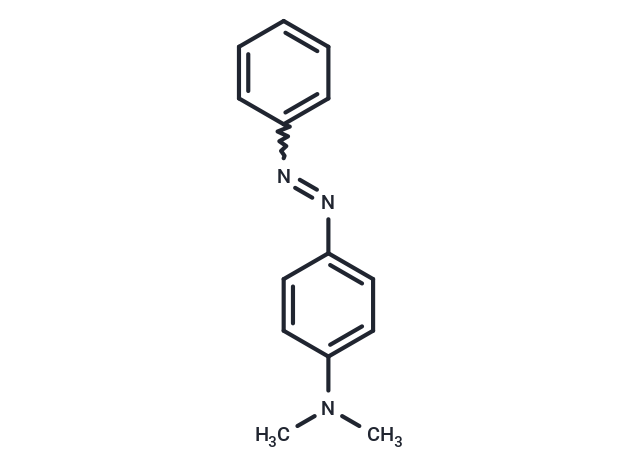
Methyl yellow (Alias: Solvent Yellow 2, Dimethyl yellow)

Catalog No. T81811 Copy Product Info
Purity: 99.61%
🥰Excellent
Methyl yellow is a pH indicator dye that appears red in acidic environments and transitions to yellow above pH 4. Methyl yellow is also employed in animal studies to induce hepatic tumor formation, where its administration alters bile composition by reducing DHA levels and increasing bile volume, with DHA concentration strongly correlating with biliary output, making this compound useful in hepatotoxicity and bile-acid metabolism research.

Methyl yellow

Copy Product Info
🥰Excellent
Catalog No. T81811
Alias Solvent Yellow 2, Dimethyl yellow

Methyl yellow is a pH indicator dye that appears red in acidic environments and transitions to yellow above pH 4. Methyl yellow is also employed in animal studies to induce hepatic tumor formation, where its administration alters bile composition by reducing DHA levels and increasing bile volume, with DHA concentration strongly correlating with biliary output, making this compound useful in hepatotoxicity and bile-acid metabolism research.

Methyl yellow
Cas No. 60-11-7
Pack SizePriceUSA StockGlobal StockQuantity
25 g$29-In Stock
In stock · Estimated delivery: USA Stock (1-2 days) Global Stock (5-7 days)
Add to Cart
Add to Quotation
For research use only—not for human use. No sales to individuals. Use as intended only.
Questions
TargetMol
View More

Batch Information

Select Batch
Purity:99.61%
Appearance:Solid
Color:Yellow
Contact us for more batch information

Resource Download

Product Introduction

Bioactivity
Description
Methyl yellow is a pH indicator dye that appears red in acidic environments and transitions to yellow above pH 4. Methyl yellow is also employed in animal studies to induce hepatic tumor formation, where its administration alters bile composition by reducing DHA levels and increasing bile volume, with DHA concentration strongly correlating with biliary output, making this compound useful in hepatotoxicity and bile-acid metabolism research.
Disease Modeling Protocol
Liver tumor model
  • Modeling Mechanism:

    Methyl yellow, a classic azo hepatotoxic agent, undergoes oxidative demethylation and cleavage reactions in rats under the action of hepatic microsomal enzymes (such as cytochrome P450), generating active metabolites. These metabolites can bind to hepatocyte DNA, leading to base damage and gene mutations. They also interfere with endoplasmic reticulum function (inducing smooth endoplasmic reticulum proliferation and inhibiting N-demethylase activity), disrupting cellular metabolic balance, and initiating the process of precancerous lesions and tumorigenesis in hepatocellular carcinoma, mimicking the pathogenesis of chemically induced liver tumors in humans.

  • Related Products:

    Methyl yellow (T81811)

  • Modeling Method:

    Experimental Subject:

    Rats, Sprague-Dawley, male, body weight 250–300 g

    Dosage and Administration Route:

    ① Core modelling (acute/chronic modelling):
    - Acute modelling (short-term injury observation): Methyl orange, 300 mg/kg, dissolved in olive oil, administered via gavage after 16-hour fasting;
    - Chronic modelling (tumour induction): Methyl orange, 0.06%-0.1%, mixed into basal diet, ad libitum feeding;
    ② Control treatment: Control group administered equivalent volume of olive oil (acute modelling) or base diet without methyl yellow (chronic modelling); all other housing and treatment conditions identical;
    ③ Promoter combination (optional): Mid-modelling phase may incorporate phenobarbital (100 mg/kg/day, intraperitoneal injection, for 5 consecutive days) to accelerate hepatic tumour progression.

    Dosing Frequency and Duration Model:

    Acute modelling: single dose;
    Chronic modelling: Ad libitum feeding for 6–12 months

  • Validation:

    1. Pathological Indicators: - Acute Injury: 48 hours after modeling, HE staining showed deep cytoplasmic staining of hepatocytes, pyknosis/fragmentation of nuclei around the central vein, and significant proliferation of smooth endoplasmic reticulum (reaching 262% of the control group at 48 hours), reduced rough endoplasmic reticulum, and increased autophagic vesicles and lipid droplets under electron microscopy; - Chronic Tumor: 6 months after modeling, nodular lesions appeared in the liver, and pathological sections showed abnormal proliferation and disordered arrangement of hepatocytes, forming precancerous liver lesions (such as lesions with abnormal glucose-6-phosphatase activity). Typical pathological features of hepatocellular carcinoma appeared after 12 months; 2. Enzymatic Indicators: - Serum Transaminases: Aspartate aminotransferase (AST) levels were significantly elevated, indicating persistent hepatocyte damage; - Liver Microsome Enzymes: NADPH-dependent aminopyrine N-demethylase activity decreased (down to 30% of the control group at 48 hours), and cytochrome P450 content decreased (down to 75% of the control group at 24 hours); 3. Biochemical indicators: - Liver components: Total protein content in liver tissue decreased (80% of the control group at 48 hours), RNA content decreased by 40%, and DNA content showed no significant change.

*Precautions: Rats were observed daily for their mental state and food intake. They were sacrificed in batches at 3, 6, 12, 24, 48, 72, and 120 hours. Changes in liver appearance (jaundice, fragility, granular surface) and weight were recorded.

*References:Arcasoy M,et,al. Acute effects of 3'-methyl-4-dimethylaminoazobenzene intoxication on rat liver. Structural and functional changes in the endoplasmic reticulum and NADPH-related electron transport. Am J Pathol. 1968 Apr;52(4):841-67.

SynonymsSolvent Yellow 2, Dimethyl yellow
Chemical Properties
Molecular Weight225.29
FormulaC14H15N3
Cas No.60-11-7
SmilesN(=NC1=CC=C(C=C1)N(C)C)C=2C=CC=CC2
Storage & Solubility Information
Storagekeep away from direct sunlight | Powder: -20°C for 3 years | In solvent: -80°C for 1 year | Shipping with blue ice/Shipping at ambient temperature.

Calculator

  • Molarity Calculator
  • Dilution Calculator
  • Reconstitution Calculator
  • Molecular Weight Calculator

In Vivo Formulation Calculator (Clear solution)

Please enter your animal experiment information in the following box and click Calculate to obtain the stock solution preparation method and in vivo formula preparation method:
TargetMol | Animal experiments For example, if the intended dosage is 10 mg/kg for animals weighing 20 g , with a dosing volume of 100 μL per animal, TargetMol | Animal experiments and a total of 10 animals are to be administered, using a formulation of TargetMol | reagent 10% DMSO+ 40% PEG300+ 5% Tween 80+ 45% Saline/PBS/ddH2O , the resulting working solution concentration would be 2 mg/mL.

Stock Solution Preparation:

Dissolve 2 mg of the compound in 100 μL DMSOTargetMol | reagent to obtain a stock solution at a concentration of 20 mg/mL . If the required concentration exceeds the compound's known solubility, please contact us for technical support before proceeding.

Preparation of the In Vivo Formulation:

1) Add 100 μL of the DMSOTargetMol | reagent stock solution to 400 μL PEG300TargetMol | reagent and mix thoroughly until the solution becomes clear.

2) Add 50 μL Tween 80 and mix well until fully clarified.

3) Add 450 μL Saline,PBS or ddH2OTargetMol | reagent and mix thoroughly until a homogeneous solution is obtained.

This example is provided solely to demonstrate the use of the In Vivo Formulation Calculator and does not constitute a recommended formulation for any specific compound. Please select an appropriate dissolution and formulation strategy based on your experimental model and route of administration.
All co-solvents required for this protocol, includingDMSO, PEG300/PEG400, Tween 80, SBE-β-CD, and Corn oil, are available for purchase on the TargetMol website.
1 Enter information below:
mg/kg
g
μL
2 Enter the in vivo formulation:
% DMSO
%
% Tween 80
% Saline/PBS/ddH2O

Dose Conversion

You can also refer to dose conversion for different animals. More Dose Conversion

Tech Support

Please see Inhibitor Handling Instructions for more frequently ask questions. Topics include: how to prepare stock solutions, how to store products, and cautions on cell-based assays & animal experiments, etc
Related Tags: buy Methyl yellow | purchase Methyl yellow | Methyl yellow cost | order Methyl yellow | Methyl yellow chemical structure | Methyl yellow formula | Methyl yellow molecular weight