


Shopping Cart
Remove All Your shopping cart is currently empty

Synonyms:
| Pack Size | Price | USA Stock | Global Stock | Quantity |
|---|---|---|---|---|
| 10 mg | Inquiry | 10-14 weeks | 10-14 weeks | |
| 50 mg | Inquiry | 10-14 weeks | 10-14 weeks |
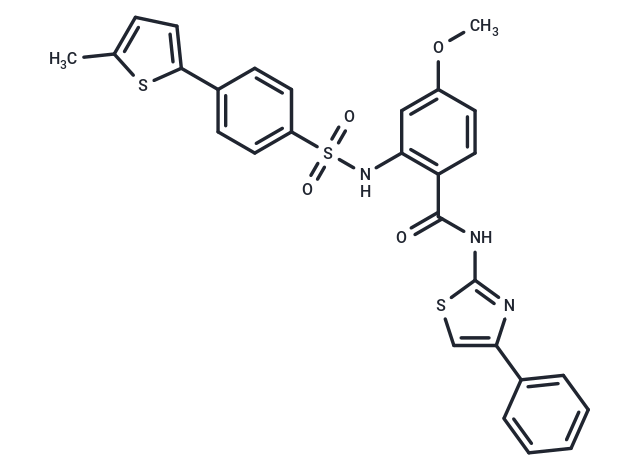
| Description | LLK203 is a potent dual-target inhibitor of USP2/USP8 with IC50 values of 0.89 μM and 0.52 μM, respectively. It promotes ERα degradation and induces apoptosis in breast cancer MCF-7 cells, demonstrating antitumor activity in the 4T1 tumor mice model [1]. |
| Targets & IC50 | USP8:0.52 μM, USP2:0.89 μM |
| In vitro | LLK203 exhibits high inhibitory activity on MCF-7 cells (IC50 = 3.4 μM) within the 0-100 μM range over 36 hours, with greater specificity compared to ML364 (IC50 = 9.3 μM). It enhances activity towards USP2 by fourfold and USP8 by ninefold relative to ML364 [1]. At concentrations of 10-50 μM for 24 hours, LLK203 increases the proportion of apoptotic MCF-7 cells, maintaining most cells in the G1 phase [1]. LLK203, at 2-50 μM over 24 hours, facilitates dose-dependent degradation of proteins such as MDM2, Cyclin D1, Her2, and ERα [1]. At a concentration of 10 μM sustained over 7 days, it exhibits strong inhibition of colony formation [1]. In cell cytotoxicity assays, LLK203 demonstrates lower cytotoxicity towards MCF10A cells (IC50 = 20.4 μM) while showing higher inhibitory activity against BC cells (MCF-7; IC50 = 3.4 μM), increases the ratio of apoptotic cells, largely maintains MCF-7 cells in the G1 phase, and degrades various proteins in a dose-dependent manner through Western blot analysis [1]. |
| In vivo | LLK203 administered intraperitoneally at a dose of 20 mg/kg daily for 23 consecutive days, significantly inhibited tumor growth in a 4T1 cell-bearing BALB/c mouse model [1]. Additionally, the pharmacokinetic parameters of LLK203 were assessed in male Sprague-Dawley rats, revealing the following: when administered intravenously (5 mg/kg), the Tmax (h) was 6, Cmax (ng/mL) was 36630, AUC0-t (h*ng/mL) was 60824, T1/2 (h) was 20, and CL (mL/h/kg) was 58, with an F (%) of 2.2%. When administered orally (50 mg/kg), the values were Tmax (h) 6, Cmax (ng/mL) 1572, AUC0-t (h*ng/mL) 19144, and T1/2 (h) 6.14 [1]. |
| Molecular Weight | 561.69 |
| Formula | C28H23N3O4S3 |
| Cas No. | 2758090-62-7 |
| Smiles | C(NC1=NC(=CS1)C2=CC=CC=C2)(=O)C3=C(NS(=O)(=O)C4=CC=C(C=C4)C=5SC(C)=CC5)C=C(OC)C=C3 |
| Storage | Powder: -20°C for 3 years | In solvent: -80°C for 1 year Shipping with blue ice/Shipping at ambient temperature. |
 For example, if the intended dosage is 10 mg/kg for animals weighing 20 g , with a dosing volume of 100 μL per animal, and a total of 10 animals are to be administered, using a formulation of
  10% DMSO+ 40% PEG300+ 5% Tween 80+ 45% Saline/PBS/ddH2O , the resulting working solution concentration would be 2 mg/mL.
Dissolve 2 mg of the compound in 100 μL DMSO to obtain a stock solution at a concentration of 20 mg/mL . If the required concentration exceeds the compound's known solubility, please contact us for technical support before proceeding.
1) Add 100 μL of the DMSO stock solution to 400 µL PEG300 and mix thoroughly until the solution becomes clear.
2) Add 50 µL Tween 80 and mix well until fully clarified.
3) Add 450 µL Saline,PBS or ddH2O and mix thoroughly until a homogeneous solution is obtained.
| Size | Quantity | Unit Price | Amount | Operation |
|---|
 Feedback
 Hello! How can I help you today?
Copyright © 2015-2026 TargetMol Chemicals Inc. All Rights Reserved.
