


Shopping Cart
Remove All Your shopping cart is currently empty


Synonyms: L-α-difluoromethylornithine monohydrochloride, L-RMI71782 monohydrochloride, L-DFMO monohydrochloride
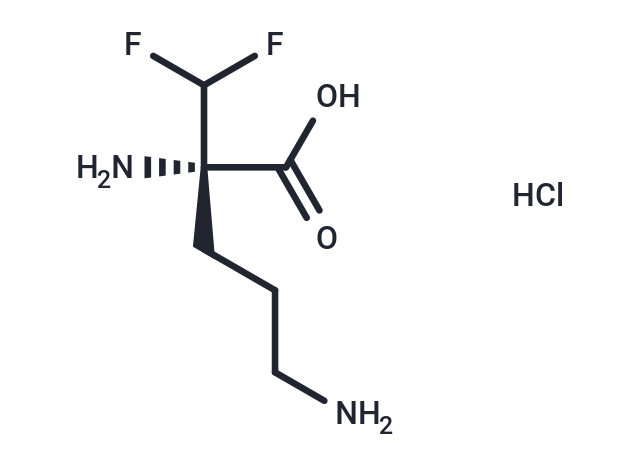

| Description | L-Eflornithine monohydrochloride is an irreversible ornithine decarboxylase (ODC) inhibitor with a KD of 1.3±0.3 μM, and a Kinact of 0.15±0.03 min-1. L-Eflornithine monohydrochloride (L-DFMO monohydrochloride) is an enantiomer of Eflornithine. L-Eflornithine is utilized in enzymology and polyamine biosynthesis research systems to investigate irreversible inhibition kinetics of ornithine decarboxylase, including enzyme inactivation parameters (KD and Kinact) and their relationship to catalytic turnover regulation in cellular metabolic models. L-Eflornithine monohydrochloride (L-DFMO monohydrochloride) is further applied in stereochemical and structure–activity relationship studies evaluating enantiomer-dependent enzyme binding and inhibition efficiency in biochemical assay systems. |
| Targets & IC50 | Ornithine decarboxylase,ODC:1.3±0.3 µM (Kd) |
| In vitro | Treatment of human colon tumour-derived HCT116 cells with either L-Eflornithine or D- Eflornithine decreases the cellular polyamine contents in a concentration-dependent manner. The enantiomers display different potencies in vitro, with the L-enantiomer having up to a 20-fold higher affinity for the target enzyme ornithine decarboxylase. ?The L-Eflornithine also appears to be more potent in cultured T.brucei gambiense parasites.Eflornithine (D/L-DFMO) is an inhibitor of ODC, the first enzyme in eukaryotic polyamine biosynthesis.?Both enantiomers of Eflornithine (DFMO) irreversibly inactivate ODC.?Both Eflornithine enantiomers (L-Eflornithine and D-Eflornithine) suppress ODC activity in a time- and concentration-dependent manner.?The inhibitor dissociation constant (KD) values for the formation of enzyme-inhibitor complexes are 28.3±3.4, 1.3±0.3 and 2.2±0.4 μM respectively for D-Eflornithine, L-Eflornithine and Eflornithine.?The inhibitor inactivation constants (Kinact) for the irreversible step were 0.25±0.03, 0.15±0.03 and 0.15±0.03 min-1 respectively for D-Eflornithine, L-Eflornithine and Eflornithine. |
| In vivo | The typical oral clearances of L-Eflornithine and D-Eflornithine are 17.4 and 8.23 liters/h, respectively. L-Eflornithine, being more potent, is present at significantly lower concentrations in both plasma and cerebrospinal fluid (CSF) compared to D-Eflornithine. On average, plasma concentrations of L-Eflornithine are 52% of those of the D-enantiomer. |
| Synonyms | L-α-difluoromethylornithine monohydrochloride, L-RMI71782 monohydrochloride, L-DFMO monohydrochloride |
| Molecular Weight | 218.63 |
| Formula | C6H13ClF2N2O2 |
| Cas No. | 69955-42-6 |
| Smiles | [C@@](CCCN)(C(F)F)(C(O)=O)N.Cl |
| Relative Density. | 1.31g/cm3 |
| Storage | Keep away from moisture, Powder: -20°C for 3 years | In solvent: -80°C for 1 year Shipping with blue ice/Shipping at ambient temperature. | |||||||||||||||||||||||||||||||||||
| Solubility Information | H2O: 40 mg/mL (182.96 mM), Sonication is recommended. DMSO: 160 mg/mL (731.83 mM), Sonication is recommended. | |||||||||||||||||||||||||||||||||||
Solution Preparation Table | ||||||||||||||||||||||||||||||||||||
H2O/DMSO
Note : The dilution table applies only to solid products. For liquid products, please calculate the stock solution based on the stated concentration and/or density. | ||||||||||||||||||||||||||||||||||||
 For example, if the intended dosage is 10 mg/kg for animals weighing 20 g , with a dosing volume of 100 μL per animal, and a total of 10 animals are to be administered, using a formulation of
  10% DMSO+ 40% PEG300+ 5% Tween 80+ 45% Saline/PBS/ddH2O , the resulting working solution concentration would be 2 mg/mL.
Dissolve 2 mg of the compound in 100 μL DMSO to obtain a stock solution at a concentration of 20 mg/mL . If the required concentration exceeds the compound's known solubility, please contact us for technical support before proceeding.
1) Add 100 μL of the DMSO stock solution to 400 µL PEG300 and mix thoroughly until the solution becomes clear.
2) Add 50 µL Tween 80 and mix well until fully clarified.
3) Add 450 µL Saline,PBS or ddH2O and mix thoroughly until a homogeneous solution is obtained.
| Size | Quantity | Unit Price | Amount | Operation |
|---|
 Feedback
 Hello! How can I help you today?
Copyright © 2015-2026 TargetMol Chemicals Inc. All Rights Reserved.
