


Shopping Cart
Remove All Your shopping cart is currently empty

Synonyms: LY 195115

| Pack Size | Price | USA Stock | Global Stock | Quantity |
|---|---|---|---|---|
| 1 mg | $96 | In Stock | In Stock | |
| 5 mg | $233 | In Stock | In Stock | |
| 10 mg | $353 | In Stock | In Stock | |
| 25 mg | $566 | In Stock | In Stock | |
| 50 mg | $768 | In Stock | In Stock | |
| 100 mg | $1,030 | In Stock | In Stock | |
| 200 mg | $1,390 | - | In Stock |
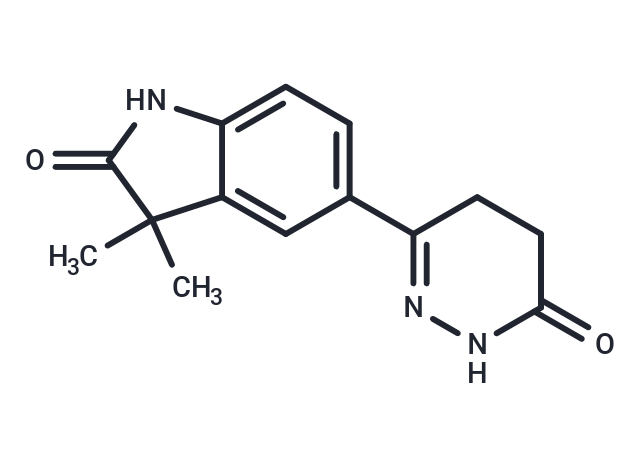
| Description | Indolidan (LY 195115) induces cardiovascular and adrenal hyperplastic lesions in Fischer 344 rats. Indolidan increases the risk of cardiovascular disease. |
| In vivo | Male and female Fischer 344 rats were treated with the positive inotropic agents, isomazole or indolidan, in the diet for 104 weeks. The doses were 0.0, 11.5, 23.5, or 48.0 mg/kg and 0.0, 0.12, 0.40, or 1.3 mg/kg, respectively. Only 17% of the males treated with 48.0 mg/kg isomazole survived the duration of the study. The male component of the indolidan study was terminated at 22 months, with only 18% of the high-dose males surviving. Sixty-five percent of the males treated with 48.0 mg/kg isomazole and 70% of the males treated with 1.3 mg/kg indolidan were found to have severe periarteritis, often with thrombi located mainly in the mesenteric arteries. Fifty-four percent of the male rats treated with 48.0 mg/kg isomazole and 55% of the male rats treated with 1.3 mg/kg indolidan died from cardiovascular disease compared to 1-2% among the control males. Animals in the low- and middle-dose groups of both studies had a lower incidence of cardiovascular disease than did those in the high-dose group. Additional lesions associated with the long-term administration of both drugs were markedly increased incidence of adrenal medullary proliferative lesions (both hyperplasia and pheochromocytomas) and increased incidence of chronic progressive glomerulonephrosis. These lesions, like those in the cardiovascular system, occurred in a dose-dependent manner and were more frequent in males than in females.[5] |
| Synonyms | LY 195115 |
| Molecular Weight | 257.29 |
| Formula | C14H15N3O2 |
| Cas No. | 100643-96-7 |
| Smiles | CC1(C)C=2C(NC1=O)=CC=C(C2)C=3CCC(=O)NN3 |
| Relative Density. | 1.39g/cm3 |
| Storage | Powder: -20°C for 3 years | In solvent: -80°C for 1 year Shipping with blue ice/Shipping at ambient temperature. | |||||||||||||||||||||||||
| Solubility Information | DMSO: 5.63 mg/mL (21.88 mM), Sonication is recommended.  | |||||||||||||||||||||||||
Solution Preparation Table | ||||||||||||||||||||||||||
DMSO
Note : The dilution table applies only to solid products. For liquid products, please calculate the stock solution based on the stated concentration and/or density. | ||||||||||||||||||||||||||
 For example, if the intended dosage is 10 mg/kg for animals weighing 20 g , with a dosing volume of 100 μL per animal, and a total of 10 animals are to be administered, using a formulation of
  10% DMSO+ 40% PEG300+ 5% Tween 80+ 45% Saline/PBS/ddH2O , the resulting working solution concentration would be 2 mg/mL.
Dissolve 2 mg of the compound in 100 μL DMSO to obtain a stock solution at a concentration of 20 mg/mL . If the required concentration exceeds the compound's known solubility, please contact us for technical support before proceeding.
1) Add 100 μL of the DMSO stock solution to 400 µL PEG300 and mix thoroughly until the solution becomes clear.
2) Add 50 µL Tween 80 and mix well until fully clarified.
3) Add 450 µL Saline,PBS or ddH2O and mix thoroughly until a homogeneous solution is obtained.
| Size | Quantity | Unit Price | Amount | Operation |
|---|
 Feedback
 Hello! How can I help you today?
Copyright © 2015-2026 TargetMol Chemicals Inc. All Rights Reserved.
