


Shopping Cart
Remove All Your shopping cart is currently empty


Synonyms:
| Pack Size | Price | USA Stock | Global Stock | Quantity |
|---|---|---|---|---|
| 1 mg | $129 | In Stock | In Stock | |
| 5 mg | $297 | In Stock | In Stock | |
| 10 mg | $446 | In Stock | In Stock | |
| 25 mg | $723 | In Stock | In Stock | |
| 50 mg | $996 | In Stock | In Stock | |
| 100 mg | $1,330 | In Stock | In Stock |
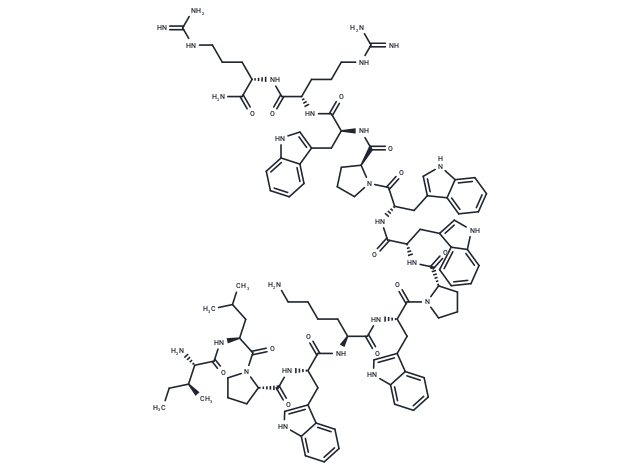
| Description | Indolicidin is comprised of 13 amino acids, 5 of which are tryptophan residues, and the carboxylterminal arginine is carboxamidated. Indolicidin has the highest tryptophan content of any known protein. |
| In vitro | Indolicidin, a powerful antimicrobial peptide extracted from bovine neutrophil cytoplasmic granules, comprises 13 amino acids, including a notably high tryptophan content, with five tryptophan residues, and features a carboxamidated carboxylterminal arginine. This peptide, recognized for having the highest tryptophan level among proteins, also acts as a tridecapeptide amide exhibiting bactericidal activities rivaling those of prominent defensins and bactenecins in vitro. Its mechanism includes binding to surface lipopolysaccharide with high affinity, facilitating the permeabilization of Escherichia coli's outer membrane via the self-promoted uptake pathway, as evidenced by its interaction with 1-N-phenylnapthylamine. Furthermore, methyl esterification at Indolicidin's carboxyl terminus amplifies its effectiveness against both Gram-negative and Gram-positive bacteria, attributed to enhanced lipopolysaccharide binding and outer membrane permeabilization in Gram-negative bacteria, and pinpointing the cytoplasmic membrane as its action site through membrane permeabilization indicators in Escherichia coli. |
| Molecular Weight | 1906.28 |
| Formula | C100H132N26O13 |
| Cas No. | 140896-21-5 |
| Smiles | C([C@@H](C(=O)N1[C@H](C(N[C@@H](CC=2C=3C(NC2)=CC=CC3)C(N[C@H](C(N[C@@H](CCCNC(=N)N)C(N)=O)=O)CCCNC(=N)N)=O)=O)CCC1)NC([C@H](CC=4C=5C(NC4)=CC=CC5)NC(=O)[C@H]6N(C([C@H](CC=7C=8C(NC7)=CC=CC8)NC([C@@H](NC([C@H](CC=9C=%10C(NC9)=CC=CC%10)NC(=O)[C@H]%11N(C([C@@H](NC([C@H]([C@H](CC)C)N)=O)CC(C)C)=O)CCC%11)=O)CCCCN)=O)=O)CCC6)=O)C=%12C=%13C(NC%12)=CC=CC%13 |
| Relative Density. | 1.45 g/cm3 (Predicted) |
| Sequence | Ile-Leu-Pro-Trp-Lys-Trp-Pro-Trp-Trp-Pro-Trp-Arg-Arg-NH₂ |
| Sequence Short | ILPWKWPWWPWRR |
| Storage | Keep away from moisture Powder: -20°C for 3 years | In solvent: -80°C for 1 year Shipping with blue ice/Shipping at ambient temperature. | ||||||||||||||||||||
| Solubility Information | DMSO: 10 mM, Sonication is recommended. | ||||||||||||||||||||
Solution Preparation Table | |||||||||||||||||||||
DMSO
Note : The dilution table applies only to solid products. For liquid products, please calculate the stock solution based on the stated concentration and/or density. | |||||||||||||||||||||
 For example, if the intended dosage is 10 mg/kg for animals weighing 20 g , with a dosing volume of 100 μL per animal, and a total of 10 animals are to be administered, using a formulation of
  10% DMSO+ 40% PEG300+ 5% Tween 80+ 45% Saline/PBS/ddH2O , the resulting working solution concentration would be 2 mg/mL.
Dissolve 2 mg of the compound in 100 μL DMSO to obtain a stock solution at a concentration of 20 mg/mL . If the required concentration exceeds the compound's known solubility, please contact us for technical support before proceeding.
1) Add 100 μL of the DMSO stock solution to 400 µL PEG300 and mix thoroughly until the solution becomes clear.
2) Add 50 µL Tween 80 and mix well until fully clarified.
3) Add 450 µL Saline,PBS or ddH2O and mix thoroughly until a homogeneous solution is obtained.
| Size | Quantity | Unit Price | Amount | Operation |
|---|
 Feedback
 Hello! How can I help you today?
Copyright © 2015-2026 TargetMol Chemicals Inc. All Rights Reserved.
