


Shopping Cart
Remove All Your shopping cart is currently empty

Synonyms:
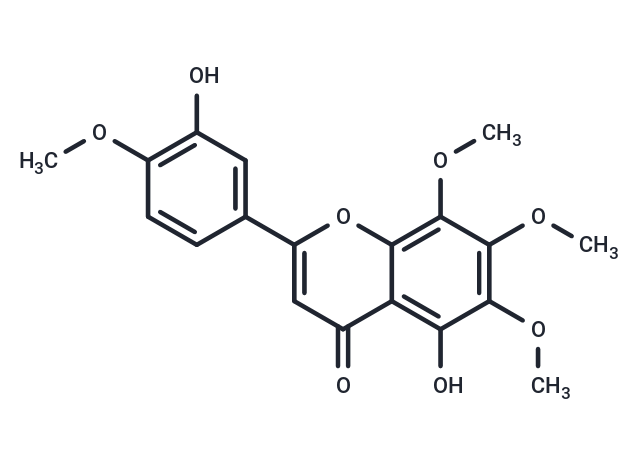
| Pack Size | Price | USA Stock | Global Stock | Quantity |
|---|---|---|---|---|
| 5 mg | $1,045 | Inquiry | Inquiry |
| Description | Gardenin D has antioxidant, and antiproliferative activities. |
| In vitro | METHODS AND RESULTS:In the present study we mined the information on Gardenia lucida (Dikamali) and identified seven polymethoxyflavones from its gum resin. We also investigated its antiproliferative and antioxidant potential. Xanthomicrol (8) found as potent DPPH scavenger (85.86±1.3%) along with strong ferric plummeting ability (53.60±2.0 FSE) and reducing potential (1.07±0.01) as compared to ascorbic acid. Gardenin B (5) strongly inhibit biochemical production of nitric oxide (IC50 10.59±0.4μg/mL) followed by 5-Desmethylnobiletin (7) and Gardenin E (10, IC5011.01±0.7-34.53±2.7μg/mL). Methanol extract, chloroform fraction and Acerosin (11), Gardenin D (9) and Gardenin B (5) exhibited superior antiproliferative activity against lung, breast, colon, hepatic and leukaemia cell lines as well as in keratinocytes (IC50 12.82±0.67-94.63±1.27μg/mL) whereas other fractions and isolated compounds moderately affect the cell proliferation (21.40±0.12-48.12±0.47%) with least and non-specific interaction against succinate dehydrogenase. Except compound 2, 3, 6, 8 and 11, others were found as a significant inhibitor of ODC (IC50 2.36±0.7-8.53±0.32μg/mL) with respect to DFMO (IC50 10.85±0.28μg/mL). In silico analysis also revealed enervated binding energy (-4.30 to -5.02kcal/mol) and inhibition constant (704.18-210.26μM) wherein 5, 7, 8, 9 and 10 showed specific interaction with the receptor while rest were non-specific. Except butanol fraction and Gardenin E, others were potently inhibited the cathepsin D activity with non-specific interaction and better binding energy (-5.78 to -7.24kcal/mol) and inhibition constant (57.87-4.90μM). |
| Molecular Weight | 374.34 |
| Formula | C19H18O8 |
| Cas No. | 29202-00-4 |
| Smiles | O=C1C=C(OC2=C(OC)C(OC)=C(OC)C(O)=C12)C=3C=CC(OC)=C(O)C3 |
| Relative Density. | 1.375g/cm3 |
| Storage | Powder: -20°C for 3 years | In solvent: -80°C for 1 year Shipping with blue ice/Shipping at ambient temperature. |
 For example, if the intended dosage is 10 mg/kg for animals weighing 20 g , with a dosing volume of 100 μL per animal, and a total of 10 animals are to be administered, using a formulation of
  10% DMSO+ 40% PEG300+ 5% Tween 80+ 45% Saline/PBS/ddH2O , the resulting working solution concentration would be 2 mg/mL.
Dissolve 2 mg of the compound in 100 μL DMSO to obtain a stock solution at a concentration of 20 mg/mL . If the required concentration exceeds the compound's known solubility, please contact us for technical support before proceeding.
1) Add 100 μL of the DMSO stock solution to 400 µL PEG300 and mix thoroughly until the solution becomes clear.
2) Add 50 µL Tween 80 and mix well until fully clarified.
3) Add 450 µL Saline,PBS or ddH2O and mix thoroughly until a homogeneous solution is obtained.
| Size | Quantity | Unit Price | Amount | Operation |
|---|
 Feedback
 Hello! How can I help you today?
Copyright © 2015-2026 TargetMol Chemicals Inc. All Rights Reserved.
