


Shopping Cart
Remove All Your shopping cart is currently empty

Synonyms:
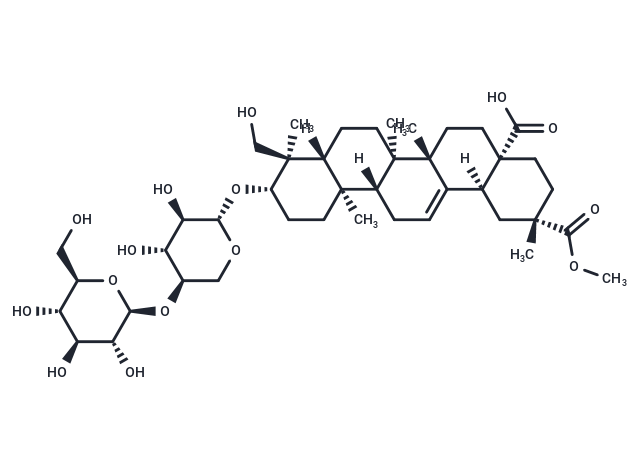
| Pack Size | Price | USA Stock | Global Stock | Quantity |
|---|---|---|---|---|
| 5 mg | $630 | Inquiry | Inquiry |
| Description | Esculentoside C exerts proinflammatory effects synergistically, it can induce inflammatory stimulation. |
| In vitro | METHODS AND RESULTS:Petroleum ether (PE), CH2Cl2, n-BuOH, and water fractions were isolated from 70% ethanol extract of P. americana. The n-BuOH fraction was dissolved in 50% ethanol and precipitated by adding ethyl ether. The resultant supernatants and precipitates were referred to as SUPs and SEDs fractions, respectively. SUPs fraction was separated by column chromatography into four main stimulating esculentosides that were identified by HR-ESI/MS and NMR as Esculentoside A(EsA), Esculentoside B(EsB), Esculentoside C(EsC), and Esculentoside F(EsF. The irritating effects of esculentosides on rabbit conjunctivae (500 μg/eye) was observed by pathological examination and those on macrophages (5, 25, 50 and 100 μg/mL) were evaluated by detecting changes of NO, TNF-α, and IL-1β levels.n-BuOH, SUP fractions, and EsC induced severe conjunctival edema. The four esculentosides induced dose-dependent releases of proinflammatory mediators NO, TNF-α, and IL-1β from macrophages, and releasing amounts peaked after 2 h of treatment. EsC and EsF induced macrophages to release mediators most significantly. EsC (50 μg/mL) functioned more effectively than EsF did, and similarly n-BuOH and SUPs fractions functioned more effectively than the esculentoside mixture. CONCLUSIONS: Thus, the four esculentosides exerted proinflammatory effects synergistically.All extracted esculentosides, especially EsC, induced inflammatory stimulation. Phytolacca americana-induced irritation of the gastrointestinal tract may be associated with esculentosides such as EsC. |
| Molecular Weight | 810.975 |
| Formula | C42H66O15 |
| Cas No. | 65931-92-2 |
| Smiles | [H][C@@]12C[C@](C)(CC[C@@]1(CC[C@]1(C)C2=CC[C@]2([H])[C@@]3(C)CC[C@H](O[C@@H]4OC[C@@H](O[C@@H]5O[C@H](CO)[C@@H](O)[C@H](O)[C@H]5O)[C@H](O)[C@H]4O)[C@@](C)(CO)[C@]3([H])CC[C@@]12C)C(O)=O)C(=O)OC |t:14| |
| Relative Density. | 1.387g/cm3 |
| Storage | Powder: -20°C for 3 years | In solvent: -80°C for 1 year Shipping with blue ice/Shipping at ambient temperature. |
 For example, if the intended dosage is 10 mg/kg for animals weighing 20 g , with a dosing volume of 100 μL per animal, and a total of 10 animals are to be administered, using a formulation of
  10% DMSO+ 40% PEG300+ 5% Tween 80+ 45% Saline/PBS/ddH2O , the resulting working solution concentration would be 2 mg/mL.
Dissolve 2 mg of the compound in 100 μL DMSO to obtain a stock solution at a concentration of 20 mg/mL . If the required concentration exceeds the compound's known solubility, please contact us for technical support before proceeding.
1) Add 100 μL of the DMSO stock solution to 400 µL PEG300 and mix thoroughly until the solution becomes clear.
2) Add 50 µL Tween 80 and mix well until fully clarified.
3) Add 450 µL Saline,PBS or ddH2O and mix thoroughly until a homogeneous solution is obtained.
| Size | Quantity | Unit Price | Amount | Operation |
|---|
 Feedback
 Hello! How can I help you today?
Copyright © 2015-2026 TargetMol Chemicals Inc. All Rights Reserved.
