


Shopping Cart
Remove All Your shopping cart is currently empty

Synonyms: L-glycero-Tetrulose, L-(+)-Erythrulose, Erythrulose
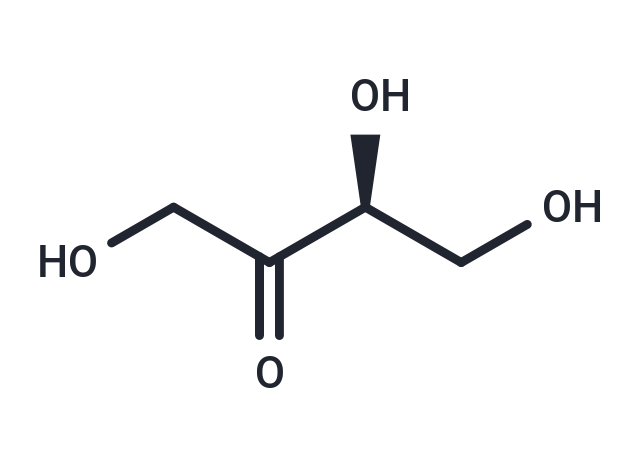

| Pack Size | Price | USA Stock | Global Stock | Quantity |
|---|---|---|---|---|
| 1 mg | $32 | - | In Stock | |
| 5 mg | $71 | In Stock | In Stock | |
| 10 mg | $98 | In Stock | In Stock | |
| 25 mg | $169 | In Stock | In Stock | |
| 50 mg | $253 | - | In Stock | |
| 100 mg | $376 | - | In Stock | |
| 500 mg | $898 | - | In Stock |
| Description | L-Erythrulose (L-glycero-Tetrulose) is a ketose extracted from sugar cane that has tanning and moisturizing effects and is often added to skin care products. |
| In vivo | b>METHODS: Numerous toxicity and metabolism studies were conducted on erythritol in rats, mice, and dogs; toxicity studies included long-term feeding studies to determine carcinogenic potential, intravenous and oral teratogenicity studies to determine possible effects on the fetus, oral studies of erythritol to determine the possibility of reproductive effects, and bacterial and mammalian systemic studies to determine mutagenic potential. RESULTS: Metabolism studies in animals showed that erythritol was almost completely absorbed, rather than systemically metabolized, and excreted unchanged in the urine; safety studies showed that erythritol was well tolerated and did not cause toxicological effects; clinical studies showed that erythritol was well tolerated and did not cause any toxicologically relevant effects even after high-dose exposure; erythritol administered orally to the human body was rapidly absorbed from the gastrointestinal tract and quantitatively excreted in the urine without metabolic changes; there was no evidence of toxicity from erythritol. [1] |
| Synonyms | L-glycero-Tetrulose, L-(+)-Erythrulose, Erythrulose |
| Molecular Weight | 120.1 |
| Formula | C4H8O4 |
| Cas No. | 533-50-6 |
| Smiles | [C@@H](C(CO)=O)(CO)O |
| Relative Density. | 1.420 g/cm3 |
| Storage | Pure form: -20°C for 3 years | In solvent: -80°C for 1 year Shipping with blue ice/Shipping at ambient temperature. |
 For example, if the intended dosage is 10 mg/kg for animals weighing 20 g , with a dosing volume of 100 μL per animal, and a total of 10 animals are to be administered, using a formulation of
  10% DMSO+ 40% PEG300+ 5% Tween 80+ 45% Saline/PBS/ddH2O , the resulting working solution concentration would be 2 mg/mL.
Dissolve 2 mg of the compound in 100 μL DMSO to obtain a stock solution at a concentration of 20 mg/mL . If the required concentration exceeds the compound's known solubility, please contact us for technical support before proceeding.
1) Add 100 μL of the DMSO stock solution to 400 µL PEG300 and mix thoroughly until the solution becomes clear.
2) Add 50 µL Tween 80 and mix well until fully clarified.
3) Add 450 µL Saline,PBS or ddH2O and mix thoroughly until a homogeneous solution is obtained.
| Size | Quantity | Unit Price | Amount | Operation |
|---|
 Feedback
 Hello! How can I help you today?
Copyright © 2015-2026 TargetMol Chemicals Inc. All Rights Reserved.
