


Shopping Cart
Remove All Your shopping cart is currently empty


Synonyms:
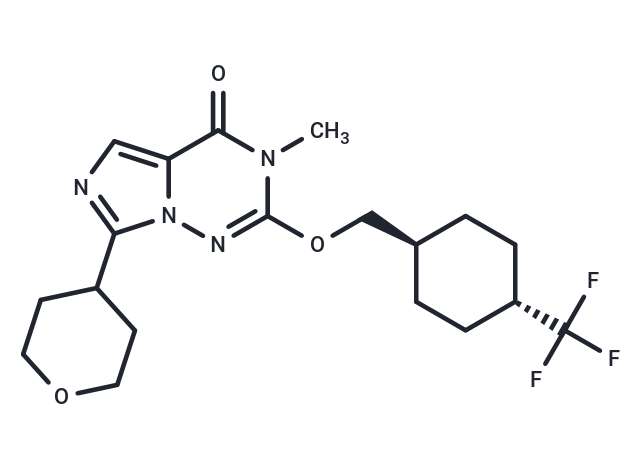

| Description | DSR-141562 is a new compound that can be taken orally and has a specific ability to inhibit phosphodiesterase 1 (PDE1) in the brain. This compound exhibits a preference for inhibiting human PDE1B, with an IC50 value of 43.9 nM. It also shows moderate inhibition of human PDE1A (IC50 = 97.6 nM) and PDE1C (IC50 = 431.8 nM). DSR-141562 is particularly useful in the study of positive symptoms, negative symptoms, and cognitive impairments associated with schizophrenia. |
| Targets & IC50 | PDE1B (human):43.9 nM (IC50), PDE1A (human):97.6 nM (IC50), PDE1C (human):431.8 nM (IC50) |
| In vivo | DSR-141562, when administered orally to rats and monkeys, demonstrates effective brain uptake and pharmacological activity across multiple dosages and time points. At a single dose of 30 mg/kg, it achieves good brain penetration, evidenced by a brain-to-blood concentration ratio of 0.99 in rats, and exhibits significant pharmacological effects at various intervals post-administration (0.5, 1, 2, and 3 hours). A lower dose of 10 mg/kg, given 2 hours prior, modestly yet significantly enhances cGMP levels in the frontal cortex and striatum of rats. This compound, at doses of 30 mg/kg or 100 mg/kg, notably increases cGMP concentration in monkey cerebrospinal fluid (CSF) after 2 hours, with plasma concentrations of the unbound drug exceeding 43.9 nM, which is its IC50 for PDE1B inhibition in vitro. Furthermore, DSR-141562 effectively counteracts methamphetamine-induced hyperactivity in rats at 3 mg/kg, 10 mg/kg, and 30 mg/kg doses without affecting spontaneous locomotor activity at the lower doses of 3 and 10 mg/kg. Likewise, it significantly mitigates the phencyclidine-induced decline in social interaction in mice at doses of 0.3 mg/kg, 1 mg/kg, and 3 mg/kg. These findings demonstrate DSR-141562's potential in modulating neural activity and behavior in animal models through its pharmacological actions on cGMP levels and its ability to penetrate the brain, suggesting its therapeutic relevance. |
| Molecular Weight | 414.42 |
| Formula | C19H25F3N4O3 |
| Cas No. | 2007975-22-4 |
| Smiles | Cn1c(OC[C@H]2CC[C@@H](CC2)C(F)(F)F)nn2c(ncc2c1=O)C1CCOCC1 |
| Storage | Powder: -20°C for 3 years | In solvent: -80°C for 1 year Shipping with blue ice/Shipping at ambient temperature. |
 For example, if the intended dosage is 10 mg/kg for animals weighing 20 g , with a dosing volume of 100 μL per animal, and a total of 10 animals are to be administered, using a formulation of
  10% DMSO+ 40% PEG300+ 5% Tween 80+ 45% Saline/PBS/ddH2O , the resulting working solution concentration would be 2 mg/mL.
Dissolve 2 mg of the compound in 100 μL DMSO to obtain a stock solution at a concentration of 20 mg/mL . If the required concentration exceeds the compound's known solubility, please contact us for technical support before proceeding.
1) Add 100 μL of the DMSO stock solution to 400 µL PEG300 and mix thoroughly until the solution becomes clear.
2) Add 50 µL Tween 80 and mix well until fully clarified.
3) Add 450 µL Saline,PBS or ddH2O and mix thoroughly until a homogeneous solution is obtained.
| Size | Quantity | Unit Price | Amount | Operation |
|---|
 Feedback
 Hello! How can I help you today?
Copyright © 2015-2026 TargetMol Chemicals Inc. All Rights Reserved.
