


Shopping Cart
Remove All Your shopping cart is currently empty

Synonyms: VU-364849, VU364849, VU 364849, DMH-2, DMH 2
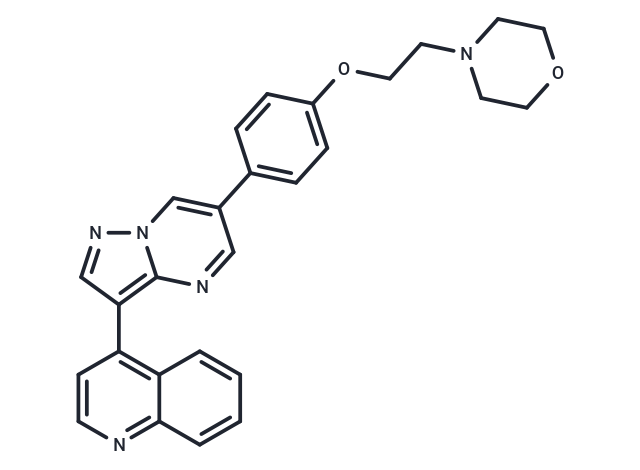

| Pack Size | Price | USA Stock | Global Stock | Quantity |
|---|---|---|---|---|
| 1 mg | $132 | - | In Stock | |
| 5 mg | $327 | - | In Stock | |
| 10 mg | $523 | - | In Stock | |
| 25 mg | $837 | - | In Stock | |
| 50 mg | $1,120 | - | In Stock |
| Description | DMH2 is a selective BMP type I receptor (ALK2/ALK3) inhibitor. DMH2 inhibits the proliferation of lung cancer cell lines and induces cell death. DMH2 can be used in research on tumors, stem cell differentiation, and bone formation. |
| In vitro | Methods: Human hepatocellular carcinoma cells (Huh7) were treated with 10 μM DMH2. After a 1-hour preincubation, 20 mM APAP was added, and the cells were treated with APAP for 16 hours. Cell viability was assessed by crystal violet staining and qPCR. Results: DMH2 pretreatment increased cell viability and reduced the APAP-induced upregulation of HMOX1, GSTM3, and SOD2 expression. [1] Methods: Oct4/GFP⁺ and Nestin cells sorted from cell lines such as H1299 and A549 were treated with DMH2 (1 μM) for 48 hours, stained with ethidium bromide, and the percentage of dead cells was counted. Results: DMH2 significantly induced apoptosis, and the cell death induced by DMH2 in Nestin/GFP⁺ cells was significantly higher than in Oct4/GFP⁺ cells. [2] |
| In vivo | Methods: To verify the protective effect of DMH2 against APAP-induced liver injury, male C57BL/6J mice were administered APAP (500 mg/kg) intraperitoneally. One hour later, they received an intraperitoneal injection of DMH2 (3 mg/kg) and were sacrificed 2 hours after the APAP injection. Results: Post-treatment with DMH2 significantly reduced the area of APAP-induced hepatic necrosis and the number of apoptotic cells, and lowered serum ALT levels. DMH2 treatment effectively protected against APAP-induced liver injury. [1] |
| Synonyms | VU-364849, VU364849, VU 364849, DMH-2, DMH 2 |
| Molecular Weight | 451.52 |
| Formula | C27H25N5O2 |
| Cas No. | 1206711-14-9 |
| Smiles | N=1C=CC(C=2C=NN3C=C(C=NC23)C=4C=CC(OCCN5CCOCC5)=CC4)=C6C=CC=CC16 |
| Relative Density. | 1.31 g/cm3 (Predicted) |
| Storage | Powder: -20°C for 3 years | In solvent: -80°C for 1 year Shipping with blue ice/Shipping at ambient temperature. | ||||||||||||||||||||||||||||||
| Solubility Information | DMSO: 40 mg/mL (88.59 mM), Sonication is recommended. | ||||||||||||||||||||||||||||||
Solution Preparation Table | |||||||||||||||||||||||||||||||
DMSO
Note : The dilution table applies only to solid products. For liquid products, please calculate the stock solution based on the stated concentration and/or density. | |||||||||||||||||||||||||||||||
 For example, if the intended dosage is 10 mg/kg for animals weighing 20 g , with a dosing volume of 100 μL per animal, and a total of 10 animals are to be administered, using a formulation of
  10% DMSO+ 40% PEG300+ 5% Tween 80+ 45% Saline/PBS/ddH2O , the resulting working solution concentration would be 2 mg/mL.
Dissolve 2 mg of the compound in 100 μL DMSO to obtain a stock solution at a concentration of 20 mg/mL . If the required concentration exceeds the compound's known solubility, please contact us for technical support before proceeding.
1) Add 100 μL of the DMSO stock solution to 400 µL PEG300 and mix thoroughly until the solution becomes clear.
2) Add 50 µL Tween 80 and mix well until fully clarified.
3) Add 450 µL Saline,PBS or ddH2O and mix thoroughly until a homogeneous solution is obtained.
| Size | Quantity | Unit Price | Amount | Operation |
|---|
 Feedback
 Hello! How can I help you today?
Copyright © 2015-2026 TargetMol Chemicals Inc. All Rights Reserved.
