


Shopping Cart
Remove All Your shopping cart is currently empty

Synonyms:
| Pack Size | Price | USA Stock | Global Stock | Quantity |
|---|---|---|---|---|
| 10 mg | Inquiry | Inquiry | Inquiry | |
| 50 mg | Inquiry | Inquiry | Inquiry |
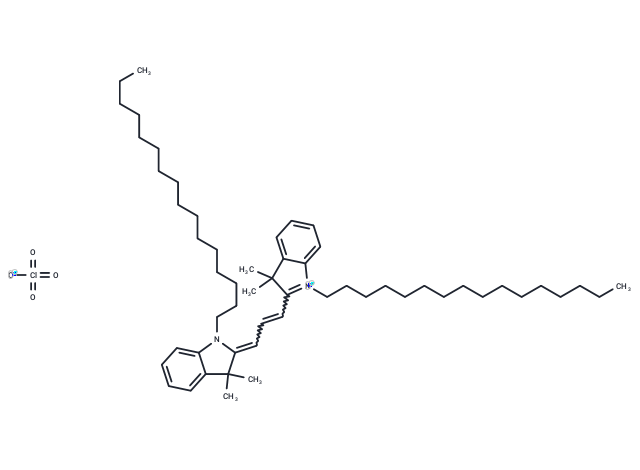
| Description | DiIC16(3), a long-chain carbocyanine dye, is extensively utilized for labeling cells, organelles, liposomes, viruses, and lipoproteins [2]. |
| In vitro | Carbocyanine dyes serve as lipophilic tracers used for labeling cells, organelles, liposomes, viruses, and lipoproteins. Long-chain carbocyanines include DiO (DiOC18(3)), DiI (DiIC18(3)), DiD (DiIC18(5)), and DiR, as well as the dialkylaminostyryl dye DiA (4-Di-16-ASP) for labeling membranes and other hydrophobic structures. The alkyl group of DiIC16(3) (C16) is shorter than that of DiI (C18). These dyes exhibit high extinction coefficients in lipid environments, environment-dependent fluorescence, and short excited-state lifetimes. They show weak fluorescence in aqueous solutions but are highly fluorescent and photostable when bound to membranes or lipophilic biomolecules, making them suitable for staining plasma membranes. Upon application, these dyes diffuse laterally within the plasma membrane, resulting in uniform cell staining. DiO, DiI, DiD, and DiR exhibit distinct green, orange, red, and infrared fluorescence, respectively, facilitating multicolor imaging and flow cytometry analysis of live cells. DiO and DiI are suitable for the standard FITC and TRITC fluorescence channels. DiI and its derivatives are commonly used due to their low cytotoxicity and are extensively utilized in lipoprotein assays such as LDL and HDL detection. The lipophilic aminostyryl dye DiA is also frequently used for neuronal tracing. Preparation of Di Staining Solution: 1.1. Prepare stock solutions of 1-5 mM in dimethylformamide (DMF), dimethyl sulfoxide (DMSO), or ethanol. DMF is a preferred solvent for Di. Use the stock solution promptly; any unused solution can be aliquoted and stored at -20°C for up to 6 months, avoiding repeated freeze-thaw cycles. 1.2. Dilute the stock into an appropriate buffer, such as serum-free media, HBS, or PBS, to a 1-5 μM working solution. The final concentration should be determined experimentally. For Suspended Cells: 2.1. Centrifuge to collect cells and wash twice with PBS, 5 minutes each. Maintain a cell density of 1×10^6/mL. 2.2. Add 1 mL Di working solution and incubate at room temperature for 5-30 minutes. 2.3. Centrifuge at 400 g, 4°C for 3-4 minutes; discard supernatant. 2.4. Wash cells twice with PBS, 5 minutes each. 2.5. Resuspend cells in 1 mL serum-free medium or PBS, then observe with fluorescence microscopy or flow cytometry. For Adherent Cells: 3.1. Cultivate cells on sterile coverslips. 3.2. Remove coverslips from the medium and aspirate excess culture medium. 3.3. Add 100 μL dye working solution, gently agitate to cover cells, and incubate for 5-30 minutes. 3.4. Remove dye solution, wash with medium 2-3 times, 5 minutes each, and observe using fluorescence microscopy or flow cytometry. The above information is based on published literature. Experimental procedures should be appropriately modified to meet specific research demands. |
| Molecular Weight | 877.76 |
| Formula | C55H89ClN2O4 |
| Cas No. | 84109-11-5 |
| Smiles | Cl(=O)(=O)(=O)[O-].C(CCCCCCCCCCCCCCC)N1C=2C(C(C)(C)C1=CC=CC3=[N+](CCCCCCCCCCCCCCCC)C=4C(C3(C)C)=CC=CC4)=CC=CC2 |
| Storage | Powder: -20°C for 3 years | In solvent: -80°C for 1 year Shipping with blue ice/Shipping at ambient temperature. |
 For example, if the intended dosage is 10 mg/kg for animals weighing 20 g , with a dosing volume of 100 μL per animal, and a total of 10 animals are to be administered, using a formulation of
  10% DMSO+ 40% PEG300+ 5% Tween 80+ 45% Saline/PBS/ddH2O , the resulting working solution concentration would be 2 mg/mL.
Dissolve 2 mg of the compound in 100 μL DMSO to obtain a stock solution at a concentration of 20 mg/mL . If the required concentration exceeds the compound's known solubility, please contact us for technical support before proceeding.
1) Add 100 μL of the DMSO stock solution to 400 µL PEG300 and mix thoroughly until the solution becomes clear.
2) Add 50 µL Tween 80 and mix well until fully clarified.
3) Add 450 µL Saline,PBS or ddH2O and mix thoroughly until a homogeneous solution is obtained.
| Size | Quantity | Unit Price | Amount | Operation |
|---|
 Feedback
 Hello! How can I help you today?
Copyright © 2015-2026 TargetMol Chemicals Inc. All Rights Reserved.
