


Shopping Cart
Remove All Your shopping cart is currently empty

Synonyms:
| Pack Size | Price | USA Stock | Global Stock | Quantity |
|---|---|---|---|---|
| 10 mg | Inquiry | 10-14 weeks | 10-14 weeks | |
| 50 mg | Inquiry | 10-14 weeks | 10-14 weeks |
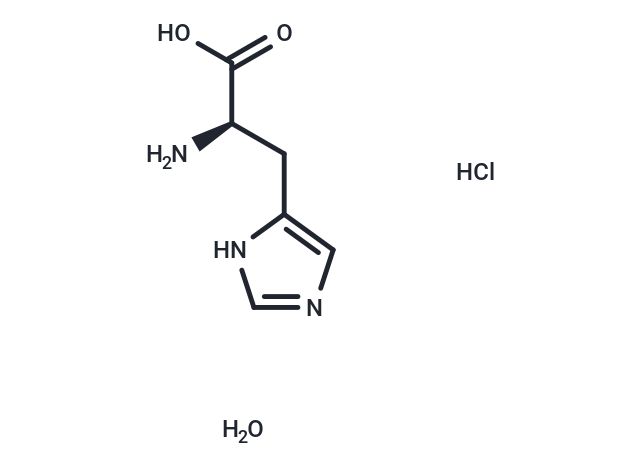
| Description | D-Histidine hydrochloride hydrate is an agent that targets bacterial quorum sensing systems, such as the RhlI/RhlR pathway, to inhibit biofilm formation with antibacterial properties. It acts by non-covalently binding to bacterial regulatory factors or copper ion complexes, selectively inhibiting bacterial biofilm formation and motility. Additionally, D-Histidine hydrochloride hydrate downregulates quorum sensing-related gene expression, reduces synthesis of virulence factors (such as alginate and protease), and disrupts bacterial membrane stability. This results in inhibiting biofilm formation, promoting the disassembly of mature biofilms, and increasing antibiotic sensitivity. Furthermore, it serves as an efficient catalyst for the salt-induced peptide formation (SIPF) reaction by forming complexes with copper ions (Cu2+), which facilitates the condensation of amino acids to form dipeptides, such as di-alanine and di-lysine. |
| Molecular Weight | 209.63 |
| Formula | C6H12ClN3O3 |
| Cas No. | 328526-86-9 |
| Smiles | C([C@H](C(O)=O)N)C1=CN=CN1.Cl.O |
| Storage | Powder: -20°C for 3 years | In solvent: -80°C for 1 year Shipping with blue ice/Shipping at ambient temperature. |
 For example, if the intended dosage is 10 mg/kg for animals weighing 20 g , with a dosing volume of 100 μL per animal, and a total of 10 animals are to be administered, using a formulation of
  10% DMSO+ 40% PEG300+ 5% Tween 80+ 45% Saline/PBS/ddH2O , the resulting working solution concentration would be 2 mg/mL.
Dissolve 2 mg of the compound in 100 μL DMSO to obtain a stock solution at a concentration of 20 mg/mL . If the required concentration exceeds the compound's known solubility, please contact us for technical support before proceeding.
1) Add 100 μL of the DMSO stock solution to 400 µL PEG300 and mix thoroughly until the solution becomes clear.
2) Add 50 µL Tween 80 and mix well until fully clarified.
3) Add 450 µL Saline,PBS or ddH2O and mix thoroughly until a homogeneous solution is obtained.
| Size | Quantity | Unit Price | Amount | Operation |
|---|
 Feedback
 Hello! How can I help you today?
Copyright © 2015-2026 TargetMol Chemicals Inc. All Rights Reserved.
