


Shopping Cart
Remove All Your shopping cart is currently empty

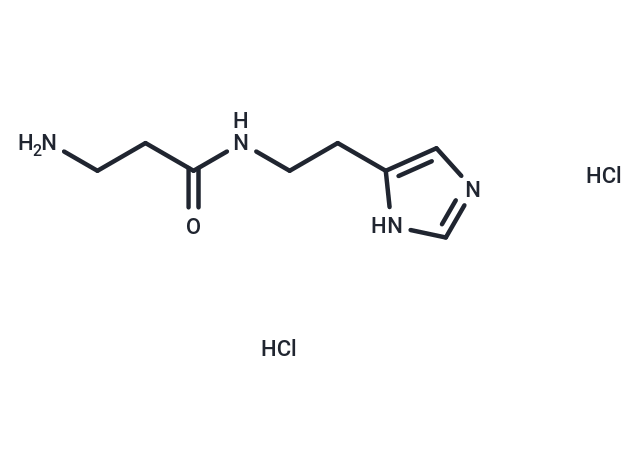
Synonyms: β-Alanylhistamine dihydrochloride
| Pack Size | Price | USA Stock | Global Stock | Quantity |
|---|---|---|---|---|
| 1 mg | $293 | - | In Stock | |
| 5 mg | $722 | - | In Stock | |
| 10 mg | $987 | - | In Stock | |
| 25 mg | $1,520 | - | In Stock | |
| 50 mg | $1,980 | - | In Stock | |
| 100 mg | $2,500 | - | In Stock |
| Description | Carcinine dihydrochloride is a dipeptide compound formed from β-alanine and histamine. As a metabolite of histamine, it acts as a highly selective histamine H3 receptor antagonist and can also serve as a chemical chaperone to reduce non-enzymatic glycation of proteins, thereby maintaining proper protein folding. Carcinine dihydrochloride possesses antioxidant properties and provides neuroprotective effects on the mouse retina in models of oxidative stress. |
| Targets & IC50 | H3 receptor:0.2939 μM (Ki), H2 Receptor:365.3 μM (Ki), H1 Receptor:3621.2 μM (Ki) |
| In vitro | Carcinine (0.5 mM, 16 h) dihydrochloride forms a stable adduct with 4-HNE, with a retention time of 17.5 minutes [1].
Carcinine (1 μg–2 mg, 90 min) dihydrochloride inhibits 4-HNE-induced retinal protein modification in mice, with an IC₅₀ value of 33.2 μg/μL [1]. Carcinine (1 mg, 0–72 h) dihydrochloride reverses preformed 4-HNE-retinal protein adducts [1]. Carcinine (5 mM, 4–8 h) dihydrochloride restores the protein levels of retinal dehydrogenase 12 in 4-HNE-treated mouse retinal explants [1]. Carcinine dihydrochloride exhibits high affinity for histamine H3 receptors (Ki value of 0.2939 μM), while showing lower affinity for H1 receptors (Ki value of 3621.2 μM) and H2 receptors (Ki value of 365.3 μM) [2]. Carcinine (2–50 μM, 22.5 min) dihydrochloride increases K+-induced endogenous 5-HT release in mouse forebrain slices but has no effect on dopamine release [2]. Carcinine (10 mM) dihydrochloride scavenges hydroxyl radicals and inhibits deoxyribonucleic acid damage [3]. Carcinine (10–25 mM, 60 min) dihydrochloride reduces the reduction of linoleic acid 13-hydroperoxide (LOOH) and phosphatidylcholine hydroperoxide (PCOOH) to hydroxyl products (LOH) in PC liposomes [3]. |
| In vivo | Carcinine dihydrochloride (2 M, 1 μL per eye, intravitreal injection, with a 48-hour recovery period prior to light exposure) dihydrochloride has a protective effect on the retinal photoreceptors of BALB/c mice exposed to intense light [1].
Carcinine dihydrochloride (0.2–20 mg/mouse, administered orally once daily for 5 consecutive days) dihydrochloride has a protective effect on the retina of BALB/c mice exposed to intense light [1]. Carcinine dihydrochloride (5–50 mg/kg, administered intraperitoneally) dihydrochloride reduces histamine levels in the cortex and midbrain of ICR mice [2]. Carcinine dihydrochloride (2–20 mg/kg, intraperitoneal injection, administered prior to PTZ treatment) dihydrochloride significantly reduces the severity of p-tetrazolium (PTZ)-induced seizures in ICR mice [2]. Carcinine dihydrochloride (10–20 mg/kg, intraperitoneal injection, administered 30 minutes before scopolamine treatment) dihydrochloride significantly improves scopolamine-induced learning deficits in ICR mice [2]. Carcinine dihydrochloride (10–50 mg/kg, intraperitoneal injection) dihydrochloride increased the total distance traveled in ICR mice [2]. Carcinine dihydrochloride (10–100 μg, administered via cardiac perfusion through a perfusion cannula) dihydrochloride exhibited positive inotropic effects in guinea pigs [4]. |
| Synonyms | β-Alanylhistamine dihydrochloride |
| Molecular Weight | 255.15 |
| Formula | C8H16Cl2N4O |
| Cas No. | 57022-38-5 |
| Smiles | O=C(CCN)NCCC1=CN=CN1.Cl.Cl |
| Storage | Powder: -20°C for 3 years | In solvent: -80°C for 1 year Shipping with blue ice/Shipping at ambient temperature. | |||||||||||||||||||||||||||||||||||
| Solubility Information | H2O: 140 mg/mL (548.7 mM), Sonication is recommended. | |||||||||||||||||||||||||||||||||||
Solution Preparation Table | ||||||||||||||||||||||||||||||||||||
H2O
Note : The dilution table applies only to solid products. For liquid products, please calculate the stock solution based on the stated concentration and/or density. | ||||||||||||||||||||||||||||||||||||
 For example, if the intended dosage is 10 mg/kg for animals weighing 20 g , with a dosing volume of 100 μL per animal, and a total of 10 animals are to be administered, using a formulation of
  10% DMSO+ 40% PEG300+ 5% Tween 80+ 45% Saline/PBS/ddH2O , the resulting working solution concentration would be 2 mg/mL.
Dissolve 2 mg of the compound in 100 μL DMSO to obtain a stock solution at a concentration of 20 mg/mL . If the required concentration exceeds the compound's known solubility, please contact us for technical support before proceeding.
1) Add 100 μL of the DMSO stock solution to 400 µL PEG300 and mix thoroughly until the solution becomes clear.
2) Add 50 µL Tween 80 and mix well until fully clarified.
3) Add 450 µL Saline,PBS or ddH2O and mix thoroughly until a homogeneous solution is obtained.
| Size | Quantity | Unit Price | Amount | Operation |
|---|
 Feedback
 Hello! How can I help you today?
Copyright © 2015-2026 TargetMol Chemicals Inc. All Rights Reserved.
