


Shopping Cart
Remove All Your shopping cart is currently empty

Synonyms:
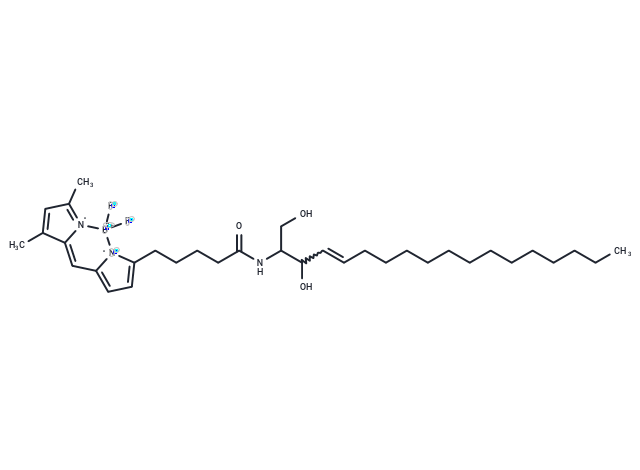
| Pack Size | Price | USA Stock | Global Stock | Quantity |
|---|---|---|---|---|
| 10 mg | Inquiry | Inquiry | Inquiry | |
| 50 mg | Inquiry | Inquiry | Inquiry |
| Description | BODIPY Fl C5-Ceramide is a Golgi-specific green fluorescent dye used to visualize individual cells, with excitation/emission wavelengths at 505 nm/512 nm. The Golgi fluorescent probe, a BODIPY-labeled ceramide derivative, is synthesized in the endoplasmic reticulum and transported to the Golgi via ceramide transport protein (CERT) or vesicular translocation, enabling specific labeling of the dye [1][2]. |
| In vitro | Golgi working solution preparation involves initially creating a 5 mM stock solution using DMSO, which should be stored at -20°C or -80°C, protected from light, to avoid repeated freeze-thaw cycles. For working solution preparation, pre-warmed PBS or culture medium is utilized to make a 1-10 μM Golgi solution, adjusting the concentration as necessary and preparing fresh solutions for immediate use. For suspension cell staining, cells are collected by centrifugation at 1,000 g, 4°C for 3-5 minutes, with the supernatant discarded, followed by two washes with PBS, maintaining a cell density of 1×10^6/mL. Cells are then incubated with 1 mL of Golgi working solution at room temperature for 20-30 minutes, centrifuged at 400 g, 4°C for 3-4 minutes, with the supernatant discarded, and washed twice with PBS. Cells are resuspended in 1 mL serum-free medium or PBS for observation via fluorescence microscopy or flow cytometry. For adherent cell staining, cells are cultured on sterile cover slips, with excess medium removed before applying 100 μL of dye working solution, ensuring full cell coverage, and incubating for 20-30 minutes. The excess dye is removed, followed by two washes with medium, and observed using fluorescence microscopy or flow cytometry. Storage conditions require keeping the solution at -20℃, protected from light for up to a year. It is crucial to adjust the working solution concentration and incubation time based on the specific experimental conditions, use Hanks balanced salt solution if necessary during washing, and ensure the product is solely for scientific research by professional personnel, not used for clinical or therapeutic purposes, food, or drugs. Safety measures should include wearing lab coats and disposable gloves during handling. The above information is based on published literature. Experimental procedures should be appropriately modified to meet specific research demands. |
| Molecular Weight | 601.62 |
| Formula | C34H54BF2N3O3 |
| Cas No. | 133867-53-5 |
| Smiles | C(CCCC(NC(C(C=CCCCCCCCCCCCCC)O)CO)=O)C=1[N-]2C(C=C3[N]([B+3]2([F-])[F-])=C(C)C=C3C)=CC1 |
| Storage | Powder: -20°C for 3 years | In solvent: -80°C for 1 year Shipping with blue ice/Shipping at ambient temperature. |
 For example, if the intended dosage is 10 mg/kg for animals weighing 20 g , with a dosing volume of 100 μL per animal, and a total of 10 animals are to be administered, using a formulation of
  10% DMSO+ 40% PEG300+ 5% Tween 80+ 45% Saline/PBS/ddH2O , the resulting working solution concentration would be 2 mg/mL.
Dissolve 2 mg of the compound in 100 μL DMSO to obtain a stock solution at a concentration of 20 mg/mL . If the required concentration exceeds the compound's known solubility, please contact us for technical support before proceeding.
1) Add 100 μL of the DMSO stock solution to 400 µL PEG300 and mix thoroughly until the solution becomes clear.
2) Add 50 µL Tween 80 and mix well until fully clarified.
3) Add 450 µL Saline,PBS or ddH2O and mix thoroughly until a homogeneous solution is obtained.
| Size | Quantity | Unit Price | Amount | Operation |
|---|
 Feedback
 Hello! How can I help you today?
Copyright © 2015-2026 TargetMol Chemicals Inc. All Rights Reserved.
