


Shopping Cart
Remove All Your shopping cart is currently empty

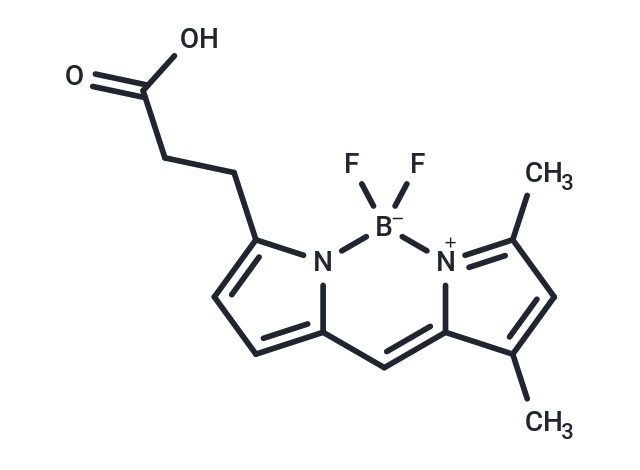
Synonyms: BDP FL acid

| Pack Size | Price | USA Stock | Global Stock | Quantity |
|---|---|---|---|---|
| 1 mg | $72 | In Stock | In Stock | |
| 5 mg | $208 | In Stock | In Stock | |
| 10 mg | $328 | In Stock | In Stock | |
| 25 mg | $563 | In Stock | In Stock | |
| 50 mg | $697 | - | In Stock | |
| 100 mg | $1,070 | - | In Stock | |
| 200 mg | $1,450 | - | In Stock |

| Description | BODIPY-FL (BDP FL acid) is a broad-spectrum and effective fluorescent dye that can be used to label probes or primers and is a compound for the quantitative detection of specific DNA/RNA based on fluorescence bursts.BODIPY-FL-labelled monoterpenes can be used to detect Gram-positive and Gram-negative bacteria as characteristic and pathogenic fungi. |
| In vitro | I. DNA/RNA detection: 1. Primer labeling: BODIPY-FL is chemically labeled with the target DNA primer or RNA probe. After labeling, the primer can be used for real-time PCR or other nucleic acid detection methods. 2. Fluorescence detection: The fluorescence signal changes of BODIPY-FL primers or probes are observed by real-time PCR instruments or fluorescence detectors, and then the quantitative analysis of DNA/RNA is performed. 3. Quantitative analysis: The content of target DNA/RNA is quantified according to the intensity of the fluorescence signal and the reaction curve. II. Bacterial detection 1. Bacterial staining: BODIPY-FL dye is added to the bacterial sample and incubated at 37°C for 30 minutes to 1 hour. 2. Staining observation: BODIPY-FL-labeled bacteria are observed using a fluorescence microscope or flow cytometer, and real-time fluorescence imaging is performed to analyze the bacterial species and their number. 3. Identification of bacteria: Gram-positive and negative bacteria are identified based on the fluorescence characteristics of bacteria (such as color and brightness). 3. Fungal Detection 1. Fungal labeling: BODIPY-FL and fungal samples are stained and labeled by flow cytometry. 2. Microscopic observation: Fluorescent signals in samples are observed using a fluorescence microscope to confirm the fungal species. The above information is based on published literature. Experimental procedures should be appropriately modified to meet specific research demands. |
| Synonyms | BDP FL acid |
| Molecular Weight | 292.089 |
| Formula | C14H15BF2N2O2 |
| Cas No. | 165599-63-3 |
| Smiles | CC1=CC(C)=[N+]2C1=CC1=CC=C(CCC(=O)O)N1[B-]2(F)F |
| Storage | Keep away from direct sunlight Powder: -20°C for 3 years | In solvent: -80°C for 1 year Shipping with blue ice/Shipping at ambient temperature. | |||||||||||||||||||||||||||||||||||
| Solubility Information | DMSO: 100.00 mg/mL (342.36 mM), Sonication is recommended.  | |||||||||||||||||||||||||||||||||||
| In Vivo Formulation | 10% DMSO+40% PEG300+5% Tween 80+45% Saline: < 10 mg/mL (34.24 mM), Lower concentrations may be soluble, but exact solubility limit is unknown. 10% DMSO+90% Saline: < 10 mg/mL (34.24 mM), Lower concentrations may be soluble, but exact solubility limit is unknown. 10% DMSO+90% (20% SBE-β-CD in Saline): < 10 mg/mL (34.24 mM), Lower concentrations may be soluble, but exact solubility limit is unknown. 10% DMSO+90% Corn oil: < 10 mg/mL (34.24 mM), Lower concentrations may be soluble, but exact solubility limit is unknown. Please add the solvents sequentially, clarifying the solution as much as possible before adding the next one. Dissolve by heating and/or sonication if necessary. Working solution is recommended to be prepared and used immediately. The formulation provided above is for reference purposes only. In vivo formulations may vary and should be modified based on specific experimental conditions. | |||||||||||||||||||||||||||||||||||
Solution Preparation Table | ||||||||||||||||||||||||||||||||||||
DMSO
Note : The dilution table applies only to solid products. For liquid products, please calculate the stock solution based on the stated concentration and/or density. | ||||||||||||||||||||||||||||||||||||
 For example, if the intended dosage is 10 mg/kg for animals weighing 20 g , with a dosing volume of 100 μL per animal, and a total of 10 animals are to be administered, using a formulation of
  10% DMSO+ 40% PEG300+ 5% Tween 80+ 45% Saline/PBS/ddH2O , the resulting working solution concentration would be 2 mg/mL.
Dissolve 2 mg of the compound in 100 μL DMSO to obtain a stock solution at a concentration of 20 mg/mL . If the required concentration exceeds the compound's known solubility, please contact us for technical support before proceeding.
1) Add 100 μL of the DMSO stock solution to 400 µL PEG300 and mix thoroughly until the solution becomes clear.
2) Add 50 µL Tween 80 and mix well until fully clarified.
3) Add 450 µL Saline,PBS or ddH2O and mix thoroughly until a homogeneous solution is obtained.
| Size | Quantity | Unit Price | Amount | Operation |
|---|
 Feedback
 Hello! How can I help you today?
Copyright © 2015-2026 TargetMol Chemicals Inc. All Rights Reserved.
