


Shopping Cart
Remove All Your shopping cart is currently empty

Synonyms:

| Pack Size | Price | USA Stock | Global Stock | Quantity |
|---|---|---|---|---|
| 500 µg | $152 | - | In Stock | |
| 1 mg | $243 | - | In Stock | |
| 5 mg | $768 | - | In Stock | |
| 10 mg | $1,080 | - | In Stock | |
| 25 mg | $1,630 | - | In Stock | |
| 50 mg | $2,190 | - | In Stock | |
| 1 mL x 10 mM (in DMSO) | $717 | - | In Stock |
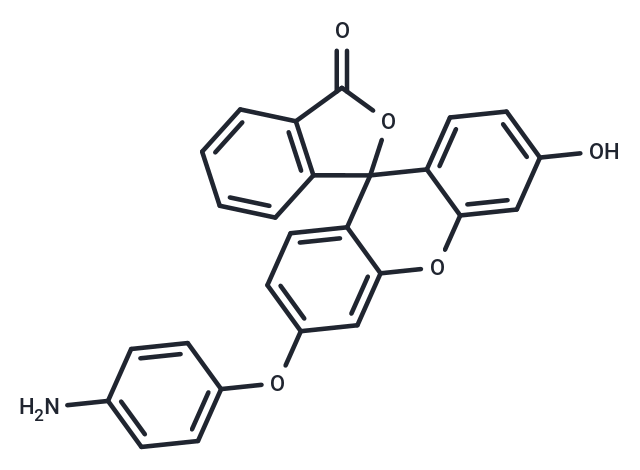
| Description | APF is an aromatic amino-fluorescein derivative that serves as a highly specific fluorescent probe for detecting highly reactive radicals, exhibiting low intrinsic fluorescence but converting into strongly fluorescent fluorescein upon oxidation by hydroxyl radicals, hypochlorite ions, and selected peroxidase intermediates. APF remain unreactive to nitric oxide and hydrogen peroxide, while with fluorescein displays excitation and emission maxima of 490 nm and 515 nm, respectively, enabling sensitive visualization of oxidative stress in biological systems. |
| In vitro | In cellular assays for detecting Reactive Oxygen Species (ROS), APF was utilized at a working concentration of 1-10 μM. The probe effectively stained both suspension and adherent cells when incubated at 37°C for 20-60 minutes in serum-free media or PBS. This staining allowed for subsequent detection via fluorescence microscopy or flow cytometry [1]. |
| Molecular Weight | 423.42 |
| Formula | C26H17NO5 |
| Cas No. | 359010-70-1 |
| Smiles | O=C1OC2(C3=CC=C(O)C=C3OC4=CC(OC5=CC=C(N)C=C5)=CC=C42)C=6C=CC=CC16 |
| Storage | Keep away from direct sunlight Store at -20°C Shipping with blue ice/Shipping at ambient temperature. | |||||||||||||||||||||||||
| Solubility Information | DMF: 20 mg/mL (47.23 mM), Sonication is recommended. DMSO: 8 mg/mL (18.89 mM), Sonication is recommended. Ethanol:PBS (pH 7.2)(1:3): 0.5 mg/mL (1.18 mM), Sonication is recommended. Ethanol: 10 mg/mL (23.62 mM), Sonication is recommended. | |||||||||||||||||||||||||
Solution Preparation Table | ||||||||||||||||||||||||||
DMSO/Ethanol/DMF
Ethanol/DMF
Note : The dilution table applies only to solid products. For liquid products, please calculate the stock solution based on the stated concentration and/or density. | ||||||||||||||||||||||||||
 For example, if the intended dosage is 10 mg/kg for animals weighing 20 g , with a dosing volume of 100 μL per animal, and a total of 10 animals are to be administered, using a formulation of
  10% DMSO+ 40% PEG300+ 5% Tween 80+ 45% Saline/PBS/ddH2O , the resulting working solution concentration would be 2 mg/mL.
Dissolve 2 mg of the compound in 100 μL DMSO to obtain a stock solution at a concentration of 20 mg/mL . If the required concentration exceeds the compound's known solubility, please contact us for technical support before proceeding.
1) Add 100 μL of the DMSO stock solution to 400 µL PEG300 and mix thoroughly until the solution becomes clear.
2) Add 50 µL Tween 80 and mix well until fully clarified.
3) Add 450 µL Saline,PBS or ddH2O and mix thoroughly until a homogeneous solution is obtained.
| Size | Quantity | Unit Price | Amount | Operation |
|---|
 Feedback
 Hello! How can I help you today?
Copyright © 2015-2026 TargetMol Chemicals Inc. All Rights Reserved.
