


Shopping Cart
Remove All Your shopping cart is currently empty

Synonyms: Q702
| Pack Size | Price | USA Stock | Global Stock | Quantity |
|---|---|---|---|---|
| 25 mg | $2,120 | 8-10 weeks | 8-10 weeks | |
| 50 mg | $2,780 | 8-10 weeks | 8-10 weeks | |
| 100 mg | $3,700 | 8-10 weeks | 8-10 weeks |
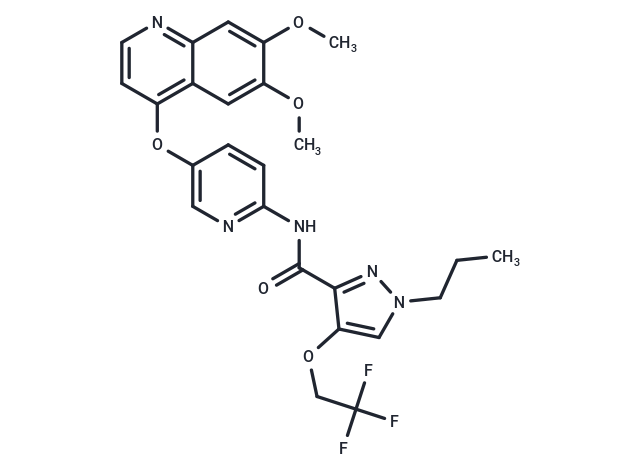
| Description | Adrixetinib (Q702) is an orally active triple inhibitor against CSF1R, Mer, and Axl, with Kd values of 8.7 nM, 0.8 nM, and 0.3 nM, respectively. Adrixetinib (Q702) acts as a potent immune modulator that remodels the tumor microenvironment, increasing M1 macrophages and CD8⁺ T cells while decreasing M2 macrophages and myeloid-derived suppressor cells (MDSCs). Adrixetinib (Q702) upregulates MHC class I and E-cadherin in tumor cells and shows efficacy in syngeneic mouse tumor models. Adrixetinib (Q702) is utilized in oncology research focused on tumor microenvironment reprogramming, macrophage polarization dynamics, and immune cell infiltration in breast cancer, renal adenocarcinoma, colon carcinoma, and melanoma models. |
| Targets & IC50 | Mer:0.8 nM (Kd), Axl:0.3 nM (Kd) |
| In vitro | Methods:Target inhibitory activity was detected via in vitro kinase assay. Multiple tumor cell lines were pretreated with gradient drug concentrations, and phosphorylation levels of pathway proteins were determined. The effects of the compound on tumor cell proliferation and viability were evaluated. Results: 1.After 1-hour incubation, adrixetinib potently inhibited Axl, Mer and CSF1R kinases with IC₅₀ values of 0.3 nM, 0.8 nM and 8.7 nM respectively. 2.Adrixetinib blocked ligand-induced phosphorylation of Axl, Mer, CSF1R and downstream pathway proteins in a concentration-dependent manner. 3.Adrixetinib reduced EMT6 cell viability after 72-hour treatment with an IC₅₀ of 8.4 μM. It suppressed M-NFS-60 cell proliferation via inhibiting CSF1R pathway, with the IC₅₀ lower than 1.0 μM [1-2]. |
| In vivo | Methods:Multiple allogeneic and syngeneic mouse tumor models were established. Oral administration was performed at diverse doses and cycles. Target phosphorylation, tumor growth, gene expression, immune cell infiltration and levels of related molecules and cytokines were detected. Results: 1.Oral administration of adrixetinib at 30 mg/kg daily for 7 days inhibited the phosphorylation of Axl and CSF1R in xenograft tumors of nude mice. 2.Treatment with adrixetinib at 10–100 mg/kg for 14 days suppressed breast tumor growth in a dose-dependent manner, with tumor inhibition rates ranging from 54.3% to 84.6%. 3.Adrixetinib regulated tumor gene expression and reshaped intratumoral immune composition. It upregulated MHC-I and E-cadherin to form an immune-activated microenvironment. 4.The drug promoted secretion of IFN-γ and granzyme B, enhanced cytotoxicity of T cells and NK cells, increased intratumoral infiltration of CD8⁺ T cells and reduced myelocyte accumulation. 5.Adrixetinib exerted prominent anti-tumor effects on multiple mouse tumor models including melanoma and colorectal carcinoma, with tumor growth inhibition rates of 64%–77% [1]. |
| Synonyms | Q702 |
| Molecular Weight | 531.48 |
| Formula | C25H24F3N5O5 |
| Cas No. | 2394874-66-7 |
| Smiles | O=C(NC1=NC=C(OC=2C=CN=C3C=C(OC)C(OC)=CC32)C=C1)C4=NN(C=C4OCC(F)(F)F)CCC |
| Storage | Keep away from moisture,Keep away from direct sunlight, Powder: -20°C for 3 years | In solvent: -80°C for 1 year Shipping with blue ice/Shipping at ambient temperature. | |||||||||||||||||||||||||||||||||||
| Solubility Information | DMSO: 80 mg/mL (150.52 mM), Sonication is recommended. | |||||||||||||||||||||||||||||||||||
Solution Preparation Table | ||||||||||||||||||||||||||||||||||||
DMSO
Note : The dilution table applies only to solid products. For liquid products, please calculate the stock solution based on the stated concentration and/or density. | ||||||||||||||||||||||||||||||||||||
 For example, if the intended dosage is 10 mg/kg for animals weighing 20 g , with a dosing volume of 100 μL per animal, and a total of 10 animals are to be administered, using a formulation of
  10% DMSO+ 40% PEG300+ 5% Tween 80+ 45% Saline/PBS/ddH2O , the resulting working solution concentration would be 2 mg/mL.
Dissolve 2 mg of the compound in 100 μL DMSO to obtain a stock solution at a concentration of 20 mg/mL . If the required concentration exceeds the compound's known solubility, please contact us for technical support before proceeding.
1) Add 100 μL of the DMSO stock solution to 400 µL PEG300 and mix thoroughly until the solution becomes clear.
2) Add 50 µL Tween 80 and mix well until fully clarified.
3) Add 450 µL Saline,PBS or ddH2O and mix thoroughly until a homogeneous solution is obtained.
| Size | Quantity | Unit Price | Amount | Operation |
|---|
 Feedback
 Hello! How can I help you today?
Copyright © 2015-2026 TargetMol Chemicals Inc. All Rights Reserved.
