


Shopping Cart
Remove All Your shopping cart is currently empty


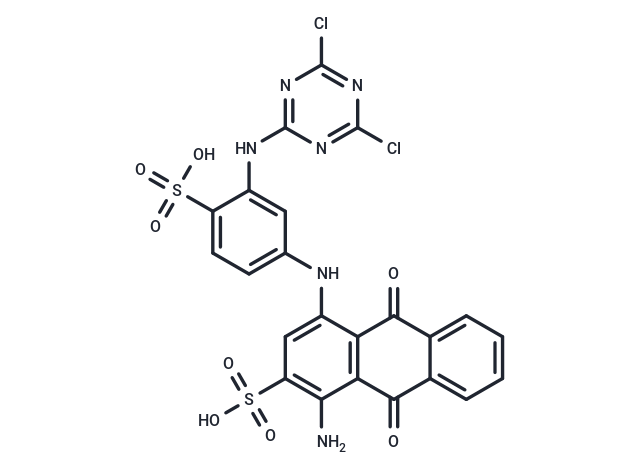
Reactive Blue 4, an anthraquinone dye, exhibits phytotoxic, cytotoxic, and genotoxic properties. It functions as a single colorimetric chemosensor for the sequential detection of multiple analytes, each with distinct optical responses, in aqueous media.
| Pack Size | Price | USA Warehouse | Global Warehouse | Quantity |
|---|---|---|---|---|
| 2 g | $30 | - | In Stock | |
| 1 mL x 10 mM (in DMSO) | $29 | In Stock | In Stock |
| Description | Reactive Blue 4, an anthraquinone dye, exhibits phytotoxic, cytotoxic, and genotoxic properties. It functions as a single colorimetric chemosensor for the sequential detection of multiple analytes, each with distinct optical responses, in aqueous media. |
| Cell Research | Instructions I. Solution preparation 1. Stock solution: Dissolve Reactive Blue 4 in deionized water or an appropriate solvent (such as ethanol, PBS) to prepare a stock solution with a concentration of 1–10 mM. 2. Working solution: Dilute the stock solution to a working concentration according to the experimental requirements, usually 0.1–1 mM. Deionized water or buffer solution can be used for dilution. II. Operation steps 1. Water quality analysis: Since Reactive Blue 4 can react with a variety of analytes under different optical responses, it is usually used for water quality testing. Add the working solution to the sample and measure the absorbance by colorimetry (spectrophotometer can be used). 2. Cell or biological tissue staining: Incubate cells or tissues with an appropriate concentration of dye (usually 1–10 µM) and stain for a specified time. After staining, the reaction signal in the cell can be analyzed by microscope or flow cytometer. 3. Surfactant determination: Use this dye as a sensor in aqueous solution to monitor the concentration of surfactant in water. The concentration of the pollutant can be inferred by the change in the absorbance of the dye. 4. Fluorescence detection: Excitation and emission wavelengths: Reactive Blue 4 can be excited in the UV or visible light band, with a commonly used excitation wavelength of 480–500 nm and an emission wavelength of approximately 590 nm. Use a spectrophotometer or fluorescence microscope to observe the stained samples. 5. Calibration and control: 1) Control group: A control group without dye is set up to ensure the specificity of the experiment. 2) Standard curve: A standard curve can be established using samples of known concentrations of analytes to quantitatively analyze the sensitivity and specificity of the reaction. Precautions: 1. Toxicity: Reactive Blue 4 is phytotoxic, cytotoxic, and genotoxic, so appropriate safety measures should be taken when using it, such as wearing protective gloves and glasses, and operating in a well-ventilated environment. 2. Photosensitivity: The dye is light-sensitive and should be avoided from prolonged exposure to strong light. 3. Storage conditions: It should be stored in a cool and dry place, at a temperature not exceeding 4°C, and avoid repeated freezing and thawing. 4. Solubility: The dye has good solubility in water, but it should be ensured that there are no particles in the solution. The above information is based on published literature. Experimental procedures should be appropriately modified to meet specific research demands. |
| Molecular Weight | 637.43 |
| Formula | C23H14Cl2N6O8S2 |
| Cas No. | 13324-20-4 |
| Smiles | Nc1c(cc(Nc2ccc(c(Nc3nc(Cl)nc(Cl)n3)c2)S(O)(=O)=O)c2C(=O)c3ccccc3C(=O)c12)S(O)(=O)=O |
| Relative Density. | 1.5315 g/cm3 (Estimated) |
| Storage | keep away from direct sunlight | Powder: -20°C for 3 years | In solvent: -80°C for 1 year | Shipping with blue ice/Shipping at ambient temperature. | |||||||||||||||||||||||||||||||||||
| Solubility Information | DMSO: 83.33 mg/mL (130.73 mM), Sonication is recommended. | |||||||||||||||||||||||||||||||||||
| In Vivo Formulation | 10% DMSO+40% PEG300+5% Tween-80+45% Saline: 3.3 mg/mL (5.18 mM), Sonication is recommended. Please add the solvents sequentially, clarifying the solution as much as possible before adding the next one. Dissolve by heating and/or sonication if necessary. Working solution is recommended to be prepared and used immediately. The formulation provided above is for reference purposes only. In vivo formulations may vary and should be modified based on specific experimental conditions. | |||||||||||||||||||||||||||||||||||
Solution Preparation Table | ||||||||||||||||||||||||||||||||||||
DMSO
| ||||||||||||||||||||||||||||||||||||
 For example, if the intended dosage is 10 mg/kg for animals weighing 20 g , with a dosing volume of 100 μL per animal, and a total of 10 animals are to be administered, using a formulation of
  10% DMSO+ 40% PEG300+ 5% Tween 80+ 45% Saline/PBS/ddH2O , the resulting working solution concentration would be 2 mg/mL.
Dissolve 2 mg of the compound in 100 μL DMSO to obtain a stock solution at a concentration of 20 mg/mL . If the required concentration exceeds the compound's known solubility, please contact us for technical support before proceeding.
1) Add 100 μL of the DMSO stock solution to 400 μL PEG300 and mix thoroughly until the solution becomes clear.
2) Add 50 μL Tween 80 and mix well until fully clarified.
3) Add 450 μL Saline,PBS or ddH2O and mix thoroughly until a homogeneous solution is obtained.

| Size | Quantity | Unit Price | Amount | Operation |
|---|
 Feedback
 Hello! How can I help you today?
Copyright © 2015-2026 TargetMol Chemicals Inc. All Rights Reserved.
