


Shopping Cart
Remove All Your shopping cart is currently empty

Synonyms: DI591
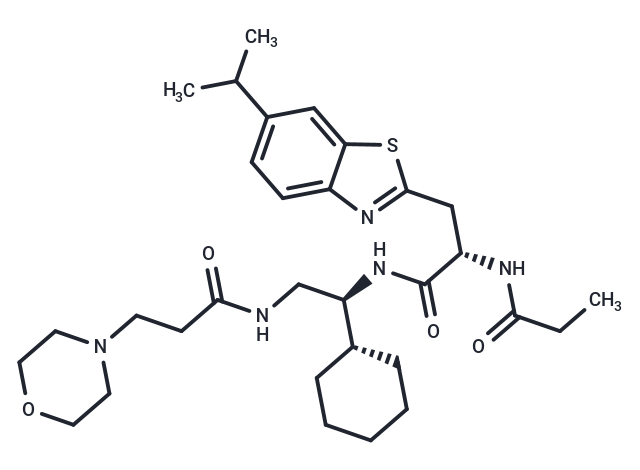
| Pack Size | Price | USA Stock | Global Stock | Quantity |
|---|---|---|---|---|
| 1 mg | $299 | - | In Stock |
| Description | DI-591 is a potent, high-affinity, cell-penetrant inhibitor of the DCN1‑UBC12 interaction. It binds to DCN1 and DCN2 with Ki values of 12 nM and 10.4 nM, respectively, while showing little to no binding to DCN3, DCN4, and DCN5. DI-591 selectively inhibits neddylation of cullin 3 without significant or only weak effects on other cullin family members. |
| In vitro | Methods: In vitro binding assays were used to detect the binding affinity of DI-591 with DCN family proteins. Its effects on protein binding, downstream gene and protein expression were investigated in KYSE70 and THLE2 cells, respectively. The regulatory mechanism of cullin neddylation and NRF2 pathway was explored via knockdown experiments. Results: DI-591 bound to DCN1 and DCN2 with Kᵢ values of 12 nM and 10.4 nM, respectively, and showed no obvious binding to DCN3‑5. The selectivity for DCN1/2 over DCN3‑5 was more than 1000‑fold.DI-591 (0–10 μM, 1 h) bound to intracellular DCN1/2 in KYSE70 cells and disrupted the interaction between DCN1 and UBC12.Treatment of THLE2 cells with DI-591 (10 μM, 24 h) significantly upregulated mRNA levels of NQO1, HO1 and protein level of HO1, but had no effect on NRF2 mRNA.DI-591 selectively inhibited neddylation of Cullin 3, thereby promoting NRF2 protein accumulation and activating its transcription. Knockdown experiments revealed that DCN1 (but not DCN2) specifically regulated neddylation of Cullin 3. DI-591 can serve as a high‑quality probe compound for studying the roles of Cullin 3‑type CRL ubiquitin ligases in biological processes and human diseases [1]. |
| Synonyms | DI591 |
| Molecular Weight | 585.80 |
| Formula | C31H47N5O4S |
| Cas No. | 2245887-38-9 |
| Smiles | C([C@@H](C(N[C@H](CNC(CCN1CCOCC1)=O)[C@@H]2CCCCC2)=O)NC(CC)=O)C=3SC=4C(N3)=CC=C(C(C)C)C4 |
| Relative Density. | 1.169 g/cm3 (Predicted) |
| Storage | Powder: -20°C for 3 years | In solvent: -80°C for 1 year Shipping with blue ice/Shipping at ambient temperature. | ||||||||||||||||||||
| Solubility Information | H2O: < 1 mg/mL (insoluble) DMSO: 10.00 mg/mL (17.07 mM), Sonication is recommended. | ||||||||||||||||||||
Solution Preparation Table | |||||||||||||||||||||
DMSO
Note : The dilution table applies only to solid products. For liquid products, please calculate the stock solution based on the stated concentration and/or density. | |||||||||||||||||||||
 For example, if the intended dosage is 10 mg/kg for animals weighing 20 g , with a dosing volume of 100 μL per animal, and a total of 10 animals are to be administered, using a formulation of
  10% DMSO+ 40% PEG300+ 5% Tween 80+ 45% Saline/PBS/ddH2O , the resulting working solution concentration would be 2 mg/mL.
Dissolve 2 mg of the compound in 100 μL DMSO to obtain a stock solution at a concentration of 20 mg/mL . If the required concentration exceeds the compound's known solubility, please contact us for technical support before proceeding.
1) Add 100 μL of the DMSO stock solution to 400 µL PEG300 and mix thoroughly until the solution becomes clear.
2) Add 50 µL Tween 80 and mix well until fully clarified.
3) Add 450 µL Saline,PBS or ddH2O and mix thoroughly until a homogeneous solution is obtained.
| Size | Quantity | Unit Price | Amount | Operation |
|---|
 Feedback
 Hello! How can I help you today?
Copyright © 2015-2026 TargetMol Chemicals Inc. All Rights Reserved.
