


Shopping Cart
Remove All Your shopping cart is currently empty

Synonyms:
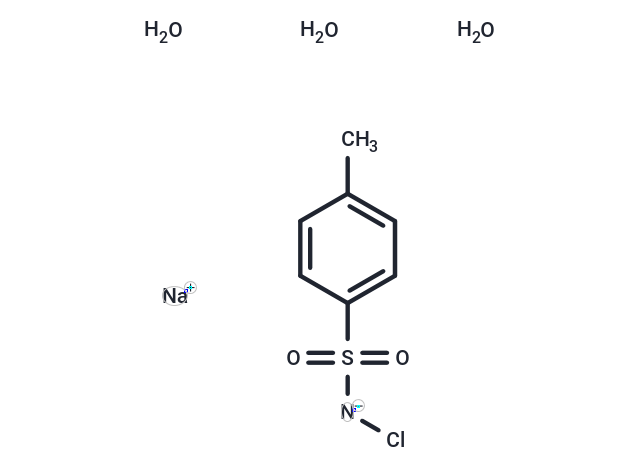
| Pack Size | Price | USA Stock | Global Stock | Quantity |
|---|---|---|---|---|
| 50 mg | Inquiry | 7-10 days | 7-10 days | |
| 100 mg | Inquiry | 7-10 days | 7-10 days |
| Description | Tosylchloramide sodium trihydrate is an agent of disinfectant. It is also used as a biocide in air fresheners and deodorants. |
| In vitro | Tosylchloramide effectively suppresses both Gram-positive bacterial growth and E. coli (gram-negative; with/without serum) proliferation. Gram-positive bacteria are diminished by 95-100% across all dosages and in the presence or absence of serum. For E. coli, reductions of 94-100% occur at antiseptic levels of 300 and 400 ppm. At a lower concentration of 200 ppm, E. coli growth is completely halted without serum and reduced by 50% when serum is present. Moreover, at concentrations of 100 and 200 ppm, cell viability exceeds 90% regardless of the experimental conditions. A brief, 3-minute exposure to a 300-ppm concentration of tosylchloramide maintains up to 70% cell viability, although extended exposure further diminishes viability. Notably, serum exposure does not influence cell viability under any tested conditions[1]. |
| In vivo | In rat tissues, significant dose-dependent DNA damage and inflammation were observed histopathologically around the terminal airways of the lung in both sexes after exposure to tosylchloramide. Additionally, a 24-hour exposure to 50 mg/L of chloramine-T was found toxic to crayfish, causing a significant energy loss evident during subsequent physical stress tests. Tosylchloramide has been noted to potentially enhance the toxicity of various xenobiotics through metabolic activation and/or the accumulation of reactive metabolites. Specifically, the activities of enzymes CYP2E1, CYP1A1/2, CYP2B1/2, CYP3A4, and CYP4A1/2 significantly increased in a dose-dependent manner with tosylchloramide doses of 2.50, 5, and 10 mg/kg bw/day. This increase in enzyme activity was not observed at a lower dose of 1.25 mg/kg bw/day. |
| Molecular Weight | 246.66 |
| Formula | C7H10ClNNaO3S |
| Cas No. | 7080-50-4 |
| Smiles | O.O.O.[Na+].Cc1ccc(cc1)S(=O)(=O)[N-]Cl |
| Relative Density. | 1.43 g/cm3 |
| Storage | Powder: -20°C for 3 years | In solvent: -80°C for 1 year Shipping with blue ice/Shipping at ambient temperature. |
 For example, if the intended dosage is 10 mg/kg for animals weighing 20 g , with a dosing volume of 100 μL per animal, and a total of 10 animals are to be administered, using a formulation of
  10% DMSO+ 40% PEG300+ 5% Tween 80+ 45% Saline/PBS/ddH2O , the resulting working solution concentration would be 2 mg/mL.
Dissolve 2 mg of the compound in 100 μL DMSO to obtain a stock solution at a concentration of 20 mg/mL . If the required concentration exceeds the compound's known solubility, please contact us for technical support before proceeding.
1) Add 100 μL of the DMSO stock solution to 400 µL PEG300 and mix thoroughly until the solution becomes clear.
2) Add 50 µL Tween 80 and mix well until fully clarified.
3) Add 450 µL Saline,PBS or ddH2O and mix thoroughly until a homogeneous solution is obtained.
| Size | Quantity | Unit Price | Amount | Operation |
|---|
 Feedback
 Hello! How can I help you today?
Copyright © 2015-2026 TargetMol Chemicals Inc. All Rights Reserved.
