


Shopping Cart
Remove All Your shopping cart is currently empty

Synonyms: Tat-Cold-inducible RNA Binding Protein
| Pack Size | Price | USA Stock | Global Stock | Quantity |
|---|---|---|---|---|
| 1 mg | $105 | Inquiry | Inquiry | |
| 5 mg | $447 | Inquiry | Inquiry | |
| 10 mg | $840 | Inquiry | Inquiry |
| Description | Tat-CIRP, a peptide inhibitor, impedes the protein-protein interaction between myeloid differentiation 2 (MD-2), also known as lymphocyte antigen 96 (LY96), and cold-inducible RNA binding protein (CIRP) by binding to MD-2. This disrupts the MD-2 and CIRP interaction as confirmed in co-immunoprecipitation assays. Notably, in vivo studies reveal that Tat-CIRP, at dosages of 10 and 20 mg/kg, significantly reduces infarct volume in both a mouse model of middle cerebral artery occlusion (MCAO) and a rhesus monkey model of thrombosis-induced stroke. Additionally, it improves motor function, evidenced by decreased time to manipulate and withdraw food with the affected arm in the primate model. |
| Synonyms | Tat-Cold-inducible RNA Binding Protein |
| Molecular Weight | 2997.30 |
| Formula | C123H206N56O33.XCF3COOH |
| Smiles | OC(C(F)(F)F)=O.O=C(NCC(N[C@@H](CCCNC(N)=N)C(N[C@@H](CCCCN[H])C(N[C@@H](CCCCN[H])C(N[C@@H](CCCNC(N)=N)C(N[C@@H](CCCNC(N)=N)C(N[C@@H](CCC(N)=O)C(N[C@@H](CCCNC(N)=N)C(N[C@@H](CCCNC(N)=N)C(N[C@@H](CCCNC(N)=N)C(NCC(N[C@@H](CCCNC(N)=N)C(NCC(N[C@H](C(N[C@@H](CO)C(N[C@@H](CCCNC(N)=N)C(NCC(NCC(NCC(N[C@@H](CC(O)=O)C(N[C@@H](CCCNC(N)=N)C(NCC(N[C@@H](CC1=CC=C(O)C=C1)C(NCC(NCC(O)=O)=O)=O)=O)=O)=O)=O)=O)=O)=O)=O)=O)CC2=CC=CC=C2)=O)=O)=O)=O)=O)=O)=O)=O)=O)=O)=O)=O)=O)[C@H](CC3=CC=C(O)C=C3)N[H] |
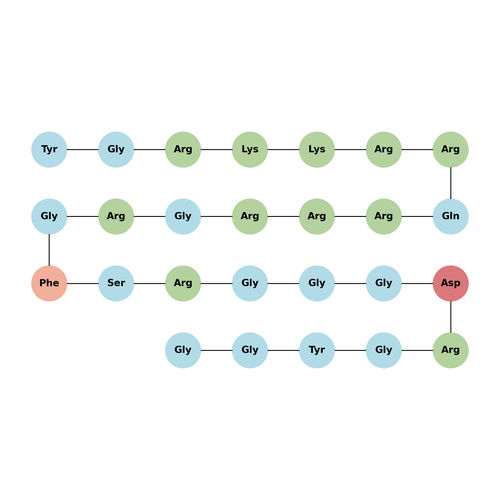
| Sequence | Tyr-Gly-Arg-Lys-Lys-Arg-Arg-Gln-Arg-Arg-Arg-Gly-Arg-Gly-Phe-Ser-Arg-Gly-Gly-Gly-Asp-Arg-Gly-Tyr-Gly-Gly |
| Sequence Short | YGRKKRRQRRRGRGFSRGGGDRGYGG |
| Storage | Keep away from moisture Powder: -20°C for 3 years | In solvent: -80°C for 1 year Shipping with blue ice/Shipping at ambient temperature. |
| Solubility Information | H2O: soluble |
 For example, if the intended dosage is 10 mg/kg for animals weighing 20 g , with a dosing volume of 100 μL per animal, and a total of 10 animals are to be administered, using a formulation of
  10% DMSO+ 40% PEG300+ 5% Tween 80+ 45% Saline/PBS/ddH2O , the resulting working solution concentration would be 2 mg/mL.
Dissolve 2 mg of the compound in 100 μL DMSO to obtain a stock solution at a concentration of 20 mg/mL . If the required concentration exceeds the compound's known solubility, please contact us for technical support before proceeding.
1) Add 100 μL of the DMSO stock solution to 400 µL PEG300 and mix thoroughly until the solution becomes clear.
2) Add 50 µL Tween 80 and mix well until fully clarified.
3) Add 450 µL Saline,PBS or ddH2O and mix thoroughly until a homogeneous solution is obtained.
| Size | Quantity | Unit Price | Amount | Operation |
|---|
 Feedback
 Hello! How can I help you today?
Copyright © 2015-2026 TargetMol Chemicals Inc. All Rights Reserved.
