


Shopping Cart
Remove All Your shopping cart is currently empty

Synonyms:
| Pack Size | Price | USA Stock | Global Stock | Quantity |
|---|---|---|---|---|
| 25 mg | $1,439 | 6-8 weeks | 6-8 weeks | |
| 50 mg | $2,539 | 6-8 weeks | 6-8 weeks | |
| 100 mg | $4,169 | 6-8 weeks | 6-8 weeks |
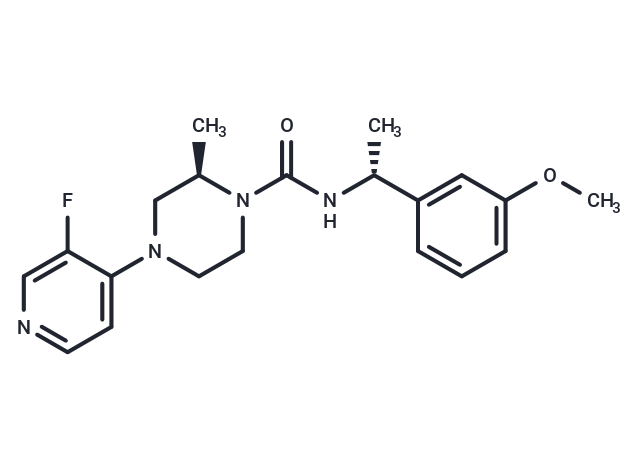
| Description | Rho-Kinase-IN-2 (Compound 23) is an orally active and selective inhibitor of Rho Kinase (ROCK) with CNS penetration, exhibiting a high affinity for ROCK2 with an IC50 of 3 nM. This compound is of potential interest for further investigations in Huntington's disease research [1]. |
| Targets & IC50 | ROCK2:3 nM |
| In vitro | Treatment with Rho-Kinase-IN-2 (0-10 mM) for 1 hour led to concentration-dependent alterations in phosphorylation levels, specifically an increase in AKT phosphorylation and a decrease in MYPT1 phosphorylation, observed across A7r5 and PANC1 cell lines. Western Blot Analysis confirmed these effects, quantifying the potency of Rho-Kinase-IN-2 in modulating AKT and MYPT1 phosphorylation with EC50 and IC50 values of 28 nM and 14 nM, respectively. |
| In vivo | Administering Rho-Kinase-IN-2 orally at 10 mg/kg six times at intervals of 0.5, 1, 2, 4, 8, and 12 hours demonstrated a dose- and time-dependent engagement with ROCK1 and ROCK2 targets. Similar administration at doses of 10 or 20 mg/kg, either once daily (QD) or twice daily (BID) for two weeks, exhibited excellent tolerability. A single dose ranging from 1-20 mg/kg revealed a direct dose- and time-dependent correlation between brain exposure and MYPT1 phosphorylation status. Moreover, a single administration at 10 or 20 mg/kg resulted in decreased mean arterial, systolic, diastolic blood pressures, and heart rate. Continuous treatment at 10 mg/kg twice daily for 90 days led to lower-than-expected brain concentrations. These findings were consistent across various animal models, including male C57BL/6 mice, 3-4-month-old heterozygote Q175DN KI and wild-type littermate mice, heterozygote HTT zQ175DN knock-in mice, and CD1 mice, demonstrating the compound’s pharmacodynamics and pharmacokinetics profiles in preclinical settings. |
| Molecular Weight | 372.44 |
| Formula | C20H25FN4O2 |
| Cas No. | 2573071-18-6 |
| Smiles | FC=1C(N2C[C@@H](C)N(C(N[C@H](C)C3=CC(OC)=CC=C3)=O)CC2)=CC=NC1 |
| Storage | Powder: -20°C for 3 years | In solvent: -80°C for 1 year Shipping with blue ice/Shipping at ambient temperature. |
 For example, if the intended dosage is 10 mg/kg for animals weighing 20 g , with a dosing volume of 100 μL per animal, and a total of 10 animals are to be administered, using a formulation of
  10% DMSO+ 40% PEG300+ 5% Tween 80+ 45% Saline/PBS/ddH2O , the resulting working solution concentration would be 2 mg/mL.
Dissolve 2 mg of the compound in 100 μL DMSO to obtain a stock solution at a concentration of 20 mg/mL . If the required concentration exceeds the compound's known solubility, please contact us for technical support before proceeding.
1) Add 100 μL of the DMSO stock solution to 400 µL PEG300 and mix thoroughly until the solution becomes clear.
2) Add 50 µL Tween 80 and mix well until fully clarified.
3) Add 450 µL Saline,PBS or ddH2O and mix thoroughly until a homogeneous solution is obtained.
| Size | Quantity | Unit Price | Amount | Operation |
|---|
 Feedback
 Hello! How can I help you today?
Copyright © 2015-2026 TargetMol Chemicals Inc. All Rights Reserved.
