


Shopping Cart
Remove All Your shopping cart is currently empty


Synonyms:
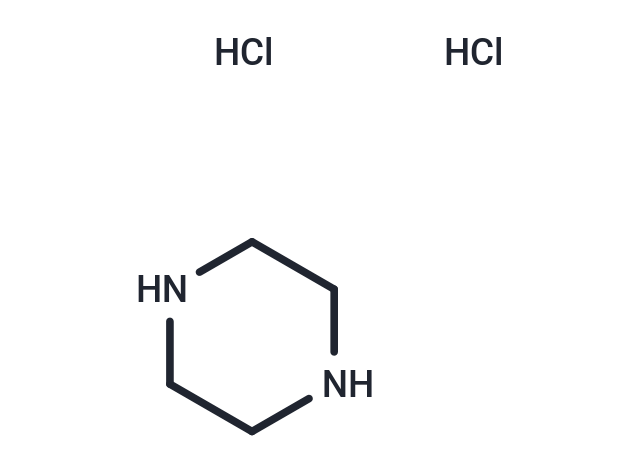

| Description | Piperazine (2HCl) is gamma-aminobutyric acid (GABA) agonists and its major effects appear to be on the central nervous system. Piperazine was the anthelmintic with the greatest number of reports of toxicoses and suspected toxicoses in cats. Piperazine neurotoxicity in cats and dogs usually was manifested by muscle tremors, ataxia, and/or behavioral disturbances within 24 hours after estimated daily dose(s) between 20 and 110 mg/kg[1]. For di-substituted derivatives, ciprofloxacin was selected and hybrids were synthesized via substitution at piperazinyl-N4. The reaction of piperazinyl-NH of ciprofloxacin with selected drugs resulted in pronounced growth inhibition of standard as well as resistant bacterial strains[2]. The parent piperazine 6 was found to exhibit a reasonable activity toward the HeLa and MDA MB 231 tumor cell lines (IC50= 9.2 and 8.4 μΜ, respectively)[3]. Piperazine adipate (10 mM) causes mortality of A. galli and H. gallinae after a maximum of 30 min exposure, inhibits malate oxidation by 78%, and inhibits aldolase activity in both parasites. Piperazine adipate (10 mM) also inhibits cholinesterase activity by 96% in Ascaridia galli (A. galli) and 93% in Heterakis gallinae (H. gallinae). Piperazine adipate inhibits oxaloacetate reduction by 26% and 55% in A. galli and H. gallinae, resepctively[4]. |
| Molecular Weight | 159.05 |
| Formula | C4H12Cl2N2 |
| Cas No. | 142-64-3 |
| Smiles | Cl.Cl.C1CNCCN1 |
| Storage | Powder: -20°C for 3 years | In solvent: -80°C for 1 year Shipping with blue ice/Shipping at ambient temperature. |
 For example, if the intended dosage is 10 mg/kg for animals weighing 20 g , with a dosing volume of 100 μL per animal, and a total of 10 animals are to be administered, using a formulation of
  10% DMSO+ 40% PEG300+ 5% Tween 80+ 45% Saline/PBS/ddH2O , the resulting working solution concentration would be 2 mg/mL.
Dissolve 2 mg of the compound in 100 μL DMSO to obtain a stock solution at a concentration of 20 mg/mL . If the required concentration exceeds the compound's known solubility, please contact us for technical support before proceeding.
1) Add 100 μL of the DMSO stock solution to 400 µL PEG300 and mix thoroughly until the solution becomes clear.
2) Add 50 µL Tween 80 and mix well until fully clarified.
3) Add 450 µL Saline,PBS or ddH2O and mix thoroughly until a homogeneous solution is obtained.
| Size | Quantity | Unit Price | Amount | Operation |
|---|
 Feedback
 Hello! How can I help you today?
Copyright © 2015-2026 TargetMol Chemicals Inc. All Rights Reserved.
