


Shopping Cart
Remove All Your shopping cart is currently empty

Synonyms:
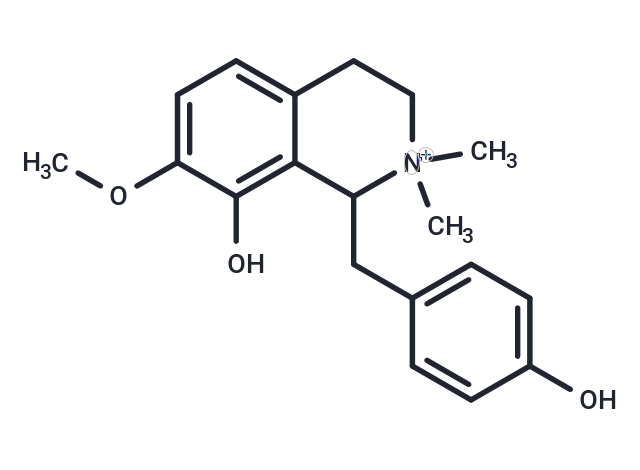
| Pack Size | Price | USA Stock | Global Stock | Quantity |
|---|---|---|---|---|
| 5 mg | Inquiry | Inquiry | Inquiry |
| Description | Oblongine chloride may have potential haemodynamic effects, it can cause a dose-dependent reduction of systolic and diastolic blood pressure, and that these effects are not mediated by α2-adrenergic receptor stimulation. |
| In vitro | Oblongine chloride (3 x 10(-5)-10(-3) M) caused concentration-dependent relaxation of ileum, an effect which was not blocked by propranolol (10(-6) M) alone or in combination with prazosin (3 x 10(-8) M), or by indomethacin (10(-6) M), but was reduced by desensitization of the preparation by prior exposure to 3 x 10(-5) M ATP and, at high concentrations of Oblongine, by a combination of propranolol and yohimbine (3 x 10(-6) M). 3. Oblongine chloride (10(-5)-3 x 10(-3) M) caused concentration-dependent relaxation of epinephrine-precontracted pulmonary artery. This effect was not affected by propranolol or by indomethacin but was significantly attenuated by pretreatment with 3 x 10(-5) M ATP and potentiated by pretreatment with quinacrine (10(-5) M). 4. Oblongine chloride (10(-5) M-3 x 10(-3) M) caused concentration-dependent increase in the contractility but did not affect the rate of the atrium. Similar effects were obtained with isolated perfused heart except that large concentrations of Oblongine (10(-3), 3 x 10(-3) M) inhibited both contractility and rate of the heart. |
| Molecular Weight | 314.404 |
| Formula | C19H24NO3 |
| Cas No. | 60008-01-7 |
| Smiles | COc1ccc2CC[N+](C)(C)C(Cc3ccc(O)cc3)c2c1O |
| Relative Density. | no data available |
| Storage | Powder: -20°C for 3 years | In solvent: -80°C for 1 year Shipping with blue ice/Shipping at ambient temperature. |
 For example, if the intended dosage is 10 mg/kg for animals weighing 20 g , with a dosing volume of 100 μL per animal, and a total of 10 animals are to be administered, using a formulation of
  10% DMSO+ 40% PEG300+ 5% Tween 80+ 45% Saline/PBS/ddH2O , the resulting working solution concentration would be 2 mg/mL.
Dissolve 2 mg of the compound in 100 μL DMSO to obtain a stock solution at a concentration of 20 mg/mL . If the required concentration exceeds the compound's known solubility, please contact us for technical support before proceeding.
1) Add 100 μL of the DMSO stock solution to 400 µL PEG300 and mix thoroughly until the solution becomes clear.
2) Add 50 µL Tween 80 and mix well until fully clarified.
3) Add 450 µL Saline,PBS or ddH2O and mix thoroughly until a homogeneous solution is obtained.
| Size | Quantity | Unit Price | Amount | Operation |
|---|
 Feedback
 Hello! How can I help you today?
Copyright © 2015-2026 TargetMol Chemicals Inc. All Rights Reserved.
