


Shopping Cart
Remove All Your shopping cart is currently empty

Synonyms:
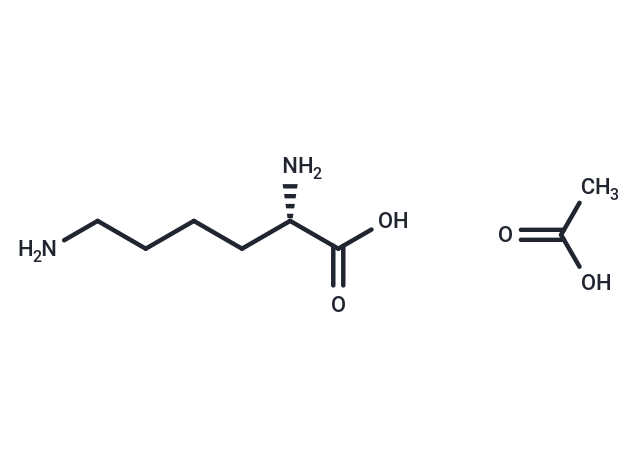
| Pack Size | Price | USA Stock | Global Stock | Quantity |
|---|---|---|---|---|
| 10 g | $29 | - | In Stock |
| Description | L-Lysine acetate is an essential amino acid for humans. Owing to its unique biological properties, it can be used in mechanistic investigations and research related to vascular calcification (VC) and acute pancreatitis. |
| In vitro | Methods: Vascular smooth muscle cells (VSMCs) were used as the research object and treated with L-Lysine acetate. Results: L-Lysine acetate decreased plasma iPTH levels and increased plasma concentrations of alanine, proline, arginine and homoarginine, thereby inhibiting apoptosis and mineral deposition in VSMCs. Methods: A systematic analysis was performed on the biological functions and pathological significance of the AKT signaling pathway. Results: AKT mediates cell survival and proliferation by inhibiting pro-apoptotic pathways. Dysregulation of the AKT signaling cascade is observed in various cancers and is associated with tumor invasiveness. Abnormal AKT function enhances cell proliferation, growth and survival, and induces apoptosis resistance. AKT1-related inhibitors can facilitate cancer-related research [1]. |
| In vivo | Methods: Adenine-induced rats were orally administered L-Lysine acetate (40 μg/kg; p.o.) by gavage. Results: L-Lysine acetate ameliorated arterial calcification in adenine-treated rats and protected their femurs against osteoporotic lesions [1]. Methods: Male mice were given L-Lysine acetate (10, 400 mg/kg; i.g., p.o.) by gavage and oral administration, respectively. Results: L-Lysine acetate inhibited pancreatic tissue damage [2]. |
| Molecular Weight | 206.24 |
| Formula | C8H18N2O4 |
| Cas No. | 57282-49-2 |
| Smiles | [C@H](CCCCN)(C(O)=O)N.C(C)(O)=O |
| Relative Density. | no data available |
| Storage | Keep away from direct sunlight Powder: -20°C for 3 years | In solvent: -80°C for 1 year Shipping with blue ice/Shipping at ambient temperature. | |||||||||||||||||||||||||||||||||||
| Solubility Information | H2O: 93.34 mg/mL (452.58 mM), Sonication is recommended. | |||||||||||||||||||||||||||||||||||
Solution Preparation Table | ||||||||||||||||||||||||||||||||||||
H2O
Note : The dilution table applies only to solid products. For liquid products, please calculate the stock solution based on the stated concentration and/or density. | ||||||||||||||||||||||||||||||||||||
 For example, if the intended dosage is 10 mg/kg for animals weighing 20 g , with a dosing volume of 100 μL per animal, and a total of 10 animals are to be administered, using a formulation of
  10% DMSO+ 40% PEG300+ 5% Tween 80+ 45% Saline/PBS/ddH2O , the resulting working solution concentration would be 2 mg/mL.
Dissolve 2 mg of the compound in 100 μL DMSO to obtain a stock solution at a concentration of 20 mg/mL . If the required concentration exceeds the compound's known solubility, please contact us for technical support before proceeding.
1) Add 100 μL of the DMSO stock solution to 400 µL PEG300 and mix thoroughly until the solution becomes clear.
2) Add 50 µL Tween 80 and mix well until fully clarified.
3) Add 450 µL Saline,PBS or ddH2O and mix thoroughly until a homogeneous solution is obtained.
| Size | Quantity | Unit Price | Amount | Operation |
|---|
 Feedback
 Hello! How can I help you today?
Copyright © 2015-2026 TargetMol Chemicals Inc. All Rights Reserved.
