


Shopping Cart
Remove All Your shopping cart is currently empty

Synonyms:
| Pack Size | Price | USA Stock | Global Stock | Quantity |
|---|---|---|---|---|
| 10 mg | Inquiry | Inquiry | Inquiry | |
| 50 mg | Inquiry | Inquiry | Inquiry |
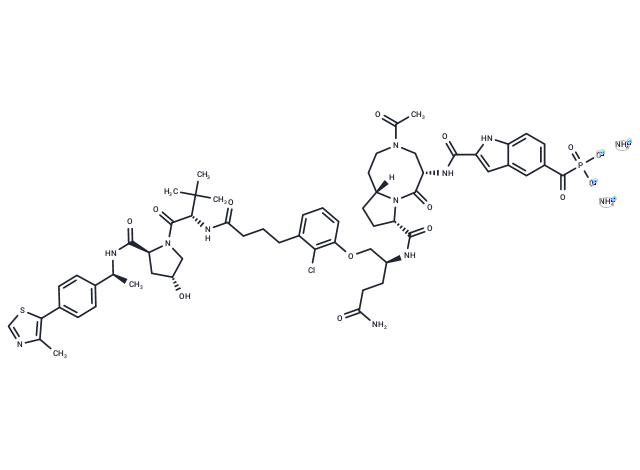
| Description | KT-333 diammonium functions as a molecular glue that targets and degrades the STAT3 protein. It selectively mediates the degradation of STAT3 via the ubiquitin-proteasome pathway by attaching to STAT3 and the E3 ubiquitin ligase von Hippel-Lindau protein (VHL). This compound exhibits strong specificity in degrading STAT3 and demonstrates significant antitumor activity. KT-333 diammonium is applicable in researching hematologic malignancies, including large granular lymphocytic leukemia (LGL-L), peripheral T-cell lymphoma (PTCL), and cutaneous T-cell lymphoma (CTCL). |
| In vitro | KT-333 ammonium, after degrading STAT3, induces irreversible growth inhibition in the SU-DHL-1 cell line and activates caspase 3/7 activity, which is a hallmark of apoptosis [1]. It shows degradative effects on the STAT3 protein and, according to cell phenotypic analysis, has GI 50 values ranging from 8.1 to 57.4 nM across multiple ALCL cell lines [1]. |
| In vivo | KT-333 diammonium, administered intravenously at doses of 5, 10, 15, and 45 mg/kg once weekly for two consecutive weeks, exhibits dose-dependent antitumor activity. At 5 mg/kg, mice exhibited a tumor growth inhibition (TGI) of 79.9%, while doses of 10, 15, or 45 mg/kg led to complete tumor regression, effects that persisted until the study's conclusion [1]. KT-333 diammonium, at doses of 10, 20, and 30 mg/kg, also administered intravenously once weekly for two weeks, demonstrated similar dose-dependent antitumor properties. A TGI of 83.8% was observed at 10 mg/kg, and complete tumor regression was noted at 20 or 30 mg/kg, with results maintained through the study's end [1]. |
| Molecular Weight | 1291.84 |
| Formula | C60H80ClN12O14PS |
| Cas No. | 2502186-80-1 |
| Smiles | ClC(C(CCCC(N[C@@H](C(C)(C)C)C(N1[C@@H](C[C@H](C1)O)C(N[C@H](C2=CC=C(C3=C(N=CS3)C)C=C2)C)=O)=O)=O)=CC=C4)=C4OC[C@H](CCC(N)=O)NC([C@H]5N6[C@](CCN(C[C@@H](C6=O)NC(C7=CC8=CC(C(P([O-])([O-])=O)=O)=CC=C8N7)=O)C(C)=O)([H])CC5)=O.[NH4+].[NH4+] |
| Storage | Powder: -20°C for 3 years | In solvent: -80°C for 1 year Shipping with blue ice/Shipping at ambient temperature. |
 For example, if the intended dosage is 10 mg/kg for animals weighing 20 g , with a dosing volume of 100 μL per animal, and a total of 10 animals are to be administered, using a formulation of
  10% DMSO+ 40% PEG300+ 5% Tween 80+ 45% Saline/PBS/ddH2O , the resulting working solution concentration would be 2 mg/mL.
Dissolve 2 mg of the compound in 100 μL DMSO to obtain a stock solution at a concentration of 20 mg/mL . If the required concentration exceeds the compound's known solubility, please contact us for technical support before proceeding.
1) Add 100 μL of the DMSO stock solution to 400 µL PEG300 and mix thoroughly until the solution becomes clear.
2) Add 50 µL Tween 80 and mix well until fully clarified.
3) Add 450 µL Saline,PBS or ddH2O and mix thoroughly until a homogeneous solution is obtained.
| Size | Quantity | Unit Price | Amount | Operation |
|---|
 Feedback
 Hello! How can I help you today?
Copyright © 2015-2026 TargetMol Chemicals Inc. All Rights Reserved.
