


Shopping Cart
Remove All Your shopping cart is currently empty

Synonyms:
| Pack Size | Price | USA Stock | Global Stock | Quantity |
|---|---|---|---|---|
| 10 mg | Inquiry | 10-14 weeks | 10-14 weeks | |
| 50 mg | Inquiry | 10-14 weeks | 10-14 weeks |
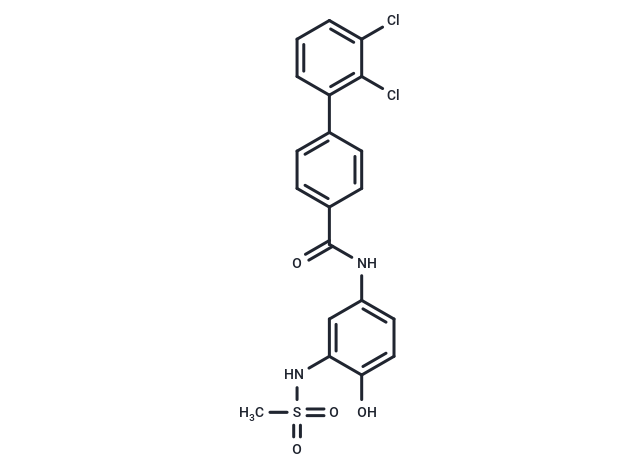
| Description | ITK-IN-6 is a potent and selective ITK inhibitor (Kd = 387 nM). It binds directly to the ITK kinase domain. This compound prevents the release of pro-inflammatory cytokines and the activation and differentiation of Th2 and Th17 cells. ITK-IN-6 improves asthma progression by reducing inflammatory cell infiltration, mucus production, and IgE generation. It significantly inhibits airway inflammation and is used in asthma research. |
| In vitro | ITK-IN-6 (Compound C-161) demonstrates a 62.27% inhibition of ITK downstream transcriptional activity after 24 hours in the Jurkat-NFAT-Luc stable cell line. At concentrations of 0.07-5 μM for 12 hours, ITK-IN-6 shows good safety in CD4+ T cells and reduces Th2 and Th17 differentiation in vitro. With exposure of 0.15-2.5 μM for 12 hours, it blocks key T cell activation factors and inhibits T cell surface activation markers in Jurkat cells. ITK-IN-6 (0.625-2.5 μM, 12 h) specifically inhibits ITK and hinders proximal T cell receptor signaling, significantly suppressing CD69 expression in Jurkat T cells. It also suppresses IL-2 expression in a dose-dependent manner at both transcriptional and protein levels in Jurkat cells, with an IC50 of 494 nM. Furthermore, treatment with 0.625-2.5 μM ITK-IN-6 for 30 minutes significantly reduces intracellular Ca2+ flux induced by anti-CD3 in Jurkat cells. |
| In vivo | ITK-IN-6 (Compound C-161) administered intraperitoneally at 10 mg/kg once daily from days 7 to 11, effectively alleviates airway inflammation in C57BL/6J mice induced by house dust mites. It achieves this by inhibiting Th2/Th17 differentiation and cytokine production, while demonstrating a good safety profile. |
| Molecular Weight | 451.32 |
| Formula | C20H16Cl2N2O4S |
| Cas No. | 2616666-32-9 |
| Smiles | O=C(NC1=CC=C(O)C(=C1)NS(=O)(=O)C)C2=CC=C(C=C2)C=3C=CC=C(Cl)C3Cl |
| Storage | Powder: -20°C for 3 years | In solvent: -80°C for 1 year Shipping with blue ice/Shipping at ambient temperature. |
 For example, if the intended dosage is 10 mg/kg for animals weighing 20 g , with a dosing volume of 100 μL per animal, and a total of 10 animals are to be administered, using a formulation of
  10% DMSO+ 40% PEG300+ 5% Tween 80+ 45% Saline/PBS/ddH2O , the resulting working solution concentration would be 2 mg/mL.
Dissolve 2 mg of the compound in 100 μL DMSO to obtain a stock solution at a concentration of 20 mg/mL . If the required concentration exceeds the compound's known solubility, please contact us for technical support before proceeding.
1) Add 100 μL of the DMSO stock solution to 400 µL PEG300 and mix thoroughly until the solution becomes clear.
2) Add 50 µL Tween 80 and mix well until fully clarified.
3) Add 450 µL Saline,PBS or ddH2O and mix thoroughly until a homogeneous solution is obtained.
| Size | Quantity | Unit Price | Amount | Operation |
|---|
 Feedback
 Hello! How can I help you today?
Copyright © 2015-2026 TargetMol Chemicals Inc. All Rights Reserved.
