


Shopping Cart
Remove All Your shopping cart is currently empty

Synonyms:
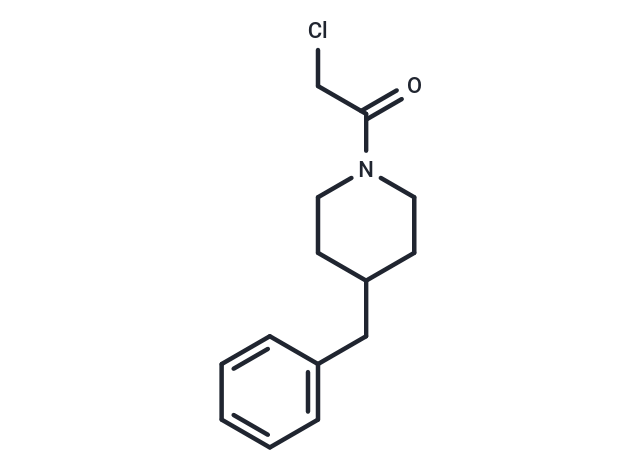
| Pack Size | Price | USA Stock | Global Stock | Quantity |
|---|---|---|---|---|
| 10 mg | Inquiry | 10-14 weeks | 10-14 weeks | |
| 50 mg | Inquiry | 10-14 weeks | 10-14 weeks |
| Description | GSTO1-IN-3 is a potent inhibitor of GSTO1-1, with an IC50 value of 0.11 μM, and exhibits selectivity towards GSTO2-2, GSTA1-1, and GSTP1-1 (IC50> 100 μM). It enhances the cytotoxic effects of Cisplatin on human breast cancer cells and inhibits IL-1β release in mouse bone marrow-derived macrophages (BMDM). Additionally, GSTO1-IN-3 reduces inflammation in mice and is applicable for research related to breast cancer and inflammation. |
| Targets & IC50 | GSTO1-1:0.11 μM |
| In vitro | GSTO1-IN-3 (compound 5C-1) demonstrates favorable in vitro safety, as it shows no thiol reactivity in ALARM NMR experiments and lacks mutagenicity in Ames tests with *Salmonella typhimurium* strains TA98 and TA100 at concentrations up to 2 mg/mL. It exhibits greater stability in human liver microsomes compared to mouse microsomes. GSTO1-IN-3 forms a covalent bond with the Cys32 of GSTO1-1, with an inhibition efficiency constant (kᵢₙₐcₜ/Kᵢ) of 3.4 × 10⁴ M⁻¹s⁻¹. At a concentration of 5 μM, GSTO1-IN-3 reduces IL-1β release by 59.2% in mouse bone marrow-derived macrophages (BMDM). Additionally, at 5-50 μM for 24 hours, it exhibits a synergistic effect with Cisplatin, significantly enhancing cytotoxicity in a concentration-dependent manner against human breast cancer MDA-MB-231 cells. |
| In vivo | GSTO1-IN-3, when administered intraperitoneally at a dose of 30 mg/kg, 30 minutes prior to LPS injection, can mitigate the inflammation induced by lipopolysaccharide (LPS) in mice. |
| Molecular Weight | 251.75 |
| Formula | C14H18ClNO |
| Cas No. | 158890-32-5 |
| Smiles | O=C(N1CCC(CC=2C=CC=CC2)CC1)CCl |
| Storage | Powder: -20°C for 3 years | In solvent: -80°C for 1 year Shipping with blue ice/Shipping at ambient temperature. |
 For example, if the intended dosage is 10 mg/kg for animals weighing 20 g , with a dosing volume of 100 μL per animal, and a total of 10 animals are to be administered, using a formulation of
  10% DMSO+ 40% PEG300+ 5% Tween 80+ 45% Saline/PBS/ddH2O , the resulting working solution concentration would be 2 mg/mL.
Dissolve 2 mg of the compound in 100 μL DMSO to obtain a stock solution at a concentration of 20 mg/mL . If the required concentration exceeds the compound's known solubility, please contact us for technical support before proceeding.
1) Add 100 μL of the DMSO stock solution to 400 µL PEG300 and mix thoroughly until the solution becomes clear.
2) Add 50 µL Tween 80 and mix well until fully clarified.
3) Add 450 µL Saline,PBS or ddH2O and mix thoroughly until a homogeneous solution is obtained.
| Size | Quantity | Unit Price | Amount | Operation |
|---|
 Feedback
 Hello! How can I help you today?
Copyright © 2015-2026 TargetMol Chemicals Inc. All Rights Reserved.
