Shopping Cart
Remove All
  • TargetMol
    Your shopping cart is currently empty

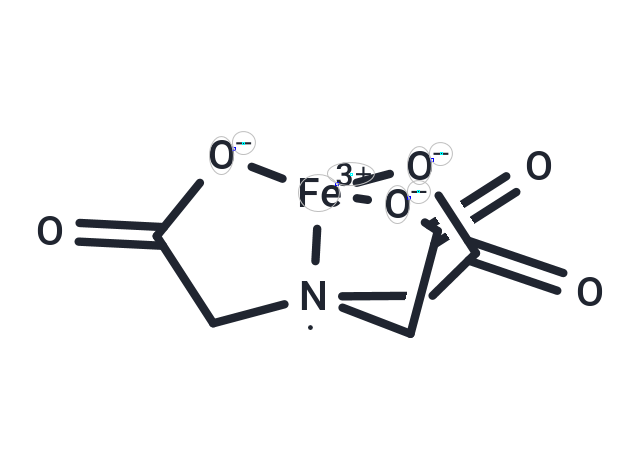
Ferric nitrilotriacetate

Copy Product Info
😃Good
Catalog No. T78655Cas No. 16448-54-7

Ferric nitrilotriacetate (Fe-NTA) is a highly active compound formed by the complexation of iron and nitrilotriacetic acid. It is primarily used to induce degenerative diseases through oxidative stress (OS) and can be applied to establish disease models such as acute kidney injury, renal cell carcinoma, liver cancer, and diabetes.

Ferric nitrilotriacetate

Ferric nitrilotriacetate

Copy Product Info
😃Good
Catalog No. T78655Cas No. 16448-54-7
Ferric nitrilotriacetate (Fe-NTA) is a highly active compound formed by the complexation of iron and nitrilotriacetic acid. It is primarily used to induce degenerative diseases through oxidative stress (OS) and can be applied to establish disease models such as acute kidney injury, renal cell carcinoma, liver cancer, and diabetes.
Pack SizePriceUSA WarehouseGlobal WarehouseQuantity
5 mgInquiry8-10 weeks8-10 weeks
50 mgInquiry8-10 weeks8-10 weeks
Add to Quotation
In Stock Estimated shipping dateUSA Warehouse[1-2 days] Global Warehouse[5-7 days]
All TargetMol products are for research purposes only and cannot be used for human consumption. We do not provide products or services to individuals. Please comply with the intended use and do not use TargetMol products for any other purpose.
Questions
TargetMol
View More

Resource Download

Product Introduction

Bioactivity
Description
Ferric nitrilotriacetate (Fe-NTA) is a highly active compound formed by the complexation of iron and nitrilotriacetic acid. It is primarily used to induce degenerative diseases through oxidative stress (OS) and can be applied to establish disease models such as acute kidney injury, renal cell carcinoma, liver cancer, and diabetes.
In vivo
Ferric nitrilotriacetate can be employed in animal modeling to construct renal carcinoma models.
Disease Modeling Protocol
Renal cell carcinoma model
  • Modeling Mechanism:

    Ferric nitrilotriacetate (Fe-NTA) generates a large amount of reactive oxygen species (ROS) through the iron-mediated Fenton reaction, inducing oxidative stress damage in proximal renal tubular cells. Simultaneously, it induces DNA oxidative modification (generating 8-hydroxy-2'-deoxyguanosine (8-OHdG) and acrolein-modified adenosine (acrolein-dA)), leading to characteristic gene mutations (preferential mutations in G:C base pairs, mainly G:C→C:G transversions, accompanied by large deletions >1kb). Long-term damage causes abnormal regeneration of renal tubular cells and homozygous deletion of tumor suppressor genes (such as p16^INK4a), ultimately inducing renal cell carcinoma.

  • Related Products:

    Ferric nitrilotriacetate (T78655)

  • Modeling Method:

    Experimental Subject:

    Mice, gpt delta/C57BL/6J transgenic mice, Male, 4 weeks old

    Dosage and Administration Route:

    ① Drug preparation: Freshly prepare Ferric nitrilotriacetate solution immediately before use
    ② Administration regimen: 3 mg iron/kg Ferric nitrilotriacetate administered intraperitoneally daily for the first 3 days, with dosage increased to 5 mg iron/kg from day 4 onwards; administered 5 times weekly;
    ③ Control treatment: Control mice received no Ferric nitrilotriacetate injections, with all other housing conditions identical;

    Dosing Frequency and Duration Model:

    Days 1–3: Once daily;
    Day 4 onwards: Once daily, administered five times weekly

  • Validation:

    1. Pathological markers: - Renal tubular injury: HE staining showed proximal tubular cell degeneration and necrosis (nuclear pyknosis) at 1 week, with abnormal regeneration cells (large nuclei and prominent nucleoli) appearing at 2-3 weeks; - Oxidative damage: Immunohistochemistry showed positive nuclear staining for 8-OHdG and acrolein-dA in renal tissue, with the highest expression level at 1 week; 2. Molecular markers: - Gene mutations: 6-thioguanine (6-TG) screening showed a 2.44-fold increase in point mutation frequency, and Spi⁻ screening showed a 1.72-fold increase in large fragment deletion frequency. Sequencing confirmed large fragment deletions mediated by G:C→C:G transversions and short homologous sequences near repetitive sequences; - Gene expression: deletion of the tumor suppressor gene p16^INK4a allele, and abnormal expression of genes such as annexin 2 and thioredoxin-binding protein-2.

*Precautions: After the last administration of medication to the animal 48He was executed when he was young.

*References:Jiang L,et,al. Deletion and single nucleotide substitution at G:C in the kidney of gpt delta transgenic mice after ferric nitrilotriacetate treatment. Cancer Sci. 2006 Nov;97(11):1159-67.

Chemical Properties
Molecular Weight243.96
FormulaC6H6FeNO6
Cas No.16448-54-7
SmilesO=C1[O-][Fe+3]23[N](CC(=O)[O-]2)(CC(=O)[O-]3)C1
Storage & Solubility Information
StoragePowder: -20°C for 3 years | In solvent: -80°C for 1 year | Shipping with blue ice/Shipping at ambient temperature.

Calculator

  • Molarity Calculator
  • Dilution Calculator
  • Reconstitution Calculator
  • Molecular Weight Calculator

In Vivo Formulation Calculator (Clear solution)

Please enter your animal experiment information in the following box and click Calculate to obtain the stock solution preparation method and in vivo formula preparation method:
TargetMol | Animal experiments For example, if the intended dosage is 10 mg/kg for animals weighing 20 g , with a dosing volume of 100 μL per animal, TargetMol | Animal experiments and a total of 10 animals are to be administered, using a formulation of TargetMol | reagent 10% DMSO+ 40% PEG300+ 5% Tween 80+ 45% Saline/PBS/ddH2O , the resulting working solution concentration would be 2 mg/mL.

Stock Solution Preparation:

Dissolve 2 mg of the compound in 100 μL DMSOTargetMol | reagent to obtain a stock solution at a concentration of 20 mg/mL . If the required concentration exceeds the compound's known solubility, please contact us for technical support before proceeding.

Preparation of the In Vivo Formulation:

1) Add 100 μL of the DMSOTargetMol | reagent stock solution to 400 μL PEG300TargetMol | reagent and mix thoroughly until the solution becomes clear.

2) Add 50 μL Tween 80 and mix well until fully clarified.

3) Add 450 μL Saline,PBS or ddH2OTargetMol | reagent and mix thoroughly until a homogeneous solution is obtained.

This example is provided solely to demonstrate the use of the In Vivo Formulation Calculator and does not constitute a recommended formulation for any specific compound. Please select an appropriate dissolution and formulation strategy based on your experimental model and route of administration.
All co-solvents required for this protocol, includingDMSO, PEG300/PEG400, Tween 80, SBE-β-CD, and Corn oil, are available for purchase on the TargetMol website.
1 Enter information below:
mg/kg
g
μL
2 Enter the in vivo formulation:
% DMSO
%
% Tween 80
% Saline/PBS/ddH2O

Dose Conversion

You can also refer to dose conversion for different animals. More Dose Conversion

Tech Support

Please see Inhibitor Handling Instructions for more frequently ask questions. Topics include: how to prepare stock solutions, how to store products, and cautions on cell-based assays & animal experiments, etc
Related Tags: buy Ferric nitrilotriacetate | purchase Ferric nitrilotriacetate | Ferric nitrilotriacetate cost | order Ferric nitrilotriacetate | Ferric nitrilotriacetate chemical structure | Ferric nitrilotriacetate in vivo | Ferric nitrilotriacetate formula | Ferric nitrilotriacetate molecular weight