


Shopping Cart
Remove All Your shopping cart is currently empty

Synonyms: DTZ

| Pack Size | Price | USA Stock | Global Stock | Quantity |
|---|---|---|---|---|
| 1 mg | $30 | In Stock | In Stock | |
| 5 mg | $89 | In Stock | In Stock | |
| 10 mg | $163 | In Stock | In Stock | |
| 25 mg | $318 | In Stock | In Stock | |
| 50 mg | $578 | In Stock | In Stock | |
| 100 mg | $828 | In Stock | In Stock | |
| 500 mg | $1,650 | - | In Stock |
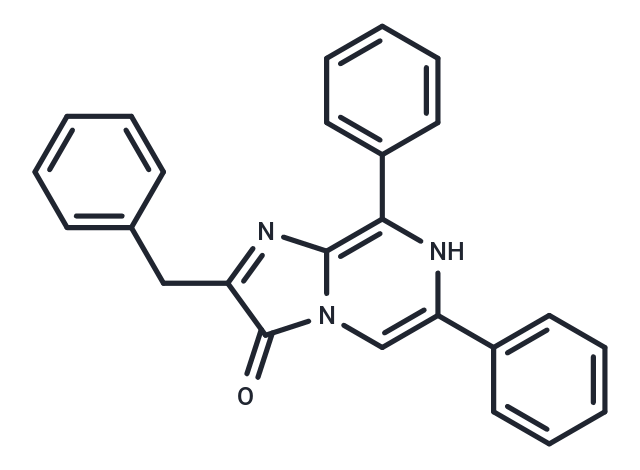
| Description | Diphenylterazine (DTZ) is a bioluminescent agent. It produces very little background of its own, giving it an excellent signal-to-noise ratio. |
| In vitro | Diphenylterazine alone yields very little background with excellent signal-to-background ratios. Furthermore, Diphenylterazine elicits minimal cell toxicity at millimolar concentrations. Diphenylterazine injections into untransfected BALB/c mice do not yield any background emission. |
| Synonyms | DTZ |
| Animal Research | I. Solution preparation 1. Preparation of mother solution: Dissolve DTZ in DMSO or ethanol to prepare a 1-10 mM mother solution; (It is recommended to store at -20 ℃ or -80 ℃ in the dark after aliquoting) 2. Preparation of working solution: Dilute the DTZ mother solution with PBS or other suitable buffer, usually 1-10 µM; (Select the appropriate working solution concentration according to the experimental requirements, and prepare it for immediate use) Imaging analysis experiment of Staphylococcus aureus reporter strain colonization in deep tissues of mice Operation steps: 24 hours after infection with CFU reporter strain, 1 μmol Diphenylterazine was injected intraperitoneally into the abdominal cavity of infected mice, and the mice were placed in a small animal in vivo imager to anesthetize them. After 3 minutes, the luminescent signal of the dorsal kidney of the mice was detected using the IVIS® Lumina LT system. The above information is based on published literature. Experimental procedures should be appropriately modified to meet specific research demands. |
| Molecular Weight | 377.44 |
| Formula | C25H19N3O |
| Cas No. | 344940-63-2 |
| Smiles | O=c1c(Cc2ccccc2)nc2c([nH]c(cn12)-c1ccccc1)-c1ccccc1 |
| Relative Density. | 1.21 g/cm3 (Predicted) |
| Storage | Keep away from direct sunlight Powder: -20°C for 3 years | In solvent: -80°C for 1 year Shipping with blue ice/Shipping at ambient temperature. | ||||||||||||||||||||||||||||||||||||||||
| Solubility Information | DMSO: 55 mg/mL (145.72 mM), DMSO inactivates the activity of Diphenylterazine.  EtOH+HCl: 1 mg/mL (2.65 mM), when pH is adjusted to 2 with 1 M HCl. Sonication and heating are recommended. | ||||||||||||||||||||||||||||||||||||||||
Solution Preparation Table | |||||||||||||||||||||||||||||||||||||||||
EtOH+HCl/DMSO
DMSO
Note : The dilution table applies only to solid products. For liquid products, please calculate the stock solution based on the stated concentration and/or density. | |||||||||||||||||||||||||||||||||||||||||
 For example, if the intended dosage is 10 mg/kg for animals weighing 20 g , with a dosing volume of 100 μL per animal, and a total of 10 animals are to be administered, using a formulation of
  10% DMSO+ 40% PEG300+ 5% Tween 80+ 45% Saline/PBS/ddH2O , the resulting working solution concentration would be 2 mg/mL.
Dissolve 2 mg of the compound in 100 μL DMSO to obtain a stock solution at a concentration of 20 mg/mL . If the required concentration exceeds the compound's known solubility, please contact us for technical support before proceeding.
1) Add 100 μL of the DMSO stock solution to 400 µL PEG300 and mix thoroughly until the solution becomes clear.
2) Add 50 µL Tween 80 and mix well until fully clarified.
3) Add 450 µL Saline,PBS or ddH2O and mix thoroughly until a homogeneous solution is obtained.
| Size | Quantity | Unit Price | Amount | Operation |
|---|
 Feedback
 Hello! How can I help you today?
Copyright © 2015-2026 TargetMol Chemicals Inc. All Rights Reserved.
