Shopping Cart
Remove All
  • TargetMol
    Your shopping cart is currently empty

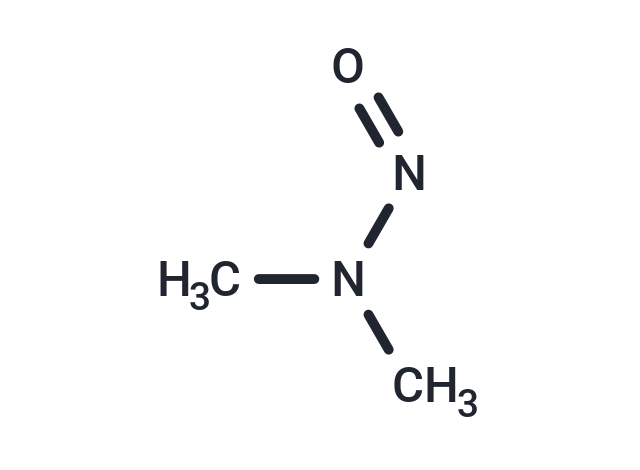
Dimethylnitrosamine

Copy Product Info
🥰Excellent
Catalog No. T82552Cas No. 62-75-9
Alias NDMA, DMN

Dimethylnitrosamine (NDMA) is a potent hepatotoxin, carcinogen, and mutagen, and is commonly used to establish liver tumor models.

Dimethylnitrosamine

Dimethylnitrosamine

Copy Product Info
🥰Excellent
Catalog No. T82552Alias NDMA, DMNCas No. 62-75-9
Dimethylnitrosamine (NDMA) is a potent hepatotoxin, carcinogen, and mutagen, and is commonly used to establish liver tumor models.
TargetMol
Product information is being updated, if you want to purchase, please click the bulk custom button.
Trade of this Product requires valid qualifications or certifications from both parties.
Add to Quotation
Questions
TargetMol
View More

Resource Download

Product Introduction

Bioactivity
Description
Dimethylnitrosamine (NDMA) is a potent hepatotoxin, carcinogen, and mutagen, and is commonly used to establish liver tumor models.
Disease Modeling Protocol
Liver Fibrosis Model
  • Modeling Mechanism:

    Dimethylnitrosamine (DMN), a liver-specific chemical carcinogen, is activated by hepatic cytochrome P450 enzymes after entering the body, producing alkylating intermediates that cause DNA damage in hepatocytes (such as increased production of 8-hydroxydeoxyguanosine). Simultaneously, it triggers oxidative stress (accumulation of reactive oxygen species (ROS) and decreased antioxidant enzyme activity), inhibits the Nrf2/ARE antioxidant pathway, activates hepatic stellate cells and transforming growth factor β (TGF-β) signaling, and promotes collagen deposition and liver fibrosis.

  • Related Products:

    Dimethylnitrosamine (T82552)

  • Modeling Method:

    Experimental Subject:

    Mice, Balb/c, male, 5 weeks old, body weight 18–22 g

    Dosage and Administration Route:

    ① Core modelling (fibrosis - precancerous stage):
    - DMN, 10 mg/kg, dissolved in 0.9% saline, intraperitoneal injection;
    ② Complete Liver Tumour Modelling (Long-Term Extension):
    - Following initial modelling, continue conventional housing or maintain low-dose DMN (5 mg/kg, weekly) for 16–24 weeks (to induce hepatocellular carcinoma formation);
    ③ Control treatment: Control group administered equal-volume saline solution via intraperitoneal injection, with all other housing conditions identical;
    ④ Intervention validation group (optional):
    - Antioxidant intervention: Nrf2 activators (e.g., sulforaphane) and glutathione (GSH) supplements administered concurrently with modelling

    Dosing Frequency and Duration Model:

    Twice weekly for 4 consecutive weeks

  • Validation:

    1. Pathological Indicators: - Liver fibrosis: Masson's trichrome staining showed a significant increase in collagen deposition in liver tissue, enhanced positive signal of α-smooth muscle actin (α-SMA) immunostaining, destruction of liver lobule structure, and sinusoidal congestion; - Hepatocellular injury: HE staining showed extensive hepatocellular necrosis and inflammatory infiltration, and abnormal proliferative nodules of hepatocellular cells were observed in long-term modeling; 2. Biochemical Indicators: - Serum transaminases: Alanine aminotransferase (ALT) and aspartate aminotransferase (AST) were significantly elevated (p<0.01), indicating hepatocellular injury; - Oxidative stress: Total antioxidant capacity (TAC) of liver tissue decreased, GSH level and GSH/GSSG ratio decreased, and SOD and catalase activities decreased (p<0.05); - Oxidative damage markers: 8-hydroxydeoxyguanosine (8-OHdG) and 4-hydroxynonenal (4-HNE) expression was upregulated in liver tissue; 3. Functional and Molecular Indicators: - Liver function: Indocyanine green (ICG) clearance test showed decreased liver metabolic function; - Redox status: DNP-MRI showed a significantly slowed reduction rate of carbamoyl-PROXYL in liver tissue (0.11±0.02 min⁻¹ vs. control group 0.18±0.02 min⁻¹, p<0.01); - Signaling pathways: TGF-β and α-SMA mRNA and protein expression were upregulated in liver tissue, while Nrf2 expression was downregulated.

*Precautions:

*References:Kawano T,et,al. Noninvasive mapping of the redox status of dimethylnitrosamine-induced hepatic fibrosis using in vivo dynamic nuclear polarization-magnetic resonance imaging. Sci Rep. 2016 Sep 2;6:32604.

SynonymsNDMA, DMN
Chemical Properties
Molecular Weight74.08
FormulaC2H6N2O
Cas No.62-75-9
SmilesO=NN(C)C
Storage & Solubility Information
StoragePowder: -20°C for 3 years | In solvent: -80°C for 1 year | Shipping with blue ice/Shipping at ambient temperature.

Calculator

  • Molarity Calculator
  • Dilution Calculator
  • Reconstitution Calculator
  • Molecular Weight Calculator

In Vivo Formulation Calculator (Clear solution)

Please enter your animal experiment information in the following box and click Calculate to obtain the stock solution preparation method and in vivo formula preparation method:
TargetMol | Animal experiments For example, if the intended dosage is 10 mg/kg for animals weighing 20 g , with a dosing volume of 100 μL per animal, TargetMol | Animal experiments and a total of 10 animals are to be administered, using a formulation of TargetMol | reagent 10% DMSO+ 40% PEG300+ 5% Tween 80+ 45% Saline/PBS/ddH2O , the resulting working solution concentration would be 2 mg/mL.

Stock Solution Preparation:

Dissolve 2 mg of the compound in 100 μL DMSOTargetMol | reagent to obtain a stock solution at a concentration of 20 mg/mL . If the required concentration exceeds the compound's known solubility, please contact us for technical support before proceeding.

Preparation of the In Vivo Formulation:

1) Add 100 μL of the DMSOTargetMol | reagent stock solution to 400 μL PEG300TargetMol | reagent and mix thoroughly until the solution becomes clear.

2) Add 50 μL Tween 80 and mix well until fully clarified.

3) Add 450 μL Saline,PBS or ddH2OTargetMol | reagent and mix thoroughly until a homogeneous solution is obtained.

This example is provided solely to demonstrate the use of the In Vivo Formulation Calculator and does not constitute a recommended formulation for any specific compound. Please select an appropriate dissolution and formulation strategy based on your experimental model and route of administration.
All co-solvents required for this protocol, includingDMSO, PEG300/PEG400, Tween 80, SBE-β-CD, and Corn oil, are available for purchase on the TargetMol website.
1 Enter information below:
mg/kg
g
μL
2 Enter the in vivo formulation:
% DMSO
%
% Tween 80
% Saline/PBS/ddH2O

Dose Conversion

You can also refer to dose conversion for different animals. More Dose Conversion

Tech Support

Please see Inhibitor Handling Instructions for more frequently ask questions. Topics include: how to prepare stock solutions, how to store products, and cautions on cell-based assays & animal experiments, etc
Related Tags: buy Dimethylnitrosamine | purchase Dimethylnitrosamine | Dimethylnitrosamine cost | order Dimethylnitrosamine | Dimethylnitrosamine chemical structure | Dimethylnitrosamine formula | Dimethylnitrosamine molecular weight