


Shopping Cart
Remove All Your shopping cart is currently empty

Synonyms:
| Pack Size | Price | USA Stock | Global Stock | Quantity |
|---|---|---|---|---|
| 10 mg | Inquiry | 10-14 weeks | 10-14 weeks | |
| 50 mg | Inquiry | 10-14 weeks | 10-14 weeks |
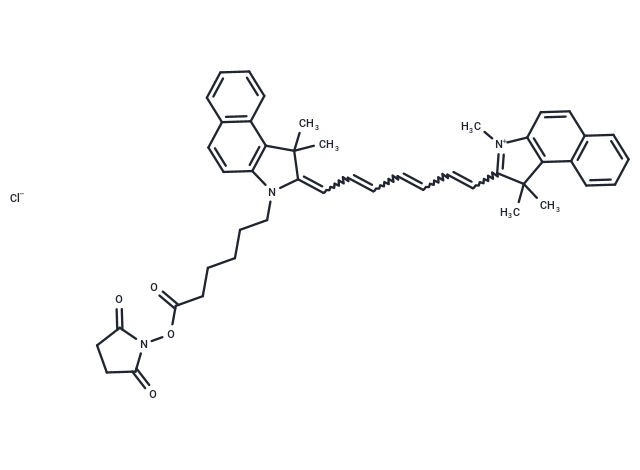
| Description | Cy7.5 NHS ester chloride is a fluorescent dye. It can react with mPEG-b-PDPA to form the fluorescent copolymer mPEG-b-PDPA-Cy7.5. This compound is suitable for use in fluorescence imaging studies [Ex/Em = 780/820 nm]. |
| In vitro | Protocol for Protein Preparation: 1) Prepare protein (antibody) at a concentration of 2 mg/mL for optimal labeling. 2) Ensure the protein solution's pH is 8.5±0.5; adjust with 1 M sodium bicarbonate if below 8.0. 3) If protein concentration is under 2 mg/mL, labeling efficiency decreases significantly. For optimal results, aim for a final protein concentration of 2-10 mg/mL. 4) Proteins must be in a buffer free of primary amines (such as Tris or Glycine) and ammonium ions to avoid reducing labeling efficiency. 2. Preparation of Dye (using CY7.5-NHS ester as an example): Add anhydrous DMSO to a vial of CY7.5-NHS ester to make a 10 mM stock solution, and homogenize using a pipette or vortex mixer. 3. Calculation of Dye Quantity: The amount of CY7.5-NHS ester required depends on the protein to be labeled, with an optimal molar ratio of CY dye to protein around 10. Example: For 500 μL of 2 mg/mL IgG (MW=150,000), dissolve 1 mg CY7.5-NHS ester in 100 μL DMSO, giving a CY7.5-NHS ester volume of 5.6 μL, calculated as follows: 1) mmol (IgG) = (mg/mL IgG × mL IgG/MW IgG) = 2 mg/mL × 0.5 mL/150,000 mg/mmol = 6.7×10⁻⁶ mmol 2) mmol (CY7.5 NHS ester) = mmol (IgG) × 10 = 6.7×10⁻⁶ mmol × 10 = 6.7 × 10⁻⁵ mmol 3) μL (CY7.5 NHS ester) = (mmol (CY7.5 NHS ester) × MW CY7 NHS ester)/(mg/μL CY7.5 NHS ester) = 6.7 ×10⁻⁵ mmol × 833.76 mg/mmol/0.01 mg/μL = 5.6 μL (CY7.5 NHS ester) 4. Conducting the Coupling Reaction: 1) Gradually add the freshly prepared 10 mg/mL CY7.5 NHS ester to 0.5 mL protein sample in solution; gently mix by shaking and briefly centrifuge to collect the sample at the tube bottom. Avoid vigorous mixing to prevent protein denaturation. 2) Incubate the reaction tube in the dark at room temperature, gently reversing the reaction every 10-15 minutes for a total of 60 minutes. 5. Purification of Conjugate: The following protocol outlines purification of the dye-protein conjugate via a SepHadex G-25 column. 1) Prepare the SepHadex G-25 column as per manufacturer’s instructions. 2) Load the reaction mixture onto the top of the SepHadex G-25 column. 3) Once the sample has run below the surface of the resin, immediately add PBS (pH 7.2-7.4). 4) Add more PBS (pH 7.2-7.4) to complete column purification; combine fractions containing the desired dye-protein conjugate. The above information is based on published literature. Experimental procedures should be appropriately modified to meet specific research demands. |
| Molecular Weight | 742.34 |
| Formula | C46H48ClN3O4 |
| Cas No. | 3091879-96-5 |
| Smiles | [Cl-].O=C(ON1C(=O)CCC1=O)CCCCCN2C=3C=CC=4C=CC=CC4C3C(C2=CC=CC=CC=CC5=[N+](C=6C=CC=7C=CC=CC7C6C5(C)C)C)(C)C |
| Storage | Keep away from direct sunlight Powder: -20°C for 3 years | In solvent: -80°C for 1 year Shipping with blue ice/Shipping at ambient temperature. |
 For example, if the intended dosage is 10 mg/kg for animals weighing 20 g , with a dosing volume of 100 μL per animal, and a total of 10 animals are to be administered, using a formulation of
  10% DMSO+ 40% PEG300+ 5% Tween 80+ 45% Saline/PBS/ddH2O , the resulting working solution concentration would be 2 mg/mL.
Dissolve 2 mg of the compound in 100 μL DMSO to obtain a stock solution at a concentration of 20 mg/mL . If the required concentration exceeds the compound's known solubility, please contact us for technical support before proceeding.
1) Add 100 μL of the DMSO stock solution to 400 µL PEG300 and mix thoroughly until the solution becomes clear.
2) Add 50 µL Tween 80 and mix well until fully clarified.
3) Add 450 µL Saline,PBS or ddH2O and mix thoroughly until a homogeneous solution is obtained.
| Size | Quantity | Unit Price | Amount | Operation |
|---|
 Feedback
 Hello! How can I help you today?
Copyright © 2015-2026 TargetMol Chemicals Inc. All Rights Reserved.
