Shopping Cart
Remove All
  • TargetMol
    Your shopping cart is currently empty

CP-20961

Copy Product Info
😃Good
Catalog No. T15003Cas No. 35607-20-6

CP-20961 is an effective synthetic non-immunogenic adjuvant that can be used to induce acute and chronic arthritis models.

CP-20961

CP-20961

Copy Product Info
😃Good
Catalog No. T15003Cas No. 35607-20-6
CP-20961 is an effective synthetic non-immunogenic adjuvant that can be used to induce acute and chronic arthritis models.
Pack SizePriceUSA WarehouseGlobal WarehouseQuantity
1 mg$13335 days35 days
Add to Cart
Add to Quotation
In Stock Estimated shipping dateUSA Warehouse[1-2 days] Global Warehouse[5-7 days]
All TargetMol products are for research purposes only and cannot be used for human consumption. We do not provide products or services to individuals. Please comply with the intended use and do not use TargetMol products for any other purpose.
Questions
TargetMol
View More

Resource Download

Product Introduction

Bioactivity
Description
CP-20961 is an effective synthetic non-immunogenic adjuvant that can be used to induce acute and chronic arthritis models.
In vivo
CP-20961 (10 mg/kg, i.v., once either 24, 48, or 72 hours post-burn) had no effect on survival after challenge with P. aeruginosa 96 hours post-burn [3].
Disease Modeling Protocol
Arthritis model
  • Modeling Mechanism:

    CP-20961, as a non-immunogenic synthetic adjuvant, has the following core modeling mechanism: ① It non-specifically activates antigen-processing cells, enhances cell transport within local draining lymph nodes, induces early activation of T lymphocytes (expressing IL-2 receptors), and initiates an autoimmune response; ② Activated T lymphocytes mediate inflammatory signals through lymphatic tissue, recruiting macrophages to infiltrate joint tissues. Macrophages (ED1⁺ subtype as pioneer cells) release destructive enzymes such as cathepsins B/L, triggering synovial inflammation, pannus formation, and osteochondral erosion; ③ In the later stages, T/B lymphocytes continuously infiltrate the joint, interacting with MHC class II antigen-positive cells to maintain a chronic inflammatory state, mimicking the pathological process of human rheumatoid arthritis.

  • Related Products:

    CP-20961 (T15003)

  • Modeling Method:

    Experimental Subject:

    Rats: Female inbred Lewis rats, body weight 140–160 g

    Dosage and Administration Route:

    Model group: CP-20961, 5 mg/animal, dissolved in 0.1 ml paraffin oil, intradermal injection at the base of the tail
    Control group: Age-matched rats, untreated or injected with equivalent volume of paraffin oil;

    Dosing Frequency and Duration Model:

    Single dose

  • Validation:

    1. Behavioral Validation (Core Indicators): - Joint Swelling: Significant swelling of the hind paw appeared from day 11, reaching a peak of visible swelling on day 14, and lasting until day 32; - Arthritis Score: Based on the degree of joint swelling, erythema, and functional impairment, the model group's score was significantly higher than that of the control group (p<0.01); 2. Histopathological Validation: - Acute Phase (11-14 days): Edema appeared in the soft tissues around the joint, with a large number of polymorphonuclear cells and macrophages infiltrating; - Chronic Phase (18-32 days): Synovial hyperplasia, pannus formation, erosion of cartilage and subchondral bone, and mononuclear cell infiltration at ligament attachment points (positive H&E staining); 3. Immunopathological Validation: - Cellular Markers: ED1⁺/ED2⁺/ED3⁺ macrophages, OX-19⁺ T lymphocytes, and OX-33⁺ B cells in the joint tissue. Lymphocyte infiltration, enhanced expression of OX-6⁺ MHC class II antigen positive cells; - Lymphoid tissue: From day 4 of lymph node drainage, there was an increase in IL-2R⁺ (OX-39⁺) activated T lymphocytes, and the red pulp/white pulp ratio of the spleen was elevated.

*Precautions: Five animals were slaughtered on days 4, 7, 11, 14, 18, 21, 25, and 32 after the onset of the disease.

*References:Meacock SC,et,al. Arthritis in Lewis rats induced by the non-immunogenic adjuvant CP20961: an immunohistochemical analysis of the developing disease. Ann Rheum Dis. 1994 Oct;53(10):653-8.

Chemical Properties
Molecular Weight667.19
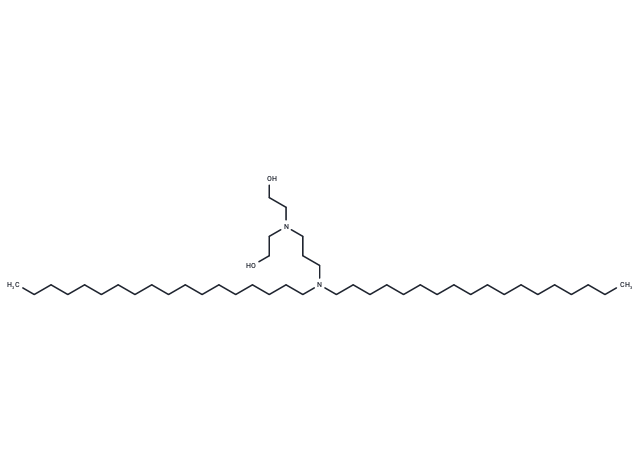
FormulaC43H90N2O2
Cas No.35607-20-6
SmilesN(CCCN(CCO)CCO)(CCCCCCCCCCCCCCCCCC)CCCCCCCCCCCCCCCCCC
Relative Density.0.892g/cm3
Storage & Solubility Information
StoragePowder: -20°C for 3 years | In solvent: -80°C for 1 year | Shipping with blue ice/Shipping at ambient temperature.

Calculator

  • Molarity Calculator
  • Dilution Calculator
  • Reconstitution Calculator
  • Molecular Weight Calculator

In Vivo Formulation Calculator (Clear solution)

Please enter your animal experiment information in the following box and click Calculate to obtain the stock solution preparation method and in vivo formula preparation method:
TargetMol | Animal experiments For example, if the intended dosage is 10 mg/kg for animals weighing 20 g , with a dosing volume of 100 μL per animal, TargetMol | Animal experiments and a total of 10 animals are to be administered, using a formulation of TargetMol | reagent 10% DMSO+ 40% PEG300+ 5% Tween 80+ 45% Saline/PBS/ddH2O , the resulting working solution concentration would be 2 mg/mL.

Stock Solution Preparation:

Dissolve 2 mg of the compound in 100 μL DMSOTargetMol | reagent to obtain a stock solution at a concentration of 20 mg/mL . If the required concentration exceeds the compound's known solubility, please contact us for technical support before proceeding.

Preparation of the In Vivo Formulation:

1) Add 100 μL of the DMSOTargetMol | reagent stock solution to 400 μL PEG300TargetMol | reagent and mix thoroughly until the solution becomes clear.

2) Add 50 μL Tween 80 and mix well until fully clarified.

3) Add 450 μL Saline,PBS or ddH2OTargetMol | reagent and mix thoroughly until a homogeneous solution is obtained.

This example is provided solely to demonstrate the use of the In Vivo Formulation Calculator and does not constitute a recommended formulation for any specific compound. Please select an appropriate dissolution and formulation strategy based on your experimental model and route of administration.
All co-solvents required for this protocol, includingDMSO, PEG300/PEG400, Tween 80, SBE-β-CD, and Corn oil, are available for purchase on the TargetMol website.
1 Enter information below:
mg/kg
g
μL
2 Enter the in vivo formulation:
% DMSO
%
% Tween 80
% Saline/PBS/ddH2O

Dose Conversion

You can also refer to dose conversion for different animals. More Dose Conversion

Tech Support

Please see Inhibitor Handling Instructions for more frequently ask questions. Topics include: how to prepare stock solutions, how to store products, and cautions on cell-based assays & animal experiments, etc

Keywords

Related Tags: buy CP-20961 | purchase CP-20961 | CP-20961 cost | order CP-20961 | CP-20961 chemical structure | CP-20961 in vivo | CP-20961 formula | CP-20961 molecular weight