


Shopping Cart
Remove All Your shopping cart is currently empty

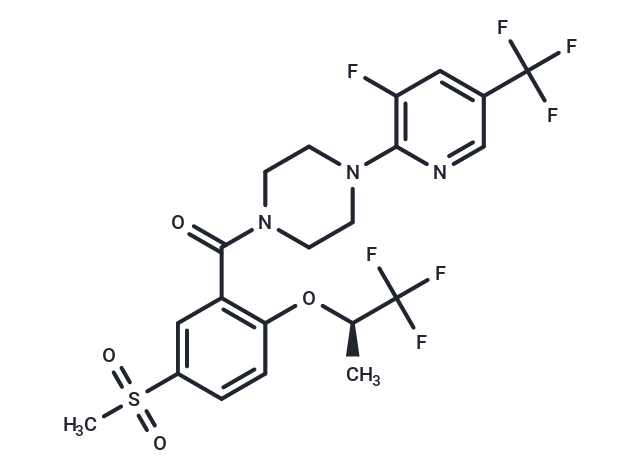
Synonyms: RO4917838 (R enantiomer), RG1678 (R enantiomer), Bitopertin R enantiomer
| Pack Size | Price | USA Stock | Global Stock | Quantity |
|---|---|---|---|---|
| 25 mg | Inquiry | 6-8 weeks | 6-8 weeks | |
| 50 mg | Inquiry | 6-8 weeks | 6-8 weeks | |
| 100 mg | Inquiry | 6-8 weeks | 6-8 weeks |
| Description | Bitopertin R enantiomer (RG1678 R enantiomer) is the R-enantiomer of Bitopertin, a noncompetitive glycine reuptake inhibitor that inhibits glycine uptake at human GlyT1 (IC50: 25 nM). |
| Targets & IC50 | GlyT1:25 nM |
| In vitro | Bitopertin (RG1678) competitively blocks [3H]ORG24598 binding sites at human GlyT1b in membranes from Chinese hamster ovary cells. In cells stably expressing hGlyT1b and mGlyT1b, Bitopertin potently inhibits [3H]glycine uptake (IC50s: 25 nM and 22 nM). Conversely, Bitopertin has no effect on hGlyT2-mediated glycine uptake up to 30 μM concentration. Bitopertin has a high affinity for the recombinant hGlyT1b transporter. Under equilibrium conditions (1 h at room temperature), Bitopertin displaces [3H]ORG24598 binding (Ki: 8.1 nM). In hippocampal CA1 pyramidal cells, Bitopertin enhances NMDA-dependent long-term potentiation at 100 nM but not at 300 nM [1]. Bitopertin has an excellent selectivity profile against the GlyT2 isoform (IC50>30 μM) and toward a panel of 86 targets including transmembrane and soluble receptors, enzymes, ion channels, and monoamine transporters (<41% inhibition at 10 μM is measured for all targets) [2]. |
| In vivo | Bitopertin dose-dependently increases cerebrospinal fluid (CSF) and striatal glycine levels measured by microdialysis in rats, attenuates hyperlocomotion induced by D-amphetamine or NMDA receptor glycine site antagonist L-687,414 in mice, and prevents hyper-response to D-amphetamine in rats chronically treated with phencyclidine. Vehicle administration has no effect on extracellular striatal glycine levels. Oral administration of Bitopertin (1-30 mg/kg) dose-dependently increases extracellular glycine levels, with a 30 mg/kg dose resulting in a 2.5-fold increase. Similar dose-dependent increases in CSF glycine concentration are observed in rats treated with Bitopertin (1-10 mg/kg) compared to vehicle-treated animals, 3 hours post-administration [1]. In vivo pharmacokinetic studies reveal that Bitopertin has low plasma clearance, intermediate volume of distribution, good oral bioavailability (78% in rats, 56% in monkeys), favorable terminal half-life (5.8 h in rats, 6.4 h in monkeys), high plasma protein binding (97% in preclinical species, 98% in humans), and better CNS penetration in rats (brain/plasma=0.7) than in mice (brain/plasma=0.5) [2]. |
| Synonyms | RO4917838 (R enantiomer), RG1678 (R enantiomer), Bitopertin R enantiomer |
| Molecular Weight | 543.46 |
| Formula | C21H20F7N3O4S |
| Cas No. | 845614-12-2 |
| Smiles | C(=O)(C1=C(O[C@@H](C(F)(F)F)C)C=CC(S(C)(=O)=O)=C1)N2CCN(CC2)C3=C(F)C=C(C(F)(F)F)C=N3 |
| Relative Density. | 1.444 g/cm3 (Predicted) |
| Storage | Powder: -20°C for 3 years | In solvent: -80°C for 1 year Shipping with blue ice/Shipping at ambient temperature. |
 For example, if the intended dosage is 10 mg/kg for animals weighing 20 g , with a dosing volume of 100 μL per animal, and a total of 10 animals are to be administered, using a formulation of
  10% DMSO+ 40% PEG300+ 5% Tween 80+ 45% Saline/PBS/ddH2O , the resulting working solution concentration would be 2 mg/mL.
Dissolve 2 mg of the compound in 100 μL DMSO to obtain a stock solution at a concentration of 20 mg/mL . If the required concentration exceeds the compound's known solubility, please contact us for technical support before proceeding.
1) Add 100 μL of the DMSO stock solution to 400 µL PEG300 and mix thoroughly until the solution becomes clear.
2) Add 50 µL Tween 80 and mix well until fully clarified.
3) Add 450 µL Saline,PBS or ddH2O and mix thoroughly until a homogeneous solution is obtained.
| Size | Quantity | Unit Price | Amount | Operation |
|---|
 Feedback
 Hello! How can I help you today?
Copyright © 2015-2026 TargetMol Chemicals Inc. All Rights Reserved.
