


Shopping Cart
Remove All Your shopping cart is currently empty

Synonyms:
| Pack Size | Price | USA Stock | Global Stock | Quantity |
|---|---|---|---|---|
| 25 mg | Inquiry | 7-10 days | 7-10 days | |
| 1 g | $29 | 7-10 days | 7-10 days |
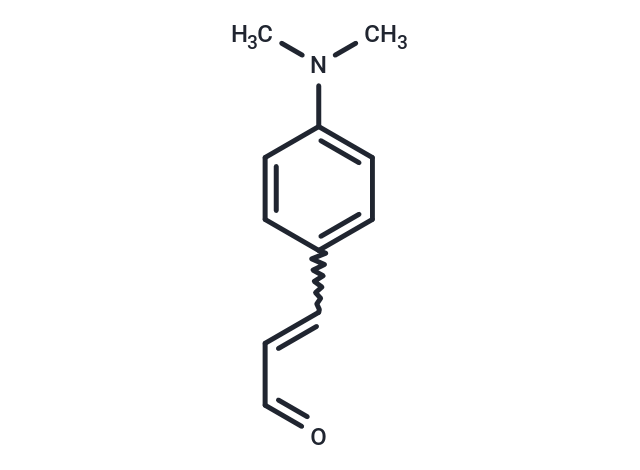
| Description | 4-Dimethylaminocinnamaldehyde is a photometric reagent for primary aromatic amines. The 4-(dimethylamino)cinnamaldehyde assay is currently used to quantify proanthocyanidin (PAC) content in cranberry products. |
| In vitro | The 4-(Dimethylamino)cinnamaldehyde (DMAC) assay is currently used to quantify proanthocyanidin (PAC) content in cranberry products. However, this method suffers from issues of accuracy and precision in the analysis and comparison of PAC levels across a broad range of cranberry products. Current use of procyanidin A2 as a standard leads to an underestimation of PACs content in certain cranberry products, especially those containing higher molecular weight PACs. METHODS AND RESULTS:To begin to address the issue of accuracy, a method for the production of a cranberry PAC standard, derived from an extraction of cranberry (c-PAC) press cake, was developed and evaluated. Use of the c-PAC standard to quantify PAC content in cranberry samples resulted in values that were 2.2 times higher than those determined by procyanidin A2. Increased accuracy is critical for estimating PAC content in relationship to research on authenticity, efficacy, and bioactivity, especially in designing clinical trials for determination of putative health benefits. |
| Molecular Weight | 175.23 |
| Formula | C11H13NO |
| Cas No. | 6203-18-5 |
| Smiles | CN(C)C1=CC=C(C=CC=O)C=C1 |
| Relative Density. | 1.0582 g/cm3 (Estimated) |
| Storage | Powder: -20°C for 3 years | In solvent: -80°C for 1 year Shipping with blue ice/Shipping at ambient temperature. |
 For example, if the intended dosage is 10 mg/kg for animals weighing 20 g , with a dosing volume of 100 μL per animal, and a total of 10 animals are to be administered, using a formulation of
  10% DMSO+ 40% PEG300+ 5% Tween 80+ 45% Saline/PBS/ddH2O , the resulting working solution concentration would be 2 mg/mL.
Dissolve 2 mg of the compound in 100 μL DMSO to obtain a stock solution at a concentration of 20 mg/mL . If the required concentration exceeds the compound's known solubility, please contact us for technical support before proceeding.
1) Add 100 μL of the DMSO stock solution to 400 µL PEG300 and mix thoroughly until the solution becomes clear.
2) Add 50 µL Tween 80 and mix well until fully clarified.
3) Add 450 µL Saline,PBS or ddH2O and mix thoroughly until a homogeneous solution is obtained.
| Size | Quantity | Unit Price | Amount | Operation |
|---|
 Feedback
 Hello! How can I help you today?
Copyright © 2015-2026 TargetMol Chemicals Inc. All Rights Reserved.
