


Shopping Cart
Remove All Your shopping cart is currently empty

Synonyms: Phthalaldehydic acid
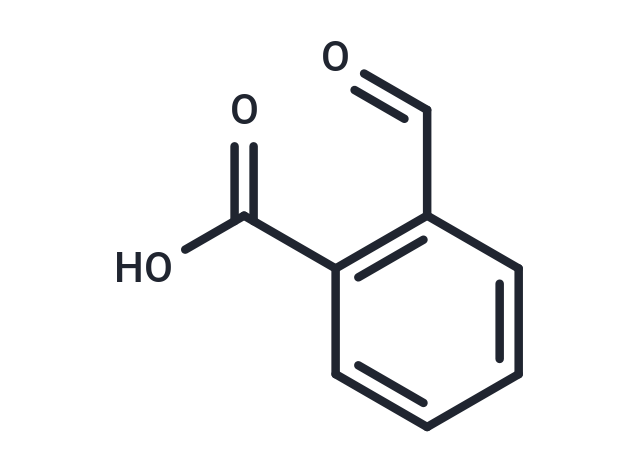
| Pack Size | Price | USA Stock | Global Stock | Quantity |
|---|---|---|---|---|
| 10 g | $29 | 7-10 days | 7-10 days |
| Description | 2-Carboxybenzaldehyde is a key intermediate metabolite in the biodegradation of polycyclic aromatic hydrocarbons such as fluoranthene and phenanthrene. It is produced during the degradation of fluoranthene by Pasteurella sp. IFA and Mycobacterium sp. PYR-1, and phenanthrene by Pseudomonas sp. PPD. |
| In vitro | 1. A rat liver cytosol enzyme, tentatively named CBA reductase, catalyses the conversion of 2-Carboxybenzaldehyde (CBA) to 2-hydroxymethyl benzoic acid in the presence of NADH (or NADPH). CBA reductase is useful for exploring the mechanism of in vitro enzyme induction, as the enzyme can be induced by phenobarbital (PB) both in vivo and in vitro. METHODS AND RESULTS:2. Possible involvement of glutathione (GSH) in gene expression was suggested by a recent study with cultured rat hepatocytes. 3. CBA reductase was purified about 200-fold by a combination of column chromatography and isoelectric focusing in the presence of mercaptoethanol. 4. The ability to form 2-hydroxymethyl benzoic acid was lost when the enzyme was chromatographed on a hydroxylapatite column in the absence of mercaptoethanol; however, it was restored if sulphydryl compounds or bovine serum albumin was added to the eluate from the column. 5. Gel filtration showed the molecular sizes of CBA reductase from the 105,000g supernatant fraction of rat liver extracts and the purified preparation were 64 kDa and 49 kDa, respectively. CONCLUSIONS:6. The results suggest that sulphydryl substances and some proteins play important roles in preserving the molecular and catalytic properties of CBA reductase. |
| Synonyms | Phthalaldehydic acid |
| Molecular Weight | 150.13 |
| Formula | C8H6O3 |
| Cas No. | 119-67-5 |
| Smiles | O=CC=1C=CC=CC1C(=O)O |
| Relative Density. | 1.4 |
| Storage | Keep away from direct sunlight,Keep away from moisture Powder: -20°C for 3 years | In solvent: -80°C for 1 year Shipping with blue ice/Shipping at ambient temperature. | |||||||||||||||||||||||||||||||||||
| Solubility Information | DMSO: 80 mg/mL (532.87 mM), Sonication is recommended. | |||||||||||||||||||||||||||||||||||
Solution Preparation Table | ||||||||||||||||||||||||||||||||||||
DMSO
Note : The dilution table applies only to solid products. For liquid products, please calculate the stock solution based on the stated concentration and/or density. | ||||||||||||||||||||||||||||||||||||
 For example, if the intended dosage is 10 mg/kg for animals weighing 20 g , with a dosing volume of 100 μL per animal, and a total of 10 animals are to be administered, using a formulation of
  10% DMSO+ 40% PEG300+ 5% Tween 80+ 45% Saline/PBS/ddH2O , the resulting working solution concentration would be 2 mg/mL.
Dissolve 2 mg of the compound in 100 μL DMSO to obtain a stock solution at a concentration of 20 mg/mL . If the required concentration exceeds the compound's known solubility, please contact us for technical support before proceeding.
1) Add 100 μL of the DMSO stock solution to 400 µL PEG300 and mix thoroughly until the solution becomes clear.
2) Add 50 µL Tween 80 and mix well until fully clarified.
3) Add 450 µL Saline,PBS or ddH2O and mix thoroughly until a homogeneous solution is obtained.
| Size | Quantity | Unit Price | Amount | Operation |
|---|
 Feedback
 Hello! How can I help you today?
Copyright © 2015-2026 TargetMol Chemicals Inc. All Rights Reserved.
