Shopping Cart
Remove All
  • TargetMol
    Your shopping cart is currently empty

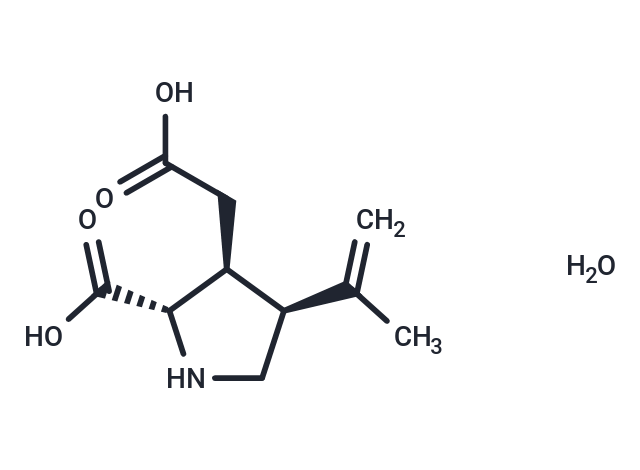
(-)-(α)-Kainic Acid (hydrate)

Copy Product Info
😃Good
Catalog No. T37557Cas No. 58002-62-3

(-)-(α)-Kainic Acid (hydrate) is an effective excitotoxic agent that acts as an agonist of ionotropic glutamate receptor subtypes, capable of inducing seizures and commonly used to establish animal models of epilepsy.

(-)-(α)-Kainic Acid (hydrate)

(-)-(α)-Kainic Acid (hydrate)

Copy Product Info
😃Good
Catalog No. T37557Cas No. 58002-62-3
(-)-(α)-Kainic Acid (hydrate) is an effective excitotoxic agent that acts as an agonist of ionotropic glutamate receptor subtypes, capable of inducing seizures and commonly used to establish animal models of epilepsy.
Pack SizePriceUSA WarehouseGlobal WarehouseQuantity
5 mg$564InquiryInquiry
10 mg$879InquiryInquiry
25 mg$1,558InquiryInquiry
50 mg$2,450InquiryInquiry
Add to Cart
Add to Quotation
In Stock Estimated shipping dateUSA Warehouse[1-2 days] Global Warehouse[5-7 days]
All TargetMol products are for research purposes only and cannot be used for human consumption. We do not provide products or services to individuals. Please comply with the intended use and do not use TargetMol products for any other purpose.
Questions
TargetMol
View More

Resource Download

Product Introduction

Bioactivity
Description
(-)-(α)-Kainic Acid (hydrate) is an effective excitotoxic agent that acts as an agonist of ionotropic glutamate receptor subtypes, capable of inducing seizures and commonly used to establish animal models of epilepsy.
Disease Modeling Protocol
Temporal Lobe Epilepsy (TLE) Model
  • Modeling Mechanism:

    (-)-(α)-Kainic Acid (hydrate), as a glutamate receptor (mainly AMPA receptor) agonist, induces epilepsy pathology through multiple mechanisms: ① Overactivation of glutamate receptors in hippocampal CA1/CA3 neurons, leading to excitotoxicity, resulting in the death of a large number of pyramidal neurons and hippocampal structural damage (hippocampal sclerosis); ② Reduction of the number of NADPH-d positive neurons in hippocampal CA1 region, disrupting the nitric oxide (NO) signaling pathway, further exacerbating neuronal excitability imbalance; ③ Induction of interictal epileptiform discharges (sharp wave complexes) in local field potentials (LFP), accompanied by behavioral comorbidities such as anxiety and depression, mimicking the core pathological and clinical features of human TLE.

  • Related Products:

    (-)-(α)-Kainic Acid (hydrate) (T37557)

  • Modeling Method:

    Experimental Subject:

    Mouse, NMRI, Male, Adult, Body weight 30–35 g

    Dosage and Administration Route:

    ① Core modelling: KA (0.8 nmol/40 nL) dissolved in physiological saline, stereotaxic injection into left dorsal hippocampus (coordinates: posterior to anterior fontanelle - 1.6 mm, lateral to midline+1.6 mm, subdural - 1.2 mm);
    ② Surgical procedure: Ketamine (100 mg/kg)+Haloperidol (10 mg/kg) intraperitoneal anaesthesia; head fixed in stereotaxic apparatus; microinjection following cranial drilling (preventing solution reflux);
    ③ Control treatment: Isovolumetric saline solution administered via identical injection protocol;
    ④ Intervention verification (optional): 2-deoxy-D-glucose (2-DG, 300 mg/kg) intraperitoneal injection initiated 20 days post-modelling, once daily for 7 days

    Dosing Frequency and Duration Model:

    Single-dose KA injection

  • Validation:

    Behavioral indicators: Motor and emotional states: In the open field test, the model group showed significantly increased movement distance and speed (P<0.05 vs. control group); in the sucrose preference test, the sucrose preference rate decreased (depressive-like behavior); in the zero maze test, the open arm dwell time increased and the first entry latency into the open arm shortened (anxiety-like behavior); 2-DG intervention could partially reverse depressive-like behavior; Electrophysiological indicators: Local field potential (LFP) recordings showed that the model group exhibited typical interictal epileptic-like discharges (sharp wave complexes, amplitude more than twice the baseline, frequency 1-20 Hz), while the control group did not show this discharge; Pathological indicators: Neuronal damage: Nissl staining showed a large loss of pyramidal neurons in the CA1 region of the hippocampus, reduced cell volume, and hippocampal structural damage; Molecular indicators: The number of NADPH-d positive neurons in the CA1 region of the hippocampus was significantly reduced (P<0.05 vs. control group), while the number of NADPH-d positive neurons in the contralateral hippocampus increased compensatorily; Cellular electrophysiology: Patch-clamp recordings showed that the model group had surviving CA1 neurons. The shortened neuronal membrane time constant (tau), decreased membrane capacitance, and increased spontaneous firing frequency (P<0.05 vs. control group) reflect enhanced neuronal excitability.

*Precautions: After the experiment was completed, the anesthetized animals were euthanized.

*References:Khatibi VA,et,al. The Glycolysis Inhibitor 2-Deoxy-D-Glucose Exerts Different Neuronal Effects at Circuit and Cellular Levels, Partially Reverses Behavioral Alterations and does not Prevent NADPH Diaphorase Activity Reduction in the Intrahippocampal Kainic Acid Model of Temporal Lobe Epilepsy. Neurochem Res. 2023 Jan;48(1):210-228.

Chemical Properties
Molecular Weight231.25
FormulaC10H17NO5
Cas No.58002-62-3
SmilesC(C(O)=O)[C@H]1[C@@H](C(C)=C)CN[C@@H]1C(O)=O.O
Storage & Solubility Information
StoragePowder: -20°C for 3 years | In solvent: -80°C for 1 year | Shipping with blue ice/Shipping at ambient temperature.
In Vivo Formulation
PBS: 50 mg/mL (216.22 mM), Solution.
Please add the solvents sequentially, clarifying the solution as much as possible before adding the next one. Dissolve by heating and/or sonication if necessary. Working solution is recommended to be prepared and used immediately. The formulation provided above is for reference purposes only. In vivo formulations may vary and should be modified based on specific experimental conditions.

Calculator

  • Molarity Calculator
  • Dilution Calculator
  • Reconstitution Calculator
  • Molecular Weight Calculator

In Vivo Formulation Calculator (Clear solution)

Please enter your animal experiment information in the following box and click Calculate to obtain the stock solution preparation method and in vivo formula preparation method:
TargetMol | Animal experiments For example, if the intended dosage is 10 mg/kg for animals weighing 20 g , with a dosing volume of 100 μL per animal, TargetMol | Animal experiments and a total of 10 animals are to be administered, using a formulation of TargetMol | reagent 10% DMSO+ 40% PEG300+ 5% Tween 80+ 45% Saline/PBS/ddH2O , the resulting working solution concentration would be 2 mg/mL.

Stock Solution Preparation:

Dissolve 2 mg of the compound in 100 μL DMSOTargetMol | reagent to obtain a stock solution at a concentration of 20 mg/mL . If the required concentration exceeds the compound's known solubility, please contact us for technical support before proceeding.

Preparation of the In Vivo Formulation:

1) Add 100 μL of the DMSOTargetMol | reagent stock solution to 400 μL PEG300TargetMol | reagent and mix thoroughly until the solution becomes clear.

2) Add 50 μL Tween 80 and mix well until fully clarified.

3) Add 450 μL Saline,PBS or ddH2OTargetMol | reagent and mix thoroughly until a homogeneous solution is obtained.

This example is provided solely to demonstrate the use of the In Vivo Formulation Calculator and does not constitute a recommended formulation for any specific compound. Please select an appropriate dissolution and formulation strategy based on your experimental model and route of administration.
All co-solvents required for this protocol, includingDMSO, PEG300/PEG400, Tween 80, SBE-β-CD, and Corn oil, are available for purchase on the TargetMol website.
1 Enter information below:
mg/kg
g
μL
2 Enter the in vivo formulation:
% DMSO
%
% Tween 80
% Saline/PBS/ddH2O

Dose Conversion

You can also refer to dose conversion for different animals. More Dose Conversion

Tech Support

Please see Inhibitor Handling Instructions for more frequently ask questions. Topics include: how to prepare stock solutions, how to store products, and cautions on cell-based assays & animal experiments, etc

Keywords

Related Tags: buy (-)-(α)-Kainic Acid (hydrate) | purchase (-)-(α)-Kainic Acid (hydrate) | (-)-(α)-Kainic Acid (hydrate) cost | order (-)-(α)-Kainic Acid (hydrate) | (-)-(α)-Kainic Acid (hydrate) chemical structure | (-)-(α)-Kainic Acid (hydrate) formula | (-)-(α)-Kainic Acid (hydrate) molecular weight