


Shopping Cart
Remove All Your shopping cart is currently empty

TIE2 Protein, Human, Recombinant (His & hFc) is expressed in HEK293 mammalian cells with His and hFc tag. The predicted molecular weight is 108.5 kDa and the accession number is AAA61139.1.
| Pack Size | Price | USA Stock | Global Stock | Quantity |
|---|---|---|---|---|
| 5 μg | $32 | - | In Stock | |
| 10 μg | $48 | - | In Stock | |
| 20 μg | $75 | - | In Stock | |
| 50 μg | $138 | - | In Stock | |
| 100 μg | $229 | - | In Stock | |
| 200 μg | $386 | - | In Stock |
| Biological Activity | Measured by its binding ability in a functional ELISA. Immobilized recombinant human Angiopoietin-2 at 10 μg/ml (100 μl/well) can bind Human Tie2 / CD202b Protein (ECD, His & Fc Tag) with a range of 0.2-20 μg/ml. 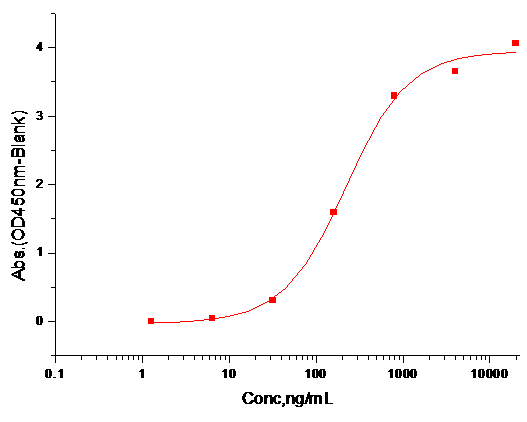 |
| Description | TIE2 Protein, Human, Recombinant (His & hFc) is expressed in HEK293 mammalian cells with His and hFc tag. The predicted molecular weight is 108.5 kDa and the accession number is AAA61139.1. |
| Species | Human |
| Expression System | HEK293 Cells |
| Tag | His, hFc |
| Accession Number | AAA61139.1 |
| Synonyms | VMCM1,VMCM,TIE-2,TIE2,TEK tyrosine kinase, endothelial,CD202B |
| Construction | A DNA sequence encoding the extracellular domain (Met1-Lys745) of human Tie2 (AAA61139.1) precursor was fused with the C-terminal polyhistidine-tagged Fc region of human IgG1 at the C-terminus. Predicted N terminal: Ala 23 |
| Protein Purity | > 90 % as determined by SDS-PAGE 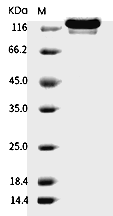 |
| Molecular Weight | 108.5 kDa (predicted); 130.7 kDa (reducing condition, due to glycosylation) |
| Endotoxin | < 1.0 EU/μg of the protein as determined by the LAL method. |
| Formulation | Lyophilized from a solution filtered through a 0.22 μm filter, containing PBS, pH 7.4. Typically, a mixture containing 5% to 8% trehalose, mannitol, and 0.01% Tween 80 is incorporated as a protective agent before lyophilization. |
| Reconstitution | Reconstituted with sterile deionized water to 0.25 mg/mL. Reconstitution conditions may vary depending on the lot. |
| Stability & Storage | It is recommended to store recombinant proteins at -20°C to -80°C for future use. Lyophilized powders can be stably stored for over 12 months, while liquid products can be stored for 6-12 months at -80°C. For reconstituted protein solutions, the solution can be stored at -20°C to -80°C for at least 3 months. Please avoid multiple freeze-thaw cycles and store products in aliquots. |
| Shipping | In general, lyophilized powders are shipped with blue ice, while solutions are shipped with dry ice. |
| Research Background | TEK, or TIE-2, is an endothelial cell-specific receptor tyrosine kinase (RTK) that is known as a functioning molecule of vascular endothelial cells. TEK comprises a subfamily of RTK with TIE, and these two receptors play critical roles in vascular maturation, maintenance of integrity and remodeling. Targeted mutagenesis of both Tek and its agonistic ligand, Angiopoietin-1, result in embryonic lethality, demonstrating that the signal transduction pathways mediated by this receptor are crucial for normal embryonic development. TEK signaling is indispensable for the development of the embryonic vasculature and suggests that TEK signaling may also be required for the development of the tumor vasculature. |
| Size | Quantity | Unit Price | Amount | Operation |
|---|
 Feedback
 Hello! How can I help you today?
Copyright © 2015-2026 TargetMol Chemicals Inc. All Rights Reserved.