


Shopping Cart
Remove All Your shopping cart is currently empty
Synonyms: SIMP, fibroblast activation protein, α, fibroblast activation protein, alpha, Fibroblast Activation Protein α, Fibroblast Activation Protein alpha, Fapα, Fapalpha, FAPA, DPPIVA, DPPIV
| Pack Size | Price | USA Stock | Global Stock | Quantity |
|---|---|---|---|---|
| 5 µg | $91 | - | In Stock | |
| 10 µg | $148 | - | In Stock | |
| 20 µg | $245 | - | In Stock | |
| 50 µg | $393 | 7-10 days | 7-10 days | |
| 100 µg | $589 | 7-10 days | 7-10 days | |
| 200 µg | $1,000 | 7-10 days | 7-10 days | |
| 500 µg | $2,030 | 7-10 days | 7-10 days |
| Bioactivity | Activity testing is in progress. It is theoretically active, but we cannot guarantee it. If you require protein activity, we recommend choosing the eukaryotic expression version first. |
| Description | FAP Protein, Human, Recombinant (His), Biotinylated is expressed in HEK293 mammalian cells with His tag. The predicted molecular weight is 87.2 kDa and the accession number is Q12884-1. |
| Species | Human |
| Expression System | HEK293 Cells |
| Tag | N-His |
| Accession Number | Q12884-1 |
| Construction | A DNA sequence encoding the human FAP isoform 1 (Q12884-1) extracellular domain (Leu26-Asp760) was fused with the polyhistidie-tag at the N-terminus. The purified protein was biotinylated in vitro. Predicted N terminal: His |
| Protein Purity | > 85 % as determined by SDS-PAGE 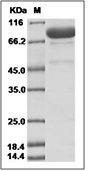 |
| Endotoxin | < 1.0 EU/μg of the protein as determined by the LAL method. |
| Formulation | Lyophilized from a solution filtered through a 0.22 μm filter, containing PBS. Typically, a mixture containing 5% to 8% trehalose, mannitol, and 0.01% Tween 80 is incorporated as a protective agent before lyophilization. |
| Reconstitution | Reconstituted with sterile deionized water to 0.25 mg/mL. Reconstitution conditions may vary depending on the lot. |
| Synonyms | SIMP, fibroblast activation protein, α, fibroblast activation protein, alpha, Fibroblast Activation Protein α, Fibroblast Activation Protein alpha, Fapα, Fapalpha, FAPA, DPPIVA, DPPIV |
| Research Background | Seprase, also known as 17 kDa melanoma membrane-bound gelatinase , Fibroblast activation protein alpha, Integral membrane serine protease and FAP, is a single-pass type II membrane protein which belongs to thepeptidase S9B family. Seprase / FAP is found in cell surface lamellipodia, invadopodia and on shed vesicles. Seprase / FAP appears to act as a proteolytically active 17-kDa dimer, consisting of two 97-kDa subunits. It is a member of the group type II integral serine proteases, which includes dipeptidyl peptidase IV ( DPPIV / CD26 ) and related type II transmembrane prolyl serine peptidases, which exert their mechanisms of action on the cell surface. Seprase / FAP colocalized with DPP4 in invadopodia and lamellipodia of migratory activated endothelial cells in collagenous matrix. Seprase / FAP colocalized with DPP4 on endothelial cells of capillary-like microvessels but not large vessels within invasive breast ductal carcinoma. DPP4 and seprase exhibit multiple functions due to their abilities to form complexes with each other and to interact with other membrane-associated molecules. In association with DPP4, Seprase / FAP is involved in the pericellular proteolysis of the extracellular matrix (ECM), the migration and invasion of endothelial cells into the ECM. Seprase / FAP has a dual function in tumour progression. The proteolytic activity of Seprase has been shown to promote cell invasiveness towards the ECM and also to support tumour growth and proliferation. Seprase / FAP may have a role in tissue remodeling during development and wound healing, and may contribute to invasiveness in malignant cancers.Cancer ImmunotherapyImmune CheckpointImmunotherapyTargeted Therapy |
| Molecular Weight | 87.2 kDa (predicted) |
| Shipping | In general, lyophilized powders are shipped with blue ice, while solutions are shipped with dry ice. |
| Storage | It is recommended to store recombinant proteins at -20°C to -80°C for future use. Lyophilized powders can be stably stored for over 12 months, while liquid products can be stored for 6-12 months at -80°C. For reconstituted protein solutions, the solution can be stored at -20°C to -80°C for at least 3 months. Please avoid multiple freeze-thaw cycles and store products in aliquots. |
| Size | Quantity | Unit Price | Amount | Operation |
|---|
 Feedback
 Hello! How can I help you today?
Copyright © 2015-2026 TargetMol Chemicals Inc. All Rights Reserved.
