


Shopping Cart
Remove All Your shopping cart is currently empty

BCMA/TNFRSF17 Protein, Rhesus, Recombinant (hFc) is expressed in HEK293 mammalian cells with hFc tag. The predicted molecular weight is 33 kDa and the accession number is A0A2K5UD97.
| Pack Size | Price | USA Stock | Global Stock | Quantity |
|---|---|---|---|---|
| 5 μg | $48 | - | In Stock | |
| 10 μg | $75 | - | In Stock | |
| 20 μg | $118 | - | In Stock | |
| 50 μg | $229 | - | In Stock | |
| 100 μg | $386 | - | In Stock | |
| 200 μg | $715 | 7-10 days | 7-10 days | |
| 500 μg | $1,610 | 7-10 days | 7-10 days |
| Biological Activity | Measured by its binding ability in a functional ELISA. Immobilized Rhesus BCMA hFc at 2 μg/ml (100 μl/well) can bind Human BAFF/BLyS hFc,Biotinylated, the EC50 of Human BAFF/BLyS hFc,Biotinylated is 1.0-6.0 ng/mL. 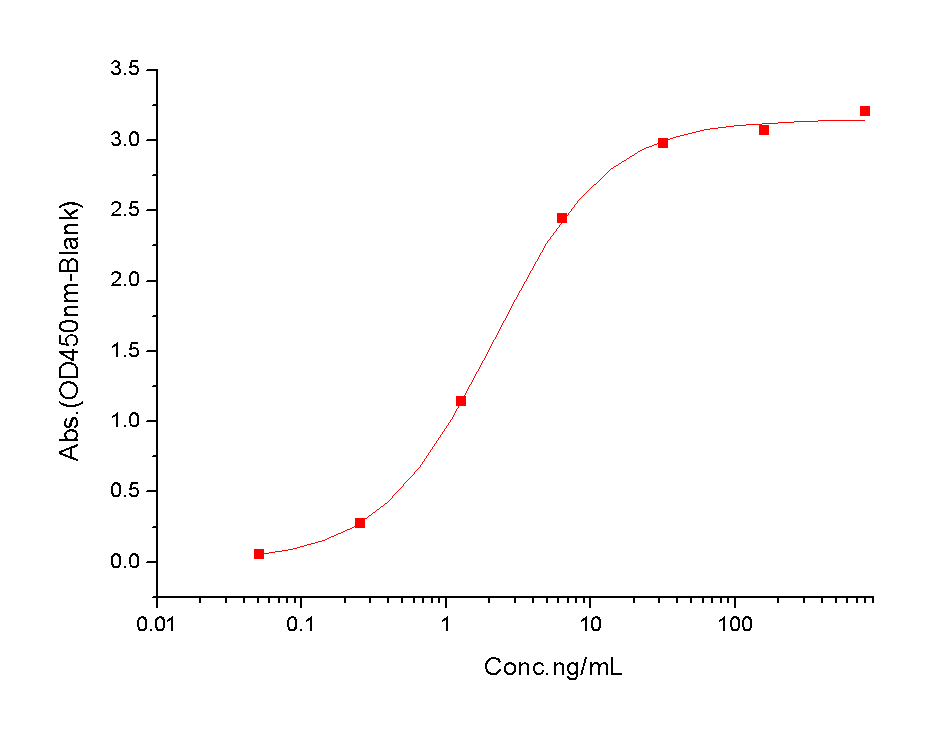 |
| Description | BCMA/TNFRSF17 Protein, Rhesus, Recombinant (hFc) is expressed in HEK293 mammalian cells with hFc tag. The predicted molecular weight is 33 kDa and the accession number is A0A2K5UD97. |
| Species | Rhesus |
| Expression System | HEK293 Cells |
| Tag | C-hFc |
| Accession Number | A0A2K5UD97 |
| Synonyms | tumor necrosis factor receptor superfamily member 17 |
| Construction | A DNA sequence encoding the rhesus TNFRSF17 (XP_001106892.1) (Met1-Ala53) was expressed with the Fc region of human IgG1 at the C-terminus. Predicted N terminal: Met |
| Protein Purity | ≥ 95 % as determined by SDS-PAGE. ≥ 90 % as determined by SEC-HPLC. 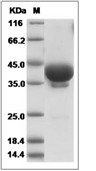 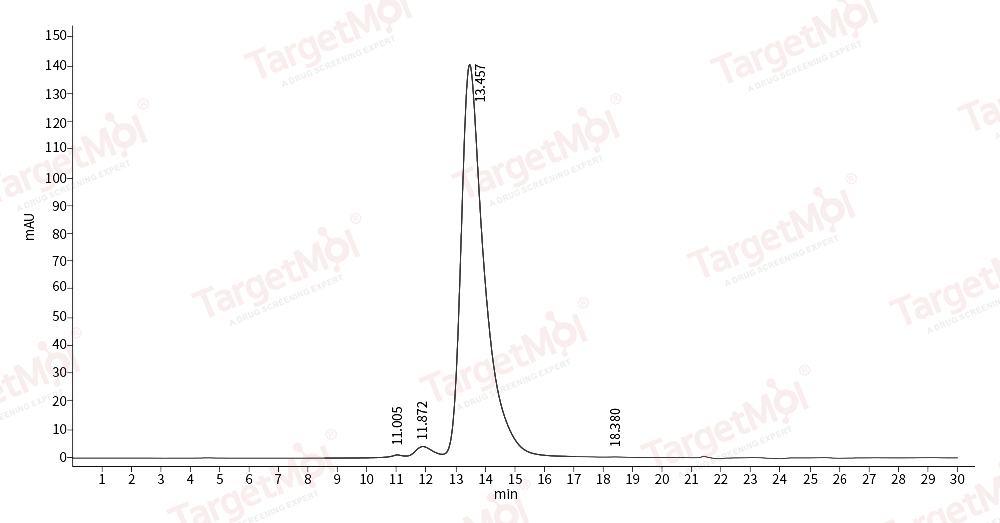 |
| Molecular Weight | 33 kDa (predicted) |
| Endotoxin | < 1.0 EU/μg of the protein as determined by the LAL method. |
| Formulation | Lyophilized from a solution filtered through a 0.22 μm filter, containing PBS, pH 7.4. Typically, a mixture containing 5% to 8% trehalose, mannitol, and 0.01% Tween 80 is incorporated as a protective agent before lyophilization. |
| Reconstitution | Reconstituted with sterile deionized water to 0.25 mg/mL. Reconstitution conditions may vary depending on the lot. |
| Stability & Storage | It is recommended to store recombinant proteins at -20°C to -80°C for future use. Lyophilized powders can be stably stored for over 12 months, while liquid products can be stored for 6-12 months at -80°C. For reconstituted protein solutions, the solution can be stored at -20°C to -80°C for at least 3 months. Please avoid multiple freeze-thaw cycles and store products in aliquots. |
| Shipping | In general, lyophilized powders are shipped with blue ice, while solutions are shipped with dry ice. |
| Research Background | Tumor necrosis factor receptor superfamily, member 17 (TNFRSF17), also known as B cell maturation antigen (BCMA) or CD269 antigen, is a member of the TNF-receptor superfamily. This receptor is preferentially expressed in mature B lymphocytes, and may be important for B cell development and autoimmune response. This receptor has been shown to specifically bind to the tumor necrosis factor (ligand) superfamily, member 13b (TNFSF13BBAFF), and to lead to NF-kappaB and MAPK8/JNK activation. TNFRSF17/BCMA/CD269 also binds to various TRAF family members, and thus may transduce signals for cell survival and proliferation. TNFRSF17/BCMA/CD269 is a receptor for TALL-1 and BCMA activates NF-kappaB through a TRAF5-, TRAF6-, NIK-, and IKK-dependent pathway. The identification of TNFRSF17 as a NF-kappaB-activating receptor for TALL-1 suggests molecular targets for drug development against certain immunodeficient or autoimmune diseases. TNFRSF17/BCMA is a target of donor B-cell immunity in patients with myeloma who respond to DLI. Antibody responses to cell-surface BCMA may contribute directly to tumor rejection in vivo. |
| Size | Quantity | Unit Price | Amount | Operation |
|---|
 Feedback
 Hello! How can I help you today?
Copyright © 2015-2026 TargetMol Chemicals Inc. All Rights Reserved.