


Shopping Cart
Remove All Your shopping cart is currently empty

Synonyms:
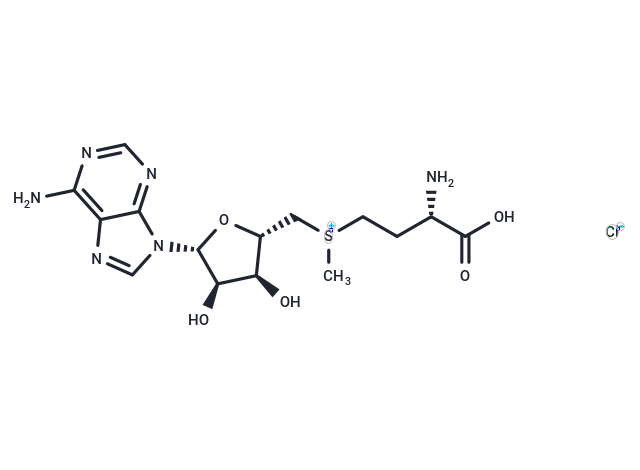
| Pack Size | Price | USA Stock | Global Stock | Quantity |
|---|---|---|---|---|
| 25 mg | $331 | Inquiry | Inquiry |
| Description | S-(5'-Adenosyl)-L-methionine chloride is a natural product. The catalog number is TN6669 and the CAS number is 24346-00-7. S-(5'-Adenosyl)-L-methionine chloride can be used as a reference standard. |
| In vitro | METHODS AND RESULTS:Norepinephrine (NE) is detected amperometrically using the enzyme Phenylethanolamine N-methyl transferase and cofactor S-(5'-Adenosyl)-L-methionine chloride dihydrochloride with disposable screen printed mesoporous carbon electrodes. The role of internal surface area and pore size of the mesoporous carbon is systematically examined using soft-templated, mesoporous silica-carbon powders with highly microporous walls obtained from etching of the silica to produce powders with surface areas ranging from 671-2339 m(2)g(-1). As the surface area increases, the sensitivity of the biosensor at very low NE concentrations (0-500 pg mL(-1)) in phosphate buffered saline (PBS) increases just as the current signal increases with respect to the NE concentration of 81-1581 μA mL ng(-1) cm(-2) for the mesoporous carbons. CONCLUSIONS: The best performing electrode provides similar sensitivity in whole rabbit blood in comparison to PBS despite no membrane layer to filter the non-desired reactants; the small (<5 nm) pore size and large internal surface area acts to minimize non-specific events that decrease sensitivity. |
| Molecular Weight | 434.9 |
| Formula | C15H23ClN6O5S |
| Cas No. | 24346-00-7 |
| Smiles | O[C@H]1[C@H](N2C=3C(N=C2)=C(N)N=CN3)O[C@H](C[S+](CC[C@@H](C(O)=O)N)C)[C@H]1O.[Cl-] |
| Relative Density. | no data available |
| Storage | Powder: -20°C for 3 years | In solvent: -80°C for 1 year Shipping with blue ice/Shipping at ambient temperature. |
 For example, if the intended dosage is 10 mg/kg for animals weighing 20 g , with a dosing volume of 100 μL per animal, and a total of 10 animals are to be administered, using a formulation of
  10% DMSO+ 40% PEG300+ 5% Tween 80+ 45% Saline/PBS/ddH2O , the resulting working solution concentration would be 2 mg/mL.
Dissolve 2 mg of the compound in 100 μL DMSO to obtain a stock solution at a concentration of 20 mg/mL . If the required concentration exceeds the compound's known solubility, please contact us for technical support before proceeding.
1) Add 100 μL of the DMSO stock solution to 400 µL PEG300 and mix thoroughly until the solution becomes clear.
2) Add 50 µL Tween 80 and mix well until fully clarified.
3) Add 450 µL Saline,PBS or ddH2O and mix thoroughly until a homogeneous solution is obtained.
| Size | Quantity | Unit Price | Amount | Operation |
|---|
 Feedback
 Hello! How can I help you today?
Copyright © 2015-2026 TargetMol Chemicals Inc. All Rights Reserved.
