


Shopping Cart
Remove All Your shopping cart is currently empty

Synonyms: NGI189, NGI 189
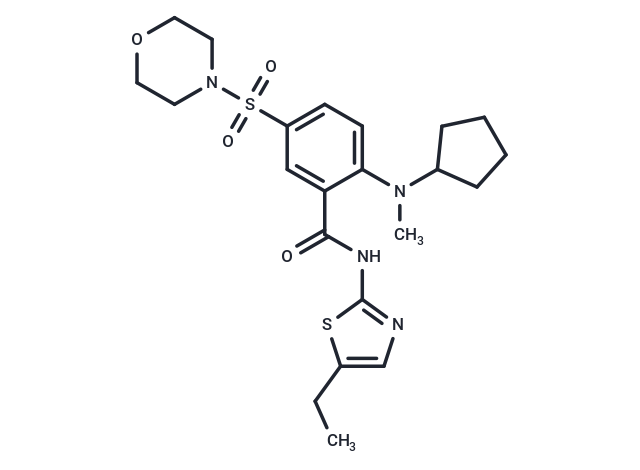

| Pack Size | Price | USA Stock | Global Stock | Quantity |
|---|---|---|---|---|
| 1 mg | $195 | - | In Stock | |
| 5 mg | $483 | - | In Stock | |
| 10 mg | $691 | - | In Stock | |
| 25 mg | $1,080 | - | In Stock | |
| 50 mg | $1,490 | - | In Stock |
| Description | NGI-189 is a selective OST-A inhibitor. Its main mechanism is to inhibit the activity of the STT3A catalytic subunit in the OST complex, thereby reducing the N-glycosylation level of target glycoproteins. It effectively blocks the conduction of oncogenic and bypass signaling pathways, significantly downregulates the phosphorylation levels of EGFR, AKT, p70S6K and S6RP proteins, and induces cell cycle arrest and apoptosis. In non-small cell lung cancer (NSCLC) xenograft models, NGI-189 significantly inhibits tumor growth and induces tumor regression, making it a potential tool molecule for mechanism and efficacy research of EGFR-mutant non-small cell lung cancer. |
| In vitro | Methods: ER-LucT reporter cells, multiple EGFR-mutant NSCLC cell lines (including PC9, H3255, etc.), as well as wild-type HEK293, STT3A-knockout, and STT3B-knockout HEK293 cells were used in this study. Cells were treated with different concentrations of NGI-189 for various durations. Indicators related to N-glycosylation level, cell proliferation, colony formation, signaling pathway activity, cell cycle distribution, and apoptosis were detected. Meanwhile, PC9-CD8-EGFR-CL cells were used to verify the functional dependence of NGI-189 action, and its effects on drug-resistant NSCLC cells were comparatively analyzed. Results: 1.NGI-189 potently inhibited N-glycosylation in ER-LucT reporter cells with an IC₅₀ of 0.09 μM. 2.NGI-189 (5 μM, 5 days of treatment) inhibited the proliferation of parental EGFR-mutant PC9 NSCLC cells by approximately 70%. This inhibitory effect was markedly reversed in PC9-CD8-EGFR-CL cells expressing N-glycosylation-independent EGFR. 3.NGI-189 (0–25 μM, 24 h of treatment) preferentially suppressed the OST-A complex in HEK293 cell lines and reduced the N-glycosylation levels of EGFR and Halo3N in a dose-dependent manner. Complete inhibition of OST-A-dependent glycosylation was only observed in STT3B-knockout cells. 4.NGI-189 (10 μM, 24 h of treatment) reduced the N-glycosylation levels of PTK7 and MET in osimertinib-resistant H1975-OR cells and gefitinib-resistant HCC827-GR cells, and further inhibited the downstream STAT3 signaling pathway. 5.NGI-189 (5 μM) reduced the colony formation survival rate of EGFR-mutant NSCLC cells, including PC9, H3255, HCC-4006, and HCC-2935. 6.NGI-189 (5 μM, 24 h of treatment) inhibited EGFR and its downstream AKT/p70 S6K/S6RP signaling pathways, and upregulated the expression of the pro-apoptotic protein Bim in H3255, HCC-4006, and HCC-2935 cells. 7.NGI-189 (5 μM, 24 h of treatment) induced G1-phase cell cycle arrest in EGFR-mutant PC9, H3255, and HCC-2935 NSCLC cells. Notably, both H3255 and HCC-2935 cells exhibited obvious sub-G1 phase cell death [1]. |
| In vivo | Methods: EGFR-mutant non-small cell lung cancer (NSCLC) patient-derived xenograft (PDX) models, gefitinib-resistant HCC827-GR, and osimertinib-resistant H1975-OR NSCLC xenograft models were established. NGI-189 was administered via intraperitoneal injection at a dose of 10 mg/kg, with dosing schedules set as once every two days for a total of eight injections or administered as needed according to different models. A single-agent treatment group (10 mg/kg, intraperitoneal injection, once every two days for three injections) was additionally arranged to evaluate mouse tolerance. Toxicity was assessed via hematological detection and organ histopathological examination, and tumor growth and regression were continuously monitored. Results: 1.NGI-189 (10 mg/kg, intraperitoneal injection, once every two days for eight administrations) significantly delayed tumor growth in EGFR-mutant NSCLC PDX models and gefitinib-resistant HCC827-GR xenograft models [1]. 2.NGI-189 (10 mg/kg, intraperitoneal injection, once every two days) induced marked tumor regression in osimertinib-resistant H1975-OR NSCLC xenografts [1]. 3.NGI-189 (10 mg/kg, intraperitoneal injection, once every two days for three administrations) was well tolerated in mice. No obvious toxicity was observed according to hematological assays and organ histopathological examination [1]. |
| Synonyms | NGI189, NGI 189 |
| Molecular Weight | 478.63 |
| Formula | C22H30N4O4S2 |
| Cas No. | 2763063-26-7 |
| Smiles | O=C(NC1=NC=C(S1)CC)C2=CC(=CC=C2N(C)C3CCCC3)S(=O)(=O)N4CCOCC4 |
| Relative Density. | no data available |
| Storage | Powder: -20°C for 3 years | In solvent: -80°C for 1 year Shipping with blue ice/Shipping at ambient temperature. |
 For example, if the intended dosage is 10 mg/kg for animals weighing 20 g , with a dosing volume of 100 μL per animal, and a total of 10 animals are to be administered, using a formulation of
  10% DMSO+ 40% PEG300+ 5% Tween 80+ 45% Saline/PBS/ddH2O , the resulting working solution concentration would be 2 mg/mL.
Dissolve 2 mg of the compound in 100 μL DMSO to obtain a stock solution at a concentration of 20 mg/mL . If the required concentration exceeds the compound's known solubility, please contact us for technical support before proceeding.
1) Add 100 μL of the DMSO stock solution to 400 µL PEG300 and mix thoroughly until the solution becomes clear.
2) Add 50 µL Tween 80 and mix well until fully clarified.
3) Add 450 µL Saline,PBS or ddH2O and mix thoroughly until a homogeneous solution is obtained.
| Size | Quantity | Unit Price | Amount | Operation |
|---|
 Feedback
 Hello! How can I help you today?
Copyright © 2015-2026 TargetMol Chemicals Inc. All Rights Reserved.
