


Shopping Cart
Remove All Your shopping cart is currently empty

Synonyms: C10-CPA
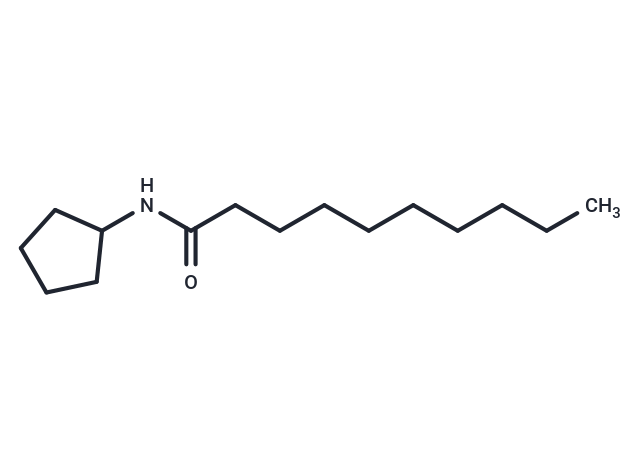
| Pack Size | Price | USA Stock | Global Stock | Quantity |
|---|---|---|---|---|
| 25 mg | $1,520 | 2-4 weeks | 2-4 weeks | |
| 50 mg | $1,980 | 2-4 weeks | 2-4 weeks | |
| 100 mg | $2,500 | 2-4 weeks | 2-4 weeks |
| Description | N-Decanoyl cyclopentylamide (C10-CPA) serves as a potent quorum sensing inhibitor in Pseudomonas aeruginosa, disrupting the expression of virulence factors governed by both the las and rhl systems. It effectively suppresses the production of elastase, pyocyanin, rhamnolipid, and hinders biofilm formation. |
| In vitro | N-Decanoyl cyclopentylamide (C10-CPA) inhibits quorum sensing in Pseudomonas aeruginosa, with half-maximal inhibitory concentrations for lasB-lacZ and rhlA-lacZ expression at 80 μM and 90 μM, respectively [1]. It also suppresses the production of virulence factors such as elastase, pyocyanin, rhamnolipids, and biofilm formation without affecting the growth of Pseudomonas aeruginosa PAO1 [1]. N-Decanoyl cyclopentylamide interferes with the las and rhl quorum sensing systems by disrupting the interaction between their response regulators (LasR and RhlR) and autoinducers [1]. |
| Synonyms | C10-CPA |
| Molecular Weight | 239.40 |
| Formula | C15H29NO |
| Cas No. | 540796-75-6 |
| Smiles | O=C(NC1CCCC1)CCCCCCCCC |
| Storage | Powder: -20°C for 3 years | In solvent: -80°C for 1 year Shipping with blue ice/Shipping at ambient temperature. |
 For example, if the intended dosage is 10 mg/kg for animals weighing 20 g , with a dosing volume of 100 μL per animal, and a total of 10 animals are to be administered, using a formulation of
  10% DMSO+ 40% PEG300+ 5% Tween 80+ 45% Saline/PBS/ddH2O , the resulting working solution concentration would be 2 mg/mL.
Dissolve 2 mg of the compound in 100 μL DMSO to obtain a stock solution at a concentration of 20 mg/mL . If the required concentration exceeds the compound's known solubility, please contact us for technical support before proceeding.
1) Add 100 μL of the DMSO stock solution to 400 µL PEG300 and mix thoroughly until the solution becomes clear.
2) Add 50 µL Tween 80 and mix well until fully clarified.
3) Add 450 µL Saline,PBS or ddH2O and mix thoroughly until a homogeneous solution is obtained.
| Size | Quantity | Unit Price | Amount | Operation |
|---|
 Feedback
 Hello! How can I help you today?
Copyright © 2015-2026 TargetMol Chemicals Inc. All Rights Reserved.
